Calorie & Macro Calculator
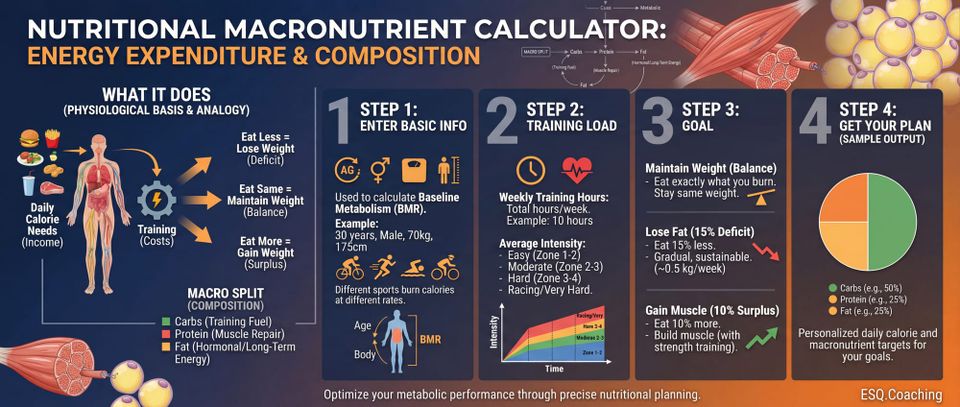
📋 What it does
Calculates daily calorie needs and macro split (carbs, protein, fat) for endurance athletes.
Think of it like budgeting money:
- Your body needs X calories per day (income)
- Training "costs" extra calories
- If you eat less → lose weight. More → gain weight.
- The macro split determines what you gain or lose.
Power you can’t repeat is decoration.
This 8-week muscular endurance block is designed to increase how long you can hold meaningful power once fatigue is already present. Sweet spot first, control later, no wasted matches.
Choose this if you feel strong early in rides but fade when the work actually matters. View Plan here

🎯 STEP-BY-STEP GUIDE
STEP 1: Enter Basic Info
- Age, Sex, Weight (kg), Height (cm) → calculates BMR
- Daily Activity → sedentary (desk job) to physical labour
STEP 2: Training Load
- Sport: Cycling, Running, Swimming, Triathlon
- Weekly Hours: Total training hours
- Intensity Distribution: % easy / moderate / hard / racing (must total 100%)
STEP 3: Choose Your Goal
| Goal | Adjustment | Rate | When |
|---|---|---|---|
| Maintain | 0% | — | Race season, stable weight |
| Lose Fat | −15% | ~0.5 kg/week | Off-season, weight target |
| Gain Muscle | +10% | ~0.25 kg/week | Off-season + strength training |
STEP 4: Read Your Plan
Example Output
30yr male, 70kg, 175cm, cycling 10h/wk
70% easy / 20% moderate / 10% hard, maintain weight

TOTAL: 3,125 kcal/day
├─ BMR:          1,649 kcal
├─ Activity:       660 kcal
└─ Training:       816 kcal

MACROS:
  Carbs:   420g (54%) → 6.0 g/kg
  Protein: 112g (14%) → 1.6 g/kg
  Fat:     112g (32%) → 1.6 g/kg

TIMING:
  Pre-training: 1–2 g/kg carbs (2–3h before)
  During: 30–90 g/h carbs (see Carb Calculator)
  Post: ~100g carbs + 25g protein (within 30 min)
  Daily protein: spread across 4–5 meals (20–30g each)
🔬 SCIENTIFIC BASIS
BMR — Mifflin-St Jeor (1990)
Men:   BMR = (10 × kg) + (6.25 × cm) − (5 × age) + 5
Women: BMR = (10 × kg) + (6.25 × cm) − (5 × age) − 161
Training Calories — Net MET Method
Training_kcal = Hours × (MET − 1) × Weight_kgThe "−1" subtracts resting energy (already counted in BMR) to avoid double-counting.
| Sport | Easy MET | Moderate | Hard | Racing |
|---|---|---|---|---|
| Cycling | 4–6 | 8–10 | 12–16 | 16+ |
| Running | 7–9 | 10–11 | 13–15 | 15+ |
| Swimming | 5–7 | 8–10 | 10–12 | 12+ |
Protein — Continuous Scaling (v2.9+)
Base:     1.0 + 0.04 × hours/week
+ Hard%:  0.01 × hard_percentage
+ Run:    +0.15 (eccentric muscle damage)
+ Deficit: +0.3 (muscle preservation)
+ Surplus: +0.15 (muscle synthesis)
Clamped: 1.4–2.2 g/kg
Carbs — Burke et al. (2011)
| Training | Carbs (g/kg/day) |
|---|---|
| Light (< 1 h/day) | 3–5 |
| Moderate (1–2 h/day) | 5–7 |
| High (2–3 h/day) | 6–10 |
| Very high (> 4 h/day) | 8–12 |
Fat — Safety Floors
Three floors enforced (strictest applies):
- Absolute minimum: 50g
- Per-kg minimum: 0.9 g/kg
- Percentage minimum: 20% of total calories
Common Mistakes
| Mistake | Consequence | Fix |
|---|---|---|
| ❌ Too few total calories | Chronic fatigue, immune suppression, muscle loss | Eat at least BMR + training cost |
| ❌ Too few carbs | Low energy, poor workout quality, irritability | Scale carbs to training volume |
| ❌ Too little protein | Poor recovery, muscle loss, injury risk | Spread 1.4–2.2 g/kg across 4–5 meals |
| ❌ Too little fat | Hormonal disruption, vitamin malabsorption | Never below 50g or 0.9 g/kg |
Key Research:
- Mifflin et al. (1990) - "New predictive equations for resting energy expenditure"
- Burke et al. (2011) - "Carbohydrates for training and competition"
- Thomas et al. (2016) - "Position stand: Nutrition and athletic performance"
- Phillips & Van Loon (2011) - "Dietary protein for athletes"
Nutrient Timing Research:
Pre-exercise (2-3 hours):
- 1-2 g/kg carbs
- Moderate protein
- Low fat/fiber (digestion)
During exercise:
- 30-90 g/h carbs (see Carb Calculator)
- Electrolytes
- Minimal protein/fat
Post-exercise (0-2 hours):
- 1-1.5 g/kg carbs (glycogen replenishment)
- 20-30g protein (muscle repair)
- 3:1 to 4:1 carb:protein ratio optimal
Daily Distribution:
- Protein: 4-5 meals of 20-30g
- Carbs: Front-load around workouts
- Fat: Spread throughout day
Common Mistakes:
❌ Too few calories:
- Chronic fatigue
- Compromised immune system
- Poor recovery
- Loss of muscle mass
❌ Too few carbs:
- Low energy
- Poor workout quality
- Constant hunger
- Irritability
❌ Too little protein:
- Muscle loss
- Poor recovery
- Increased injury risk
✅ Optimal Nutrition:
- Sufficient total calories
- High carb around workouts
- Protein spread throughout day
- Adequate fat for hormones
Disclaimer
The information provided in this newsletter is for educational purposes only and does not constitute medical advice. Exercise physiology is highly individual; what works for elite populations may not apply to everyone. Always consult with a physician before making significant changes to your training, nutrition, or supplementation protocols. The Scientist's Notebook and ESQ Coaching accept no liability for injuries or health issues arising from the application of these concepts.