Carb Intake Calculator
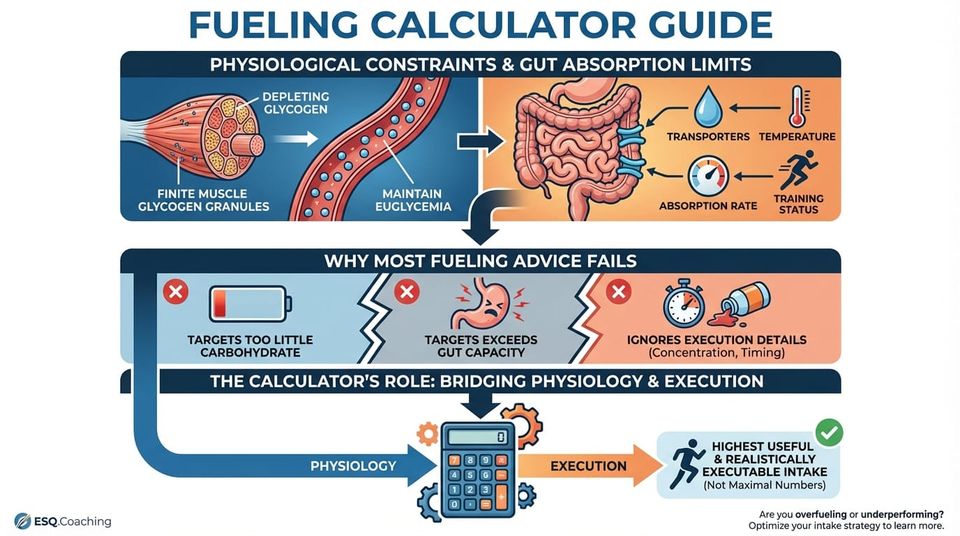
Fueling calculator guide
What this calculator is trying to solve
During endurance exercise carbohydrate availability plays a crucial role. Muscle glycogen is finite. Blood glucose must be maintained. The gut can only absorb carbohydrates up to a rate that depends on transporters, fluid, temperature, and how well the athlete has trained their intake.
Most fueling advice fails because it ignores at least one of these constraints:
- it targets too little carbohydrate for the work being done
- it targets more than the gut can absorb
- it ignores execution details like drink concentration and dose timing
This calculator exists to sit between physiology and execution. It does not chase maximal numbers. It tries to find the highest intake that is both useful and realistically executable on that day.
Carb Intake Planner
Field model.
The three core ideas behind the model
1. There is a physiology target
As exercise intensity rises, carbohydrate oxidation increases and fat contribution decreases. As duration increases, glycogen depletion becomes the dominant limiter.
The calculator estimates a target grams per hour based on:
- session duration
- relative intensity expressed as percent of Critical Power
This target represents how much carbohydrate would best support the work being done if the gut were not a limiter.
It is not an optimal maximum. It is a support level that reduces late-session power decay and cognitive fatigue.
2. There is a gut-limited ceiling
The intestine absorbs carbohydrates through specific transporters. Glucose and glucose polymers share one pathway. Fructose uses a different one.
Absorption capacity is limited by:
- transporter saturation
- gastric emptying rate
- fluid availability
- heat stress
- individual GI sensitivity
- prior gut training
The calculator therefore builds a ceiling starting from your proven tolerance, then adjusts it downward when conditions increase gut stress, such as heat or known GI sensitivity.
This ceiling answers a practical question:
How much can you realistically execute today without a high probability of symptoms.
3. The recommendation is the lower of the two
The calculator never recommends more than the gut-limited ceiling, even if the physiology target is higher.
Recommended intake =
min(physiology target, gut-limited ceiling)
This prevents a common failure mode where athletes aim for “optimal” numbers they cannot actually absorb.
Why the calculator uses glucose and fructose ratios
At intakes below roughly 60 g/h, glucose-type carbohydrates are usually sufficient.
Above that level, absorption through the glucose transporter begins to saturate. Adding fructose allows use of a second transporter, increasing total absorption capacity.
The calculator therefore:
- uses glucose-type carbs alone at lower intakes
- introduces fructose gradually above ~60 g/h
- increases the fructose fraction further only when higher intakes are enabled
This is not about maximizing oxidation in a lab. It is about reducing the fraction of carbohydrate that stays in the gut unabsorbed, which strongly correlates with GI symptoms in the field.
Why drink concentration matters
Carbohydrates in solution increase osmolality. Highly concentrated drinks slow gastric emptying and increase nausea risk, especially in heat.
The calculator enforces a maximum grams per liter based on:
- temperature
- intensity
If your planned intake exceeds what can reasonably fit into your fluid intake, the calculator shifts the excess to gels plus water.
This is an execution safeguard, not a nutrition preference.
What the “mechanistic check” means
The calculator estimates how much of the ingested carbohydrate is likely to be usable per hour given transporter saturation characteristics.
Any remainder is labeled an unabsorbed proxy.
This is not a diagnosis. It is a warning signal:
- higher unabsorbed values indicate a higher probability of GI distress
- lower values indicate that intake is well matched to absorption capacity
The calculator does not block high intakes based on this number. It shows it so you can make informed trade-offs.
Simple mode vs Advanced mode
Simple mode
Simple mode is for athletes who do not track grams per hour explicitly.
You enter:
- duration
- intensity
- temperature
- fluid intake
- experience level
The calculator maps experience level to conservative defaults for tolerance and GI sensitivity.
Use this mode if you want guidance without tuning parameters.
Advanced mode
Advanced mode exposes the real levers:
- proven tolerance in g/h
- GI sensitivity
- delivery preference
- feeding interval
- high-intake tier enablement
Use this mode if you already know what you can execute and want to refine it for specific conditions.
How to use the output in practice
- Start with the recommended intake
This is your primary number. Do not chase the physiology target if it exceeds the ceiling. - Respect the dose interval
Smaller, more frequent doses reduce peak gut load. If the calculator suggests 15 g every 15 minutes, do not compress that into 60 g once per hour. - Check the drink concentration
If the concentration is near the cap, prioritize dilution and shift carbs to gels. - Use the ramp plan
If the target exceeds your current tolerance, use the ramp plan on long rides. Increase grams per hour gradually. Keep interval and product constant.
What the science supports, and what it does not
Supported:
- carbohydrate intake improves endurance performance when matched to intensity and duration
- mixed glucose-fructose sources increase absorption capacity
- excessive concentration and large boluses increase GI risk
- gut tolerance is trainable over weeks
Not supported:
- a single “optimal” grams per hour for all athletes
- maximal intake being appropriate in all conditions
- lab oxidation numbers translating directly to race execution
This calculator is built on constraints, not maximal claims.
Who should be cautious
This tool assumes normal glucose regulation and GI function.
Athletes with:
- diabetes
- known GI disease
- post-surgical gut changes
- medications affecting glucose handling
should treat outputs as informational and individualize further with clinical guidance.
Bottom line
Fueling works when physiology, gut capacity, and execution align.
This calculator exists to keep those three in the same place.
If you want to see what I read to keep my own work sharp outside this newsletter, this is the list.
 Thomas Mortelmans
References
- Jeukendrup AE (2014). A Step Towards Personalized Sports Nutrition: Carbohydrate Intake During Exercise.
- Jeukendrup AE, Jentjens R (2000). Oxidation of carbohydrate feedings during prolonged exercise: current thoughts, guidelines and directions for future research.
- Currell K, Jeukendrup AE (2008). Superior endurance performance with ingestion of multiple transportable carbohydrates.
- Costa RJS et al. (2017). Systematic review: Exercise-induced gastrointestinal syndrome: implications for health and intestinal disease.
- Thomas DT, Erdman KA, Burke LM (2016). Position of the Academy of Nutrition and Dietetics, Dietitians of Canada, and the American College of Sports Medicine: Nutrition and Athletic Performance.
Disclaimer
The information provided in this newsletter is for educational purposes only and does not constitute medical advice. Exercise physiology is highly individual; what works for elite populations may not apply to everyone. Always consult with a physician before making significant changes to your training, nutrition, or supplementation protocols. The Scientist's Notebook and ESQ Coaching accept no liability for injuries or health issues arising from the application of these concepts.