Fractional Utilization: Are You a Diesel or a Sprinter?
Why This Matters
Fractional utilization (FU) is one of the most important and most overlooked metrics in endurance sports. It answers a simple question: what fraction of your aerobic ceiling can you actually sustain?
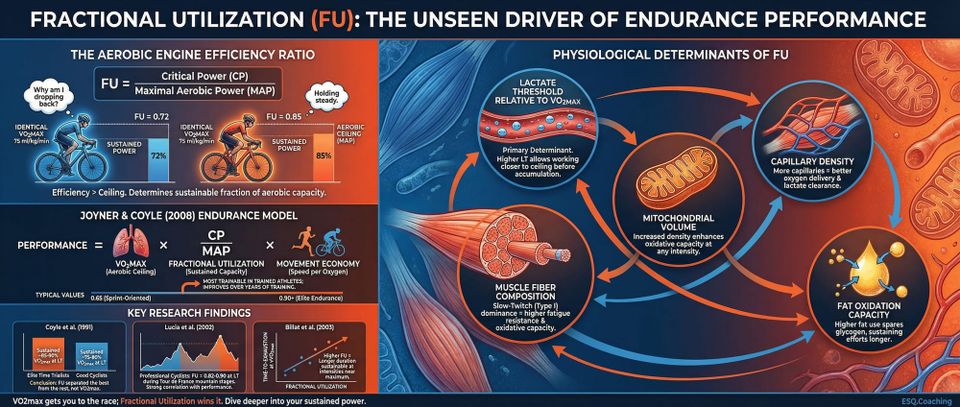
Expressed as a ratio of Critical Power (CP) to Maximal Aerobic Power (MAP), FU reveals the efficiency of your aerobic engine. Two cyclists with identical VO2max values can have radically different race performances if one sustains 85% of their ceiling while the other manages only 72%. FU explains why.
FU = CP / MAP
Where:
- CP = Critical Power, the highest power output sustainable without progressive fatigue (~40-60 minute effort)
- MAP = Maximal Aerobic Power, the power output at VO2max (~5-minute all-out effort)
Typical values range from 0.65 (sprint-oriented) to 0.90+ (elite endurance specialists).
The Research
Joyner's Endurance Performance Model
In their landmark 2008 paper, Joyner and Coyle proposed that endurance performance is determined by three factors:
Performance = VO2max × Fractional Utilization × Movement Economy
VO2max sets the aerobic ceiling. FU determines how close to that ceiling an athlete can operate before lactate accumulation forces them to slow down. Movement economy (running economy or cycling mechanical efficiency) determines how much speed each unit of oxygen consumption produces.
Of these three, FU is the most trainable in already-trained athletes. While VO2max plateaus relatively early in a training career, FU continues to improve with years of endurance training.
What Determines FU?
Fractional utilization is governed by several interconnected physiological systems:
-
Lactate threshold relative to VO2max: The primary determinant. Athletes with a high lactate threshold relative to their VO2max have high FU because they can work at a greater fraction of their ceiling before lactate accumulates faster than it can be cleared.
-
Muscle fiber composition: Slow-twitch (Type I) fibers are more oxidative and fatigue-resistant. Athletes with a higher proportion of Type I fibers naturally sustain a greater fraction of their VO2max.
-
Capillary density: More capillaries per muscle fiber mean better oxygen delivery and lactate clearance, enabling higher sustained fractions.
-
Mitochondrial volume: Greater mitochondrial density increases the muscle's oxidative capacity, allowing more work to occur aerobically at any given intensity.
-
Fat oxidation capacity: Athletes who oxidize more fat at moderate intensities spare glycogen, enabling longer sustained efforts at higher fractions of VO2max.
Key Research
Coyle et al. (1991) studied elite and good cyclists, finding that elite time trialists sustained 85-90% of VO2max at lactate threshold, compared to 75-80% in merely good cyclists - despite similar VO2max values. The conclusion: FU, not VO2max, separated the best from the rest.
Lucia et al. (2002) analyzed professional Tour de France cyclists and reported FU values of 0.82-0.90 at lactate threshold during mountain stages. These values correlated strongly with general classification performance.
Billat et al. (2003) demonstrated that the time-to-exhaustion at vVO2max (the velocity eliciting VO2max) is directly related to fractional utilization - athletes with higher FU could sustain intensities closer to their maximum for longer durations.
Interpreting Your FU
| FU Range | Rating | Typical Profile |
|---|---|---|
| > 86% | Exceptional | Grand Tour climbers, Ironman podium, elite time trialists |
| 80-86% | Very Good | Competitive time trialists, long-distance specialists |
| 74-80% | Good | Trained competitive cyclists with balanced profiles |
| 68-74% | Developing | Sprint-oriented riders, newer endurance athletes |
| < 68% | Anaerobic-Dominant | Track cyclists, criterium specialists, or early-stage endurance athletes |
Context Matters
A "low" FU is not necessarily bad - it depends on your target event:
- Criterium racing demands repeated surges above CP. A rider with FU of 0.72 but exceptional W' (anaerobic capacity) may outperform a "diesel" with FU of 0.85 who cannot respond to accelerations.
- Ironman cycling rewards high FU above all else. The ability to sustain 82-88% of MAP for 4-6 hours is the primary performance determinant on the bike leg.
- Road racing requires a balance. High enough FU to stay in the group during sustained climbs, but enough anaerobic capacity (W') to survive surges and contest the finale.
Sport-Specific FU Targets
| Discipline | Target FU | Rationale |
|---|---|---|
| Road Racing | 76-84% | Balance between sustained climbing and surge capacity |
| Time Trial | 82-90% | Maximum sustained fraction for solo pacing |
| Criterium | 70-78% | Lower sustained need, repeated above-threshold surges |
| Ironman Bike | 80-88% | Highest possible sustainability for 4-6 hours |
| Olympic Triathlon | 76-84% | ~1 hour sustained effort before run |
| Sprint Triathlon | 74-82% | Higher intensity, shorter duration |
| Gravel Racing | 74-82% | Sustained effort with terrain-forced variability |
| Mountain Stages | 80-88% | Long climbs demand high threshold sustainability |
Training to Improve FU
If Your FU Is Low (< 74%): Raise CP
Your aerobic ceiling (MAP) is already high relative to your threshold. The priority is closing the gap from below:
- Sweet-spot training (88-93% CP): The most time-efficient way to raise threshold. 2-3 sessions per week, 20-40 minute intervals.
- Threshold work (95-105% CP): Traditional 2x20 or 3x15 minute intervals at or slightly above CP.
- Endurance volume (Zone 2): Long rides at 60-75% CP build the aerobic base that supports threshold improvements.
If Your FU Is Moderate (74-82%): Balanced Development
You can improve from both directions:
- Maintain threshold volume to continue raising CP.
- Add VO2max intervals (3-8 minute efforts at 106-120% CP) to raise the ceiling.
- The ratio may stay similar, but both numbers improve - meaning faster absolute performance.
If Your FU Is High (> 82%): Raise MAP
Your threshold is already excellent relative to your ceiling. The limiting factor is the ceiling itself:
- VO2max intervals: 4-6 x 4-5 minutes at 106-120% CP with equal recovery.
- Short-short intervals: 30/15 or 40/20 second work/rest at 120-140% CP (Billat protocol).
- Maintain threshold volume - don't let CP drop while chasing MAP.
The Training Paradox
Improving FU is not always about raising the ratio. Sometimes the best path is raising MAP (which temporarily lowers FU) because the absolute power at any given fraction increases. An athlete with 300W MAP and 0.82 FU rides at 246W. If MAP rises to 330W and FU temporarily drops to 0.78, they now ride at 257W - faster despite a lower ratio.
Limitations
-
MAP approximation: True MAP is measured in a laboratory ramp test to exhaustion. The 5-minute all-out test is a practical proxy (r = 0.90-0.95 with lab MAP) but not identical.
-
CP estimation: CP from a 2-point model has inherent uncertainty. FU inherits that uncertainty. A CP error of +/-5W on a 280W threshold shifts FU by approximately +/-1.5%.
-
Day-to-day variability: Both CP and MAP fluctuate with fatigue, nutrition, temperature, and motivation. FU should be interpreted as a range, not a precise point.
-
Training phase effects: FU naturally varies across a season. Base phase typically shows lower FU (high volume raises MAP faster than CP). Race phase shows higher FU as threshold-specific work peaks.
-
Age effects: FU tends to improve with training age, partially compensating for the VO2max decline that occurs after ~35 years. Many masters athletes have exceptional FU despite lower absolute VO2max.
⚠️ HEALTH & SAFETY WARNING
This calculator involves training modifications that can affect your health and performance if misapplied. Consult qualified professionals before making changes.
Medical consultation required if: You have underlying health conditions, are taking medications, pregnant/nursing, under 18, or experience adverse symptoms during training.
ℹ️ IMPORTANT DISCLAIMER
This calculator is for educational purposes only and does NOT constitute medical advice. Consult qualified professionals before making changes. Individual physiology varies. You assume all risk. Must be 18+.
References
- Joyner MJ, Coyle EF. Endurance exercise performance: the physiology of champions. Journal of Physiology. 2008;586(1):35-44.
- Coyle EF, Feltner ME, Kautz SA, et al. Physiological and biomechanical factors associated with elite endurance cycling performance. Medicine and Science in Sports and Exercise. 1991;23(1):93-107.
- Lucia A, Hoyos J, Perez M, Santalla A, Chicharro JL. Inverse relationship between VO2max and economy/efficiency in world-class cyclists. Medicine and Science in Sports and Exercise. 2002;34(12):2079-2084.
- Billat VL, Sirvent P, Py G, Koralsztein JP, Mercier J. The concept of maximal lactate steady state: a bridge between biochemistry, physiology, and sport science. Sports Medicine. 2003;33(6):407-426.
- Coyle EF. Integration of the physiological factors determining endurance performance ability. Exercise and Sport Sciences Reviews. 1995;23:25-63.
- Mujika I, Padilla S. Physiological and performance characteristics of male professional road cyclists. Sports Medicine. 2001;31(7):479-487.
- Jones AM, Vanhatalo A. The "critical power" concept: applications to sports performance with a focus on intermittent high-intensity exercise. Sports Medicine. 2017;47(Suppl 1):65-78.