Gear Ratio & Cadence/Speed Calculator
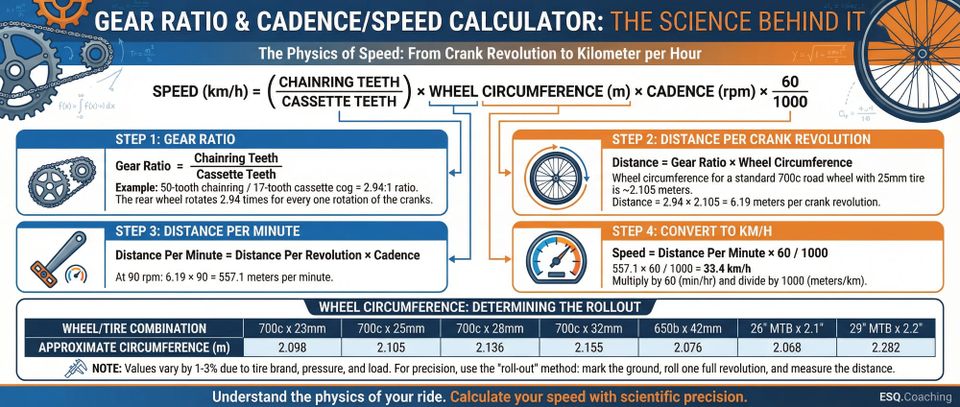
Gear Ratio & Cadence/Speed Calculator: The Science Behind It
How the Calculator Works
The Formula
Speed (km/h) = (Chainring Teeth / Cassette Teeth) × Wheel Circumference (m) × Cadence (rpm) × 60 / 1000
Breaking this down step by step:
-
Gear Ratio = Chainring Teeth / Cassette Teeth
- Example: 50-tooth chainring / 17-tooth cassette cog = 2.94:1 ratio
- This means the rear wheel rotates 2.94 times for every one rotation of the cranks.
-
Distance Per Crank Revolution = Gear Ratio * Wheel Circumference
- Wheel circumference for a standard 700c road wheel with 25mm tire is approximately 2.105 meters.
- Distance = 2.94 × 2.105 = 6.19 meters per crank revolution.
-
Distance Per Minute = Distance Per Revolution * Cadence
- At 90 rpm: 6.19 × 90 = 557.1 meters per minute.
-
Convert to km/h: Multiply by 60 (minutes/hour) and divide by 1000 (meters/km).
- 557.1 × 60 / 1000 = 33.4 km/h
Wheel Circumference
The wheel circumference is calculated from the wheel and tire dimensions. Common values (using the ISO/ETRTO standard):
| Wheel/Tire Combination | Approximate Circumference (m) |
|---|---|
| 700c x 23mm | 2.098 |
| 700c x 25mm | 2.105 |
| 700c x 28mm | 2.136 |
| 700c x 32mm | 2.155 |
| 650b x 42mm | 2.076 |
| 26" MTB x 2.1" | 2.068 |
| 29" MTB x 2.2" | 2.282 |
These values can vary by 1-3% depending on tire brand, inflation pressure, and actual tire width under load. For precision, cyclists can measure their own wheel circumference using the "roll-out" method (marking the ground, rolling one full revolution, and measuring the distance).
Practical Application
Scenario 1: Flat Road Time Trial Pacing
A triathlete wants to maintain 40 km/h on a flat time trial course. With a 54/11 gear (ratio = 4.91) and 700c x 25mm tires (circumference = 2.105 m):
- Required cadence = 40 × 1000 / (4.91 × 2.105 × 60) = 64.5 rpm
That cadence is too low for efficient sustained riding. Switching to 54/14 (ratio = 3.86):
- Required cadence = 40 × 1000 / (3.86 × 2.105 × 60) = 82.0 rpm
This is within the optimal cadence range for sustained power output.
Scenario 2: Climbing Cadence Selection
A rider is climbing a mountain pass at 12 km/h with a compact crankset (34-tooth chainring) and 34-tooth cassette cog (1:1 ratio):
- Cadence = 12 × 1000 / (1.00 × 2.105 × 60) = 95.0 rpm
This is actually a high climbing cadence. If the rider's comfortable climbing cadence is 75 rpm:
- Speed at 75 rpm = 1.00 × 2.105 × 75 × 60 / 1000 = 9.5 km/h
This tells the rider what speed to expect at their preferred climbing cadence.
Scenario 3: Equipment Decision - Cassette Choice
A cyclist is choosing between an 11-28 and an 11-32 cassette for a hilly sportive. At a comfortable climbing cadence of 70 rpm with a 34-tooth chainring:
- 34/28 gear: Speed = (34/28) × 2.105 × 70 × 60 / 1000 = 10.73 km/h
- 34/32 gear: Speed = (34/32) × 2.105 × 70 × 60 / 1000 = 9.39 km/h
The 32-tooth cog allows climbing at 1.3 km/h slower at the same cadence, meaning significantly less effort on steep gradients. For most recreational riders, the 11-32 provides critical bail-out gearing on 10%+ grades.
Why This Matters
Every cyclist makes gear choices - consciously or not - on every ride. Shift to a bigger gear and each pedal stroke covers more ground but requires more force. Shift to a smaller gear and you spin faster but travel less distance per revolution. The relationship between gear selection, pedal speed (cadence), and forward velocity is governed by elementary mechanics, but understanding it quantitatively unlocks real training and racing benefits.
For competitive cyclists, knowing exactly what speed a given gear-and-cadence combination produces is essential for pacing strategy, equipment selection (choosing chainring and cassette sizes), and optimizing cadence for different terrain. For recreational riders, it demystifies the gearing system and helps match equipment to riding goals.
The Research
The gear-speed relationship is pure Newtonian mechanics - it does not require empirical research to derive. The practical context of optimal cadence selection, however, has been the subject of extensive sports science investigation.
Cadence Research: Key Studies
Abbiss, Peiffer, & Laursen (2009) conducted a comprehensive review of optimal cadence selection in cycling. Their key finding was that "optimal" cadence depends on the criterion: metabolic efficiency is maximized at lower cadences (60-80 rpm), while peak power output occurs at higher cadences (100-120 rpm). They concluded that the ideal cadence may differ according to whether the goal is economy, power output, fatigue reduction, or subjective comfort.
Hansen, Andersen, Nielsen, & Sjogaard (2002) demonstrated that muscle fiber type composition directly influences optimal cadence. Riders with a higher proportion of slow-twitch (Type I) fibers tend to prefer lower cadences, while those with more fast-twitch (Type II) fibers naturally gravitate to higher cadences. This explains why optimal cadence is highly individual.
Foss & Hallen (2005) found that the energetically optimal cadence - the one that minimizes oxygen consumption for a given power output - is approximately 60-80 rpm for submaximal efforts. However, freely chosen cadences of trained cyclists are typically higher (85-95 rpm), suggesting that factors beyond pure metabolic efficiency (such as neuromuscular fatigue and perceived effort) influence cadence selection.
Lucia, Hoyos, & Chicharro (2001) studied professional cyclists in the Tour de France and found that elite riders typically maintain cadences of 90-100 rpm during flat stages and 70-90 rpm during mountain stages, with the lower climbing cadences reflecting a shift from aerodynamic to gravitational resistance.
Limitations
-
Does not account for power requirements: Knowing that a certain gear produces 35 km/h at 90 rpm tells you nothing about whether you can sustain that combination. Power, fitness, and conditions determine achievable speed.
-
Cadence "zones" are individual: While research provides general ranges (60-80 rpm for efficiency, 90-100 for race pace), the true optimal cadence depends on individual physiology, particularly muscle fiber type composition.
-
Tire circumference variation: Nominal tire sizes vary by manufacturer, and circumference changes with inflation pressure and wear. A 25mm tire from one brand may measure 27mm on a given rim.
-
No consideration of aero or rolling resistance: The calculator is purely kinematic. For predicting real-world speed from a given power output, a full physics model (accounting for aerodynamics, rolling resistance, gradient, and wind) is needed, which we have in a different calculator ;).
-
Cadence range advisories: The calculator accepts 40–140 RPM. Below 50 RPM, an advisory notes high torque loads on the knees — this range is typical only for steep climbing or standing starts. Above 120 RPM, an advisory notes this cadence is common only in track sprinting or spin-up drills; most road cycling occurs at 80–100 RPM (Lucia et al., 2001).
ℹ️ IMPORTANT DISCLAIMER
This calculator is for educational purposes only and does NOT constitute medical advice. Consult qualified professionals before making changes. Individual physiology varies. You assume all risk. Must be 18+.
References
Abbiss, C. R., Peiffer, J. J., & Laursen, P. B. (2009). Optimal cadence selection during cycling: Review article. International SportMed Journal, 10(1), 1-15.
Foss, O., & Hallen, J. (2005). Cadence and performance in elite cyclists. European Journal of Applied Physiology, 93(4), 453-462.
Hansen, E. A., Andersen, J. L., Nielsen, J. S., & Sjogaard, G. (2002). Muscle fibre type, efficiency, and mechanical optima affect freely chosen pedal rate during cycling. Acta Physiologica Scandinavica, 176(3), 185-194.
Lucia, A., Hoyos, J., & Chicharro, J. L. (2001). Preferred pedalling cadence in professional cycling. Medicine and Science in Sports and Exercise, 33(8), 1361-1366.
Martin, J. C., Milliken, D. L., Cobb, J. E., McFadden, K. L., & Coggan, A. R. (1998). Validation of a mathematical model for road cycling power. Journal of Applied Biomechanics, 14(3), 276-291.
Wilson, D. G. (2004). Bicycling Science (3rd ed.). MIT Press.
Scientific Validation Notes
Overall Validity Rating: CORRECT (mechanically exact)
The formula Speed = (chainring/cassette) × wheel_circumference × cadence × 60 / 1000 is a direct and correct derivation from first principles of rotational kinematics. There is no empirical uncertainty in the formula itself.
The only sources of error are:
- Tire circumference values: These should be specified or measured rather than assumed. A lookup table of standard ISO sizes is sufficient for most purposes.
- Drivetrain efficiency: Not included, nor should it be for a speed calculator (it would be relevant for a power calculator).
The research context on cadence selection adds significant value to this calculator. Users should understand that while the mechanics are exact, choosing the right cadence involves physiological optimization that varies by individual and riding context. The literature consensus is:
- Metabolic efficiency peak: 60-80 rpm (Foss & Hallen, 2005)
- Freely chosen cadence (trained): 85-95 rpm (Hansen et al., 2002)
- Sprint power peak: 100-120 rpm (Abbiss et al., 2009)
- Professional racing cadence: 90-100 rpm flat, 70-90 rpm climbing (Lucia et al., 2001)