Interval Workout Builder
The Science Behind It
How the Calculator Works
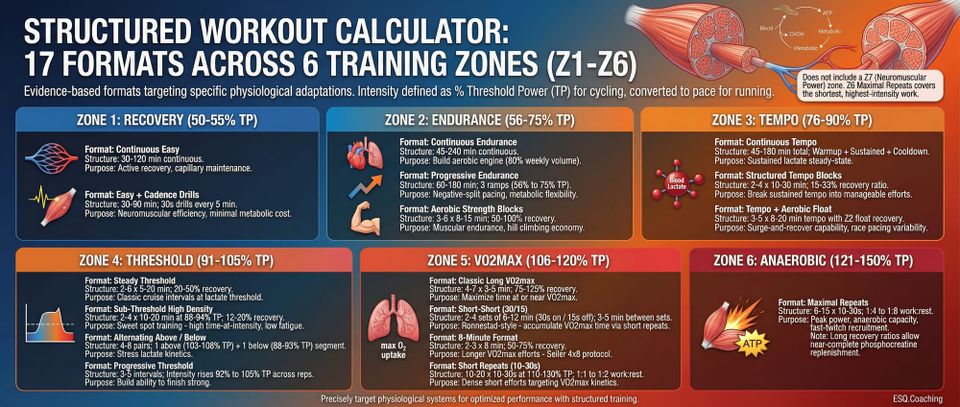
The calculator provides 17 structured workout formats across six training zones (Z1-Z6). Each format targets a specific physiological adaptation, with evidence-based work:rest ratios and configurable parameters.
Zone intensity ranges are defined as percentages of Threshold Power (TP) for cycling. For running, the calculator converts those same percentages to pace targets using the relationship: target pace = threshold pace / intensity fraction.
Zone 1: Recovery (50-55% TP)
| Format | Structure | Purpose |
|---|---|---|
| Continuous Easy | 30-120 min continuous | Active recovery, capillary maintenance |
| Easy + Cadence Drills | 30-90 min; 30s drills woven every 5 min | Neuromuscular efficiency at minimal metabolic cost |
Zone 2: Endurance (56-75% TP)
| Format | Structure | Purpose |
|---|---|---|
| Continuous Endurance | 45-240 min continuous | Build aerobic engine - 80% of weekly volume target |
| Progressive Endurance | 60-180 min; 3 blocks ramping from 56% to 75% TP | Negative-split pacing, metabolic flexibility |
| Aerobic Strength Blocks | 3-6 x 8-15 min; 50-100% recovery | Muscular endurance, hill climbing economy |
Zone 3: Tempo (76-90% TP)
| Format | Structure | Purpose |
|---|---|---|
| Continuous Tempo | 45-180 min total; warmup + sustained effort + cooldown | Sustained lactate steady-state |
| Structured Tempo Blocks | 2-4 x 10-30 min; 15-33% recovery ratio | Break sustained tempo into manageable efforts |
| Tempo + Aerobic Float | 3-5 x 8-20 min tempo with Z2 float recovery | Surge-and-recover capability, race pacing variability |
The "Tempo + Aerobic Float" format uses Z2 intensity (not full rest) for the recovery segments. This differs from standard tempo blocks and is closer in structure to a polarized session with aerobic recovery.
Zone 4: Threshold (91-105% TP)
| Format | Structure | Purpose |
|---|---|---|
| Steady Threshold | 2-6 x 5-20 min; 20-50% recovery | Classic cruise intervals at lactate threshold |
| Sub-Threshold High Density | 2-4 x 10-20 min at 88-94% TP; 12-20% recovery | Sweet spot training - high time-at-intensity with low fatigue |
| Alternating Above / Below | 4-8 pairs; each pair = 1 above-threshold + 1 below-threshold segment | Stress lactate kinetics; above at 103-108% TP, below at 88-93% TP |
| Progressive Threshold | 3-5 intervals; intensity rises from 92% to 105% TP across reps | Build the ability to finish strong |
Note: Sub-Threshold High Density uses a power override of 88-94% TP, which sits just below the Z4 lower boundary. This is intentional - it is the "sweet spot" range.
Zone 5: VO2max (106-120% TP)
| Format | Structure | Purpose |
|---|---|---|
| Classic Long VO2max | 4-7 x 3-5 min; 75-125% recovery | Maximize time at or near VO2max |
| Short-Short (30/15) | 2-4 sets of 6-12 min (30s on / 15s off); 3-5 min between sets | Ronnestad-style - accumulate VO2max time via short repeats |
| 8-Minute Format | 2-3 x 8 min; 50-75% recovery | Longer VO2max efforts - Seiler 4x8 protocol |
| Short Repeats (10-30s) | 10-20 x 10-30s at 110-130% TP; 1:1 to 1:2 work:rest | Dense short efforts targeting VO2max kinetics |
Zone 6: Anaerobic (121-150% TP)
| Format | Structure | Purpose |
|---|---|---|
| Maximal Repeats | 6-15 x 10-30s; 1:4 to 1:8 work:rest | Peak power, anaerobic capacity, fast-twitch recruitment |
Z6 uses long recovery ratios (4:1 to 8:1 rest:work) to allow near-complete phosphocreatine replenishment between maximal efforts. This is distinct from Z5 short repeats, which use incomplete recovery by design.
Note: The calculator covers Z1-Z6. It does not include a Z7 (Neuromuscular Power) zone. Coggan's original model defines Z7 separately for peak sprint efforts, but the calculator omits this zone. Z6 Maximal Repeats covers the shortest, highest-intensity work available in this tool.
Running Intensity Targets
For running, the calculator does not use simple additive pace modifiers. Instead, it applies the same intensity fractions as cycling and converts them to pace using:
target pace (s/km) = threshold pace (s/km) / intensity fraction
For example, with a threshold pace of 4:00/km (240 s/km) and a Z2 target of 65% intensity, the target pace is 240 / 0.65 = 369 s/km = approximately 6:09/km.
This means running pace targets scale continuously with threshold pace rather than using fixed offsets. The effective pace ranges for a 4:00/km threshold runner work out to approximately:
- Z1 (50-55% TP): 7:16 to 8:00/km
- Z2 (56-75% TP): 5:20 to 7:09/km
- Z3 (76-90% TP): 4:27 to 5:16/km
- Z4 (91-105% TP): 3:50 to 4:24/km
- Z5 (106-120% TP): 3:20 to 3:46/km
- Z6 (121-150% TP): 2:40 to 3:18/km
3-Week Progression Mode
Each format that supports progression increases one training dimension per week. The dimension used depends on the format:
- Reps (adding repetitions): Z1 cadence drills, Z2 aerobic strength blocks, Z4 alternating above/below, Z4 progressive threshold, Z5 classic VO2max, Z5 8-minute format, Z5 short repeats, Z6 maximal repeats
- Work duration (extending interval length): Z2 aerobic strength, Z3 tempo + aerobic float, Z4 steady threshold, Z4 sub-threshold high density, Z5 short-short
- Recovery ratio (reducing rest): Z3 structured tempo blocks
Formats without a progression dimension (continuous Z1/Z2/Z3) use only the single-session mode. The 3-week plan advances by one step per week and caps at each format's defined maximum.
Session Load Estimation
Each workout includes an estimated Session Load calculated as:
Session Load = IR² × hours × 100
where IR is the Intensity Ratio (step power fraction / threshold power). A one-hour threshold session produces a Session Load of 100 by definition. The formula accumulates load across each step in the workout, including warmup, work, rest, and cooldown segments.
Workout Export
Generated workouts export in two file formats:
- ZWO (Zwift Workout Format): XML structured workout file for Zwift and TrainingPeaks. Available for both running and cycling workouts.
- ERG (MRC/ERG Format): Power-based file for TrainerRoad, Wahoo, and other smart trainer platforms. Cycling-only - ERG files require watt targets and are not shown for running workouts.
In 3-week progression mode, each week generates its own export file plus a "Download All" button for the full three-file block.
Practical Application
Scenario 1: Threshold development for a marathon runner (threshold pace 4:10/km)
Z4 Steady Threshold: 3 x 10 min at approximately 4:10/km with 2.5 min jog recovery (4:1 work:rest). This matches Daniels' cruise interval format. Three-week progression extends to 4 x 10 min in week 2 by adding a rep.
Scenario 2: VO2max development for a 5K runner (threshold pace 3:45/km)
Z5 Classic Long VO2max: 5 x 4 min at approximately 3:08-3:32/km with equal-duration recovery. Total high-intensity work: 20 min. Consistent with Billat's finding that intervals at vVO2max with equal rest produce 7-8 min of total time at VO2max.
Scenario 3: Ronnestad short-short for a cyclist (TP 280W)
Z5 Short-Short (30/15): 3 sets of 8 min (30s at 297-336W, 15s easy), 4 min between sets. Each set contains approximately 10-11 individual 30/15 cycles. Total high-intensity work time: around 24 min including rest periods. Lower perceived exertion than equivalent duration in classic VO2max intervals.
Scenario 4: Endurance base for a triathlete
Z2 Continuous Endurance: 90 min at 56-75% TP. Export as ZWO for Zwift indoor sessions. This format does not support automatic progression - duration adjustments are made manually.
Scenario 5: Anaerobic power for a track cyclist (TP 350W)
Z6 Maximal Repeats: 8 x 20s at 424-525W, 2 min recovery between efforts (1:6 work:rest). Targets phosphocreatine system and peak neuromuscular power.
Why This Matters
The duration, intensity, rest period, and repetition count of an interval session are not arbitrary. Each variable targets a specific physiological system and determines which adaptations occur. The same total training time distributed differently produces substantially different outcomes.
The Interval Workout Builder draws on five primary frameworks in endurance science to prescribe structured sessions across six zones, with export formats compatible with the most common smart trainer platforms.
The Research
Andrew Coggan's Power Zone Model (2003)
Coggan's training zone system, published in Training and Racing with a Power Meter, defines intensity zones as percentages of Threshold Power (TP). This calculator implements six of Coggan's zones for cycling power targets:
- Z1 (Active Recovery): 50-55% TP. Promotes blood flow and recovery without adding stress.
- Z2 (Endurance): 56-75% TP. Builds aerobic base, mitochondrial density, fat oxidation.
- Z3 (Tempo): 76-90% TP. Develops sustainable power and lactate clearance.
- Z4 (Lactate Threshold): 91-105% TP. The primary zone for time-trial and sustained race performance.
- Z5 (VO2max): 106-120% TP. Maximizes oxygen delivery and aerobic power.
- Z6 (Anaerobic): 121-150% TP. Develops anaerobic glycolytic capacity and peak power.
Coggan's original model includes a Z7 (Neuromuscular Power) zone for maximal sprints above 150% TP. The calculator does not implement Z7.
Jack Daniels' Running Formula (1998, 4th ed. 2021)
Daniels developed the VDOT system - a pseudo-VO2max that integrates maximal oxygen uptake with running economy to produce individualized training paces. His system defines five training intensity zones (E, M, T, I, R) with specific work:rest prescriptions.
For VO2max intervals (I pace), Daniels prescribes 3-5 minute work bouts with recovery equal to or slightly less than work duration. His rationale: it takes approximately 2 minutes to reach VO2max during hard running, so intervals shorter than 3 minutes provide insufficient time at target intensity. Intervals longer than 5 minutes risk excessive lactate accumulation without additional VO2max stimulus.
For threshold work (T pace), Daniels prescribes cruise intervals of 5-15 minutes with short recovery (roughly 20-25% of work time). This maps to the calculator's Z4 Steady Threshold format.
Stephen Seiler's Intensity Distribution Research (2010)
Seiler's research on elite endurance athletes across multiple sports identified a consistent pattern: approximately 80% of training volume below the first ventilatory threshold, approximately 20% above the second. Relatively little training occurs in the moderate zone between the two thresholds.
Seiler and colleagues also tested different interval formats in controlled studies. A key finding: 4 x 8-minute intervals at the highest intensity athletes could sustain produced a 16% improvement in threshold power and 10% improvement in VO2max over seven weeks in recreational cyclists performing two high-intensity sessions per week. The 8-Minute Format in this calculator is drawn directly from this protocol.
Bent Ronnestad's Short-Interval Research (2014, 2020)
Ronnestad's work at Inland Norway University of Applied Sciences demonstrated the effectiveness of very short interval formats for accumulating time at high VO2 kinetics:
- 30/15 format (30s at 90-95% VO2max power, 15s active rest): Cyclists maintained higher average power and accumulated more total high-intensity work compared to traditional longer intervals.
- Short recovery prevents full VO2 recovery between efforts, keeping oxygen consumption elevated throughout each set.
- Sets of 6-12 minutes with 3-5 minutes between sets, repeated 2-4 times, produce strong aerobic stimulus with lower perceived exertion than equivalent volume in classic VO2max intervals.
Veronique Billat's VO2max Interval Research (1999, 2001)
Billat's work examined what interval duration and structure maximizes time spent at or near VO2max:
- Intervals at 100% of vVO2max with equal-duration recoveries at 50% vVO2max produced approximately 7-8 minutes of total time at VO2max in trained runners.
- Very short intervals (15s on, 15s off) at critical velocity allowed middle-aged runners to accumulate up to 14 minutes at VO2max.
- More recent evidence suggests that traditional longer intervals (3 minutes) may produce superior time above 90% VO2max compared to intensified 30-second intervals.
Limitations
-
Running and cycling share zone numbers but not physiology. The calculator maps Coggan's cycling power zones to running paces using intensity fractions. True running zones should ideally be anchored to individual lactate testing or race-pace data, not derived from cycling zone boundaries.
-
The 1:1 work:rest ratio for VO2max intervals is a common simplification. Daniels recommends recovery "equal to or slightly less than" the work bout. Billat's research shows that recovery intensity also matters - passive versus active recovery changes the kinetics. Individual fitness level modulates the optimal ratio.
-
Z6 prescriptions are the least well-defined in the literature. The anaerobic zone spans a wide range of intensities and durations. The 1:4 to 1:8 rest:work ratios in the calculator are conventional for phosphocreatine-focused work but dose-response evidence for general populations is limited.
-
No Z7 zone. Coggan's model includes a seventh zone (Neuromuscular Power) for peak sprint efforts above 150% TP. This calculator stops at Z6.
-
The calculator does not account for cumulative fatigue within a session. Interval quality typically declines across a set. Some coaches use "until quality drops" rather than fixed repetition counts.
-
Seiler's 80/20 distribution is a training-plan principle, not a single-session prescription. The calculator builds individual sessions. How those sessions fit into weekly volume and intensity distribution is a separate consideration.
-
Session Load estimation uses a simplified model. The IR² × hours × 100 formula provides a reasonable estimate but does not account for the higher metabolic cost of interval work compared to steady-state effort at the same average intensity.
-
ERG export is cycling-only. ERG files encode power in watts, which is meaningless for running. The calculator correctly suppresses the ERG button for running workouts.
-
3-week progression is linear and single-dimension. Real periodization often uses undulating or non-linear patterns. The calculator advances one variable (reps, duration, or recovery ratio) by one step per week. This is a starting framework.
-
Threshold power guardrail. Values above 500W trigger an advisory note — this level is exceptionally rare and corresponds to elite professional cyclists. Most trained amateurs fall in the 200–350W range. An implausible threshold value will produce unrealistic workout targets.
ℹ️ IMPORTANT DISCLAIMER
This calculator is for educational purposes only and does NOT constitute medical advice. Consult qualified professionals before making changes. Individual physiology varies. You assume all risk. Must be 18+.
References
Billat, V. L., et al. (1999). Intermittent runs at the velocity associated with maximal oxygen uptake enables subjects to remain at maximal oxygen uptake for a longer time than intense but submaximal runs. European Journal of Applied Physiology, 81(3), 188-196. https://doi.org/10.1007/s004210050029
Billat, V. L., et al. (2001). Very short (15s-15s) interval-training around the critical velocity allows middle-aged runners to maintain VO2max for 14 minutes. International Journal of Sports Medicine, 22(3), 201-208. https://doi.org/10.1055/s-2001-16389
Coggan, A. R. (2003). Training and racing with a power meter. In Allen, H. & Coggan, A. R. Training and Racing with a Power Meter (3rd ed., 2019). VeloPress.
Daniels, J. (2021). Daniels' Running Formula (4th ed.). Human Kinetics.
Ronnestad, B. R., & Hansen, J. (2018). Optimizing interval training at power output associated with peak oxygen uptake in well-trained cyclists. Journal of Strength and Conditioning Research, 32(8), 2335-2341. https://doi.org/10.1519/JSC.0000000000002607
Seiler, S. (2010). What is best practice for training intensity and duration distribution in endurance athletes? International Journal of Sports Physiology and Performance, 5(3), 276-291. https://doi.org/10.1123/ijspp.5.3.276
Seiler, S., & Tonnessen, E. (2009). Intervals, thresholds, and long slow distance: The role of intensity and duration in endurance training. Sportscience, 13, 32-53.
Stoggl, T. L., & Sperlich, B. (2015). The training intensity distribution among well-trained and elite endurance athletes. Frontiers in Physiology, 6, 295. https://doi.org/10.3389/fphys.2015.00295
Scientific Validation Notes
Z5 (VO2max) intervals: Well-supported. The 3-5 minute Classic Long format with 1:1 work:rest ratio is directly consistent with Daniels' prescription and Billat's research. The 30/15 Short-Short format is correctly attributed to Ronnestad's research. The 8-Minute Format matches Seiler's controlled study protocol. The Short Repeats (10-30s) at 110-130% TP extend into supramaximal range and are consistent with high-density VO2max kinetics literature.
Z4 (Threshold) intervals: Well-supported. Daniels prescribes T-pace cruise intervals of 5-15 minutes with short rest. The Steady Threshold format (5-20 min at 91-105% TP, 20-50% recovery ratio) falls within these guidelines. Sub-Threshold High Density at 88-94% TP matches the "sweet spot" concept. The Alternating Above/Below format (103-108% above, 88-93% below) targets lactate kinetics and is consistent with over-under training literature.
Z1-Z3 formats: Physiologically sound. Continuous endurance, progressive block builds, and tempo work are standard training approaches. The Tempo + Aerobic Float format (Z2 recovery between tempo blocks) aligns with polarized session design where "easy" recovery stays genuinely easy.
Z6 (Anaerobic) intervals: Conventionally supported. The 1:4 to 1:8 rest:work ratios for maximal short efforts reflect standard coaching practice for phosphocreatine-dominated work. Dose-response literature is thinner here than for Z4-Z5.
No Z7 zone: Limitation acknowledged. Coggan's model defines Z7 for neuromuscular power (peak sprints). The calculator omits this zone. Z6 Maximal Repeats covers the shortest available format (10-30s) at the highest intensities (121-150% TP).
ZWO and ERG export: Functionally correct. ZWO follows the Zwift workout XML schema and imports into Zwift and TrainingPeaks. ERG follows the MRC/ERG format compatible with TrainerRoad, Wahoo, and compatible platforms. ERG is suppressed for running workouts.
Overall: The 17-format design across 6 zones with configurable parameters and format-specific progression dimensions provides a comprehensive structured workout tool grounded in the referenced literature.