Journal Club #001: Challenging Zone 2 Optimality for Mitochondrial Health and Fitness in General Population
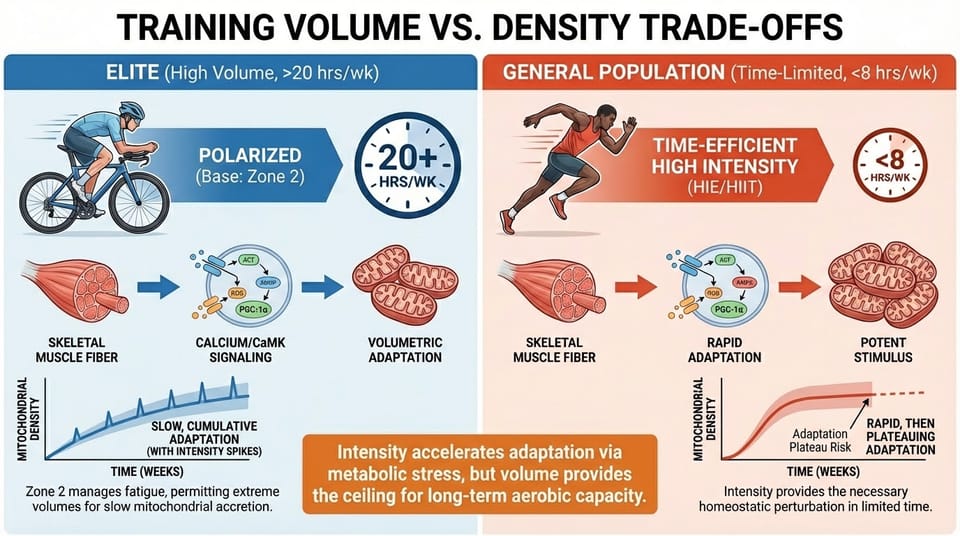
It is not often that a research paper arrives specifically to critically audit a trend currently dominating the applied physiology landscape (and social media), but this week’s selection does exactly that. If you consume fitness media or coaching literature, you are likely aware of the prevalence of "Zone 2" (low-intensity, steady-state exercise) as a proposed requisite for optimizing metabolic health, lipid oxidation, and longevity.
The prevailing narrative suggests that high-intensity exercise is excessively stressful and that the majority of training volume should be performed at a conversational pace to develop "mitochondrial capacity." This specific paper, published recently in Sports Medicine, challenges the universality of that paradigm.
The authors argue a fundamental physiological constraint: Training protocols optimized for professional cyclists accumulating 25 hours per week are not directly scalable to individuals training five hours per week. We have selected this paper for the Notebook because it addresses a critical question of dose-response and resource allocation:
For the time-limited individual, does low-intensity exercise provide a sufficient physiological stimulus to induce adaptation, or is it an inefficient application of elite training principles?
This post is for subscribers only
Found this useful?
Get articles like this and free training calculators in your inbox every week.
Recommended reads
If this was useful, these are the other research-driven newsletters I actually read.