Pace Converter
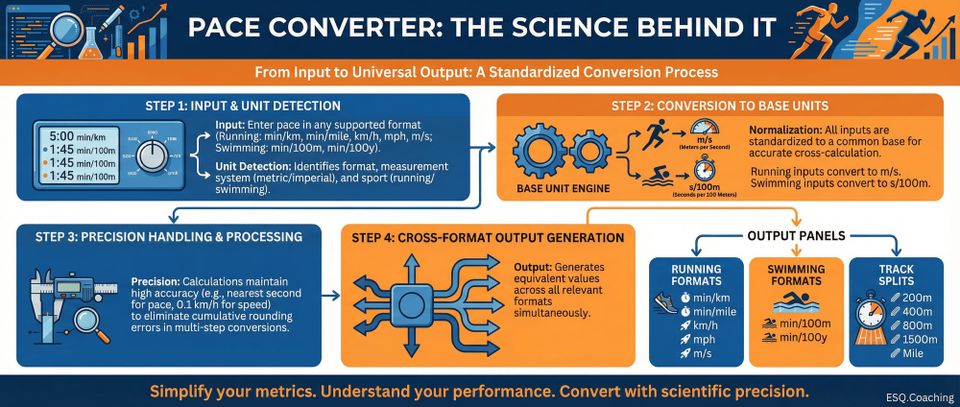
The Science Behind It
How the Calculator Works
-
Input: A pace value in any supported format (min/km, min/mile, km/h, mph, m/s) or a swimming pace (per 100m or 100y).
-
Unit detection: The calculator identifies the input unit based on the selected format (pace vs. speed, metric vs. imperial, running vs. swimming).
-
Conversion to base units: All inputs are normalized to a common base (meters per second for running, seconds per 100 meters for swimming).
-
Cross-format output: The calculator generates equivalent values across all relevant formats:
- Running: min/km, min/mile, km/h, mph, m/s
- Swimming: pace per 100m, pace per 100y
- Track splits: 200m, 400m, 800m, 1500m, mile times
-
Precision handling: All conversions maintain sufficient precision (to the nearest second for pace, 0.1 km/h for speed) to avoid cumulative rounding errors in multi-step calculations.
Practical Application
Scenario 1: International training plan (metric to imperial)
- Plan prescribes: "8 × 1 km at 4:00/km pace"
- Runner uses mile-marked routes in the US
- Conversion: 4:00/km = 6:26/mile
- Adjusted workout: "5 × 1 mile at 6:26/mile pace" (approximately equivalent volume and intensity)
Scenario 2: Treadmill session from GPS data
- Recent outdoor tempo run: 10 km at 4:30/km pace
- Treadmill displays speed in mph
- Conversion: 4:30/km = 13.33 km/h = 8.28 mph
- Treadmill setting: 8.3 mph at 1% grade (to match outdoor effort)
Scenario 3: Swimming pool length conversion
- Training plan: "10 × 100m at 1:30 pace"
- Available pool: 25-yard short course
- Conversion: 1:30 per 100m = 1:22 per 100y
- Adjusted interval: "10 × 100y at 1:22 pace" (same intensity, different distance unit)
Scenario 4: Scientific paper interpretation
- Study reports lactate threshold at 3.8 m/s
- Runner wants to train at this intensity
- Conversion: 3.8 m/s = 13.68 km/h = 4:23/km = 7:03/mile
- Training prescription: threshold runs at ~4:23/km pace
Why This Matters
Runners encounter pace in multiple formats: min/km on European training plans, min/mile on American race bibs, km/h on treadmill displays, m/s in scientific papers. Swimmers face similar complexity with pace per 100m versus 100 yards. The Pace Converter eliminates calculation errors and enables instant translation between units, ensuring training intensity targets are met regardless of how the prescription is written. This is particularly valuable when following international training plans, comparing GPS watch data to treadmill settings, or analyzing scientific literature that uses different conventions.
Beyond simple unit conversion, the calculator bridges the gap between how athletes experience effort (pace) and how equipment displays it (speed), making training more precise and race pacing more intuitive.
The Research
Fundamental Unit Relationships. Pace and speed are mathematical inverses. Pace (time per distance) and speed (distance per time) describe identical physical phenomena from different perspectives. The conversion is purely mathematical: speed (km/h) = 60 / pace (min/km), and vice versa. This reciprocal relationship means that a 5:00 min/km pace equals exactly 12 km/h (Jones & Doust, 1996).
The metric-imperial conversion relies on the internationally standardized relationship: 1 mile = 1.609344 kilometers (exact). This yields the conversion factor that pace in min/mile = pace in min/km × 1.609344. A 5:00 min/km pace therefore equals 8:03 min/mile (5 × 1.609344 = 8.047 minutes).
Swimming Pace Standards. Swimming pace conventions differ by pool length. Short-course meters (25m), long-course meters (50m), and short-course yards (25y) pools all use "pace per 100" as the standard unit, but the distance covered varies. The yard-to-meter conversion (1 yard = 0.9144 meters) means that pace per 100 yards must be multiplied by 0.9144 to convert to pace per 100 meters. A swimmer maintaining 1:20 per 100y is actually swimming 1:27 per 100m (80 seconds / 0.9144 = 87.5 seconds).
Treadmill Speed vs. Outdoor Pace. Treadmills eliminate air resistance and provide a continuous belt motion that slightly reduces the energetic cost compared to outdoor running. Jones & Doust (1996) demonstrated that setting the treadmill to a 1% gradient most accurately replicates the energy cost of outdoor running on flat terrain. A treadmill speed of 12 km/h at 0% grade therefore feels easier than outdoor running at 5:00 min/km, despite being numerically equivalent.
Track Pace Calculations. Standard outdoor running tracks are 400 meters per lap. Common track intervals (200m, 400m, 800m, 1500m, mile) require pace calculations that account for the sub-kilometer distances. A target 5K race pace of 20:00 (4:00/km) translates to 80-second 400m laps, 2:40 per 1000m, and 6:26 for the 1609m mile. These conversions are arithmetic but critical for structured track workouts.
Limitations
-
Treadmill equivalency requires gradient adjustment. Converting outdoor pace to treadmill speed assumes identical effort, but treadmills lack air resistance. A 1% treadmill grade compensates for this difference on flat terrain, but the calculator provides speed conversion only, not automatic grade adjustment.
-
Swimming pace does not account for stroke type. The calculator converts pace per 100m to pace per 100y (and vice versa), but this assumes the same stroke. Freestyle, backstroke, breaststroke, and butterfly have different speed profiles. A 1:30 per 100m freestyle pace is not equivalent to 1:30 per 100m breaststroke.
-
Track distances are rounded. The calculator uses 1 mile = 1609 meters for track splits, but the precise mile is 1609.344 meters. This introduces a ~0.3-second error on mile repeats at 5:00/mile pace, which is negligible for training purposes but relevant for competitive track racing.
-
Altitude and environmental conditions are not modeled. A 4:00/km pace at sea level in 15°C weather is physiologically easier than the same pace at 2000m altitude or in 30°C heat. The calculator converts units but does not adjust for environmental factors affecting effort.
-
Individual running economy varies. Two runners maintaining 4:00/km pace may experience different physiological stress depending on running economy (oxygen cost per kilometer). The pace is identical, but the effort may differ by 5-10% between individuals.
-
Open water swimming differs from pool pace. Pool pace assumes push-offs from walls and no navigation. Open water swimming eliminates wall-assisted propulsion and requires sighting, typically slowing pace by 3-8% for the same effort.
-
Decimal precision may exceed practical utility. The calculator outputs conversions to high precision (e.g., 4:00/km = 6:26.2/mile), but pace variation of ±2-3 seconds per kilometer is normal during training runs due to terrain, fatigue, and pacing fluctuations.
ℹ️ IMPORTANT DISCLAIMER
This calculator is for educational purposes only and does NOT constitute medical advice. Consult qualified professionals before making changes. Individual physiology varies. You assume all risk. Must be 18+.
References
Jones, A. M., & Doust, J. H. (1996). A 1% treadmill grade most accurately reflects the energetic cost of outdoor running. Journal of Sports Sciences, 14(4), 321-327. https://doi.org/10.1080/02640419608727717
Daniels, J. (2014). Daniels' Running Formula (3rd ed.). Human Kinetics.
Pugh, L. G. C. E. (1971). The influence of wind resistance in running and walking and the mechanical efficiency of work against horizontal or vertical forces. The Journal of Physiology, 213(2), 255-276. https://doi.org/10.1113/jphysiol.1971.sp009381
Costill, D. L., Kovaleski, J., Porter, D., Kirwan, J., Fielding, R., & King, D. (1985). Energy expenditure during front crawl swimming: predicting success in middle-distance events. International Journal of Sports Medicine, 6(5), 266-270. https://doi.org/10.1055/s-2008-1025849