Race Time Predictor
📋 What it does
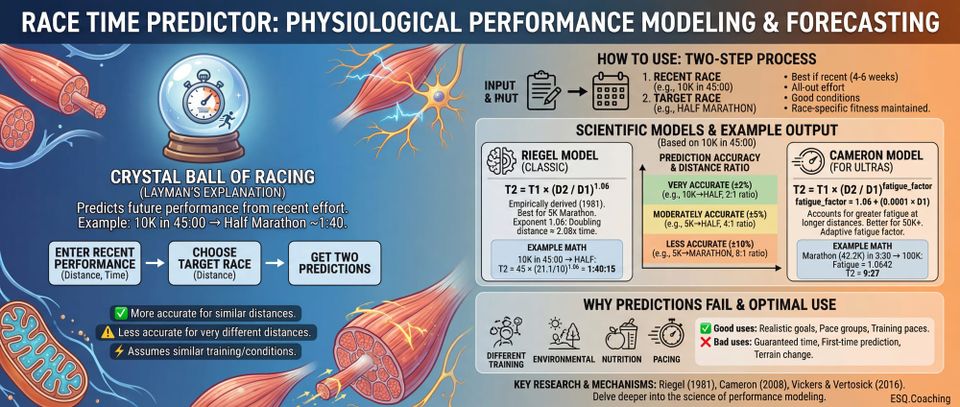
This calculator predicts your finish time for a race based on a recent performance. It's like a crystal ball for your racing:
Example:
- You ran 10K in 45:00
- The calculator predicts your half marathon time: ~1:40
It uses proven mathematical models that work for most people. However:
- ✅ More accurate for similar distances (10K → Half)
- ⚠️ Less accurate for very different distances (5K → Marathon)
- ⚡ Assumes similar training, weather, terrain
Best Results When:
- Recent race was within last 4-6 weeks
- You ran all-out effort
- Good conditions (not extreme heat/hills)
- Race-specific fitness maintained
🎯 HOW TO USE IT
- Select recent race distance (5K, 10K, Half, Marathon, or custom)
- Enter finishing time (HH:MM:SS or MM:SS)
- Select target race distance
Example
Recent: 10K in 42:00 → Marathon

Riegel:           3:05:24  (4:23/km)
Fatigue-adjusted: 3:15:07  (4:37/km)
Limitations
- No terrain, weather, or pacing adjustment
- Best for 2–3× distance extrapolation
- Marathon from 1500m = highly unreliable
🔬 Scientific Basis
Key Research:
- Riegel (1981) - "Athletic records and human endurance"
- Cameron (2008) - "Ultra-marathon running performance"
- Vickers & Vertosick (2016) - "Marathon running pace"
The Riegel Formula:
T2 = T1 × (D2 / D1)^1.06

Where:
T1 = Time for recent race
D1 = Recent distance
T2 = Predicted time
D2 = Target distance
1.06 = Fatigue exponent
Why 1.06?
- Empirically derived from thousands of race results
- Means: Doubling distance increases time by 2.08×
- Accounts for cumulative fatigue
Example Math:
10K in 45:00 → Half Marathon?

T2 = 45 minutes × (21.0975 / 10)^1.06
   = 45 × (2.10975)^1.06
   = 45 × 2.228
   = 100.3 minutes
   = 1:40:15
The Cameron Formula:
T2 = T1 × (D2 / D1)^fatigue_factor

Where:
fatigue_factor = 1.06 + (0.0001 × D1)
Why Add D1?
- Longer starting distance = more fatigue adaptation
- Marathon runners have more endurance than 5K runners
- Accounts for training specificity
Example:
Marathon (42.2K) in 3:30 → 100K?

Fatigue = 1.06 + (0.0001 × 42.2) = 1.0642

T2 = 210 min × (100 / 42.2)^1.0642
   = 210 × (2.37)^1.0642
   = 210 × 2.70
   = 567 minutes
   = 9:27
Accuracy Guidelines:
Very Accurate (±2%):
- 10K → Half Marathon (2:1 ratio)
- Half → Marathon (2:1 ratio)
- 5K → 10K (2:1 ratio)
Moderately Accurate (±5%):
- 5K → Half (4:1 ratio)
- 10K → Marathon (4:1 ratio)
Less Accurate (±10%):
- 5K → Marathon (8:1 ratio)
- Any → Ultra (>5:1 ratio)
Why Predictions Fail:
- Different Training:
- 5K training ≠ Marathon training
- Speed endurance ≠ aerobic base
- Environmental:
- Hills (marathon courses vary)
- Heat (affects longer races more)
- Wind (bigger factor at slower paces)
- Nutrition:
- 5K: No fueling needed
- Marathon: Critical success factor
- Pacing:
- Even pacing = faster times
- Most people start too fast