SWOLF Calculator
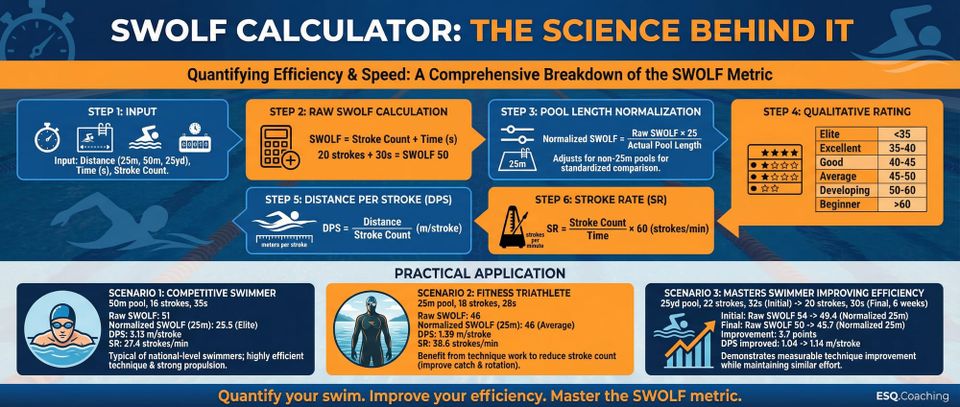
The Science Behind It
How the Calculator Works
-
Input: Distance swum (typically one pool length: 25m, 50m, or 25yd), time in seconds, and stroke count for that distance.
-
Raw SWOLF calculation: SWOLF = stroke count + time in seconds. For example: 20 strokes + 30 seconds = SWOLF 50.
-
Pool length normalization: If the pool length is not 25m, the score is proportionally adjusted to a 25m-equivalent value for standardized comparison: Normalized SWOLF = (Raw SWOLF x 25) / actual pool length.
-
Qualitative rating: The normalized SWOLF score is mapped to a performance band:
- Elite: <35
- Excellent: 35-40
- Good: 40-45
- Average: 45-50
- Developing: 50-60
- Beginner: >60
-
Distance Per Stroke (DPS): Calculated as distance / stroke count (in meters per stroke).
-
Stroke Rate (SR): Calculated as (stroke count / time) x 60 (in strokes per minute).
Practical Application
Scenario 1: Competitive swimmer (50m pool, 16 strokes, 35 seconds)
- Raw SWOLF: 51
- Normalized SWOLF (25m): 25.5 (Elite)
- DPS: 3.13 m/stroke
- SR: 27.4 strokes/min
- This profile is typical of national-level competitive swimmers with highly efficient technique and strong propulsion.
Scenario 2: Fitness triathlete (25m pool, 18 strokes, 28 seconds)
- Raw SWOLF: 46
- Normalized SWOLF (25m): 46 (Average)
- DPS: 1.39 m/stroke
- SR: 38.6 strokes/min
- This swimmer would benefit from technique work to reduce stroke count by improving catch mechanics and body rotation.
Scenario 3: Masters swimmer improving efficiency (25yd pool, 22 strokes, 32 seconds over 6 weeks -> 20 strokes, 30 seconds)
- Initial: SWOLF 54 -> 49.4 normalized (25m)
- Final: SWOLF 50 -> 45.7 normalized (25m)
- Improvement: 3.7 points
- DPS improved from 1.04 m/stroke -> 1.14 m/stroke
- This demonstrates measurable technique improvement while maintaining similar effort.
Why This Matters
Swimming efficiency is the foundation of performance improvement. Unlike cycling or running where power meters and GPS watches provide immediate feedback on intensity, swimmers have historically lacked a simple, universally accessible efficiency metric. SWOLF (Swim Golf) solves this by combining stroke count and time into a single score that reveals how efficiently you're moving through the water. Lower SWOLF scores indicate better efficiency - fewer strokes, faster swimming, or both. Every major swim watch manufacturer (Garmin, COROS, Apple Watch, Polar, Suunto) now tracks SWOLF automatically, making it the de facto standard for stroke efficiency monitoring.
Understanding your SWOLF score helps identify technical breakdowns during fatigue, track long-term efficiency gains, and optimize pacing strategies. A swimmer who can maintain a consistent SWOLF score across an entire workout has mastered the balance between speed and stroke economy.
The Research
Origins of Swim Golf. The term "Swim Golf" emerged from competitive swimming culture, drawing a parallel to golf's scoring system where lower is better. While SWOLF lacks a single founding scientific paper, the concept is grounded in two well-established biomechanical principles: stroke count as a proxy for distance per stroke (DPS), and velocity as the product of stroke rate and stroke length (Craig & Pendergast, 1979). The metric combines these into one number: SWOLF = stroke count + time in seconds (for a given distance, typically one pool length).
Distance Per Stroke (DPS). Stroke count inversely reflects distance per stroke - the fundamental measure of swimming efficiency. Elite swimmers achieve higher DPS through superior technique: better body position, effective catch mechanics, and streamlined underwater phases. Research by Costill et al. (1985) demonstrated that competitive swimmers who improved their DPS without reducing stroke rate showed corresponding improvements in swimming economy (lower oxygen cost at a given velocity). Reducing stroke count by even 1-2 strokes per length can translate to substantial energy savings over race distances.
Stroke Rate vs. Stroke Length Trade-off. The velocity equation (velocity = stroke rate x stroke length) reveals an inherent trade-off. Increasing stroke rate typically reduces stroke length, as swimmers have less time to maximize propulsion per stroke. Craig et al. (1985) found that each swimmer has an optimal stroke rate that maximizes velocity while minimizing energy expenditure. SWOLF captures this trade-off: a swimmer who increases rate but loses too much length will see their SWOLF score increase (worse), while a swimmer who maintains length while slightly increasing rate will see improvement.
Pool Length Normalization. SWOLF scores are heavily influenced by pool length. In 25m pools, swimmers benefit from more frequent wall push-offs, which provide "free" velocity and reduce stroke count per length. The same swimmer will typically score 4-8 points lower per length in a 25m pool compared to a 50m pool. Craig & Pendergast (1979) documented this effect, showing that push-off phases can contribute 15-25% of total lap velocity in short-course pools. To enable fair comparison, SWOLF must be normalized to a standard pool length, with 25m being the most common reference.
Standardization Across Devices. The proliferation of swim-tracking wearables has formalized SWOLF as a standard metric. Garmin's implementation (documented in their Connect platform since 2012) calculates SWOLF per pool length, averaged across each lap or set. COROS, Apple Watch, and Polar use identical methodologies, ensuring cross-platform consistency. This standardization has made SWOLF the swimming equivalent of running pace or cycling power - a universal language for efficiency assessment.
Limitations
-
SWOLF cannot distinguish between speed and efficiency. A SWOLF score of 45 could result from 20 strokes + 25 seconds (fast but inefficient) or 15 strokes + 30 seconds (slow but efficient). The metric provides an overall score but not diagnostic detail. Coaches should examine stroke count and time separately when analyzing technique.
-
Push-offs and underwater phases skew short-course scores. In 25m pools, strong push-offs and dolphin kicks reduce stroke count artificially, improving SWOLF without improving open-water swimming efficiency. A swimmer with a SWOLF of 35 in a 25m pool may score 42-45 in a 50m pool where push-offs contribute less to overall velocity.
-
SWOLF is stroke-specific. Butterfly, backstroke, breaststroke, and freestyle each have different typical SWOLF ranges due to biomechanical differences. Breaststroke naturally produces higher scores due to longer glide phases and lower stroke rates. Cross-stroke comparisons are not meaningful.
-
The metric does not account for effort or intensity. A swimmer can achieve an excellent SWOLF score at easy aerobic pace but see the score degrade significantly during threshold or sprint efforts as stroke mechanics break down under fatigue. SWOLF should be tracked within specific intensity zones.
-
Qualitative ratings are population-based averages. The "Elite" and "Excellent" benchmarks reflect competitive swimmer norms. A masters swimmer or triathlete with a "Good" rating may still be performing at the top of their age-group cohort.
-
Stroke count accuracy depends on manual counting or device reliability. Wrist-worn watches can miscount strokes during drills, one-arm swimming, or poor stroke technique. Manual counting is more accurate but requires concentration or a coach/partner.
-
SWOLF does not replace race pace or threshold testing. While efficiency is critical, swimming performance ultimately depends on sustainable power output and metabolic capacity. SWOLF should complement, not replace, pace-based training zones.
-
Input guardrails. Fewer than 5 strokes per 25m length triggers a warning — this is physiologically unrealistic for any stroke and likely indicates a counting error. More than 40 strokes per 25m length triggers a warning about counting method, as elite freestyle typically requires 10-14 strokes per 25m.
ℹ️ IMPORTANT DISCLAIMER
This calculator is for educational purposes only and does NOT constitute medical advice. Consult qualified professionals before making changes. Individual physiology varies. You assume all risk. Must be 18+.
References
Craig, A. B., & Pendergast, D. R. (1979). Relationships of stroke rate, distance per stroke, and velocity in competitive swimming. Medicine and Science in Sports, 11(3), 278-283.
Craig, A. B., Skehan, P. L., Pawelczyk, J. A., & Boomer, W. L. (1985). Velocity, stroke rate, and distance per stroke during elite swimming competition. Medicine and Science in Sports and Exercise, 17(6), 625-634. https://doi.org/10.1249/00005768-198512000-00001
Costill, D. L., Kovaleski, J., Porter, D., Kirwan, J., Fielding, R., & King, D. (1985). Energy expenditure during front crawl swimming: predicting success in middle-distance events. International Journal of Sports Medicine, 6(5), 266-270. https://doi.org/10.1055/s-2008-1025849
Garmin International. (2012). Garmin Connect swim metrics documentation. Retrieved from https://support.garmin.com
Maglischo, E. W. (2003). Swimming Fastest. Human Kinetics.