SWOLF Calculator
🎯 What It Does
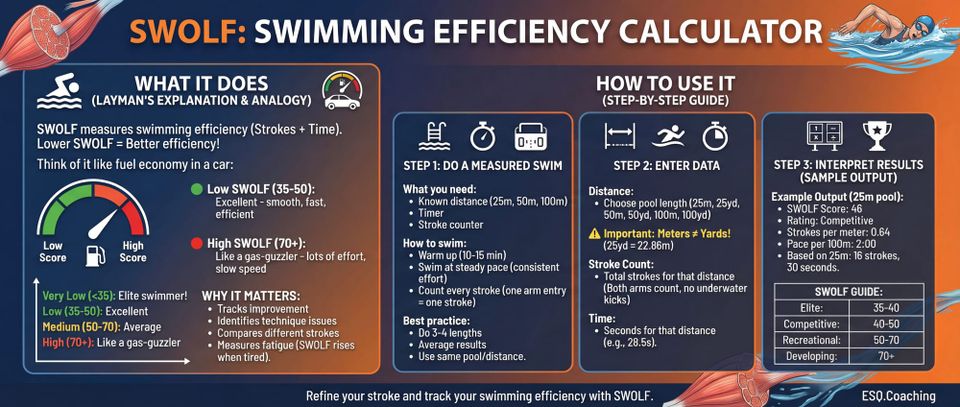
SWOLF measures your swimming efficiency - how smoothly and economically you swim. It combines:
- Strokes: How many strokes you take
- Time: How long it takes you
Lower SWOLF = Better efficiency!
Think of it like fuel economy in a car:
- High SWOLF (70+): Like a gas-guzzler - lots of effort, slow speed
- Medium SWOLF (50-70): Average efficiency
- Low SWOLF (35-50): Excellent - smooth, fast, efficient
- Very Low (<35): Elite swimmer!
Why it matters:
- Tracks improvement over time
- Identifies technique issues
- Compares different strokes
- Measures fatigue (SWOLF rises when tired)
📊 How to Use It
Step 1: Do a Measured Swim
What you need:
- Known distance (25m, 50m, or 100m)
- Timer (most watches auto-track)
- Stroke counter (count yourself or watch)
How to swim:
- Warm up first (10-15 minutes)
- Swim at steady pace (not sprinting, not super easy)
- Use consistent effort (your typical race/training pace)
- Count every stroke (one arm entry = one stroke)
Best practice:
- Do 3-4 lengths
- Average the results
- Use same pool/distance each time
Step 2: Enter Data
Distance:
- Choose pool length: 25m, 25yd, 50m, 50yd, 100m, or 100yd
- ⚠️ Important: Meters ≠ Yards!
- 25 yards = 22.86 meters
- Calculator converts correctly
Stroke Count:
- Total strokes for that distance
- Both arms count (bilateral)
- Don't count underwater dolphin kicks
Time:
- Seconds for that distance
- Example: 28.5 seconds
- Most watches show this automatically
Step 3: Interpret Results
Example Output (25m pool):
SWOLF Score: 46
Rating: Competitive

Strokes per meter: 0.64
Pace per 100m: 2:00

Based on 25 meters:
16 strokes
30 seconds

SWOLF GUIDE:
Elite: 35-40
Competitive: 40-50
Recreational: 50-70
Developing: 70+
Triathlon - From Capacity to Control (4 Weeks):
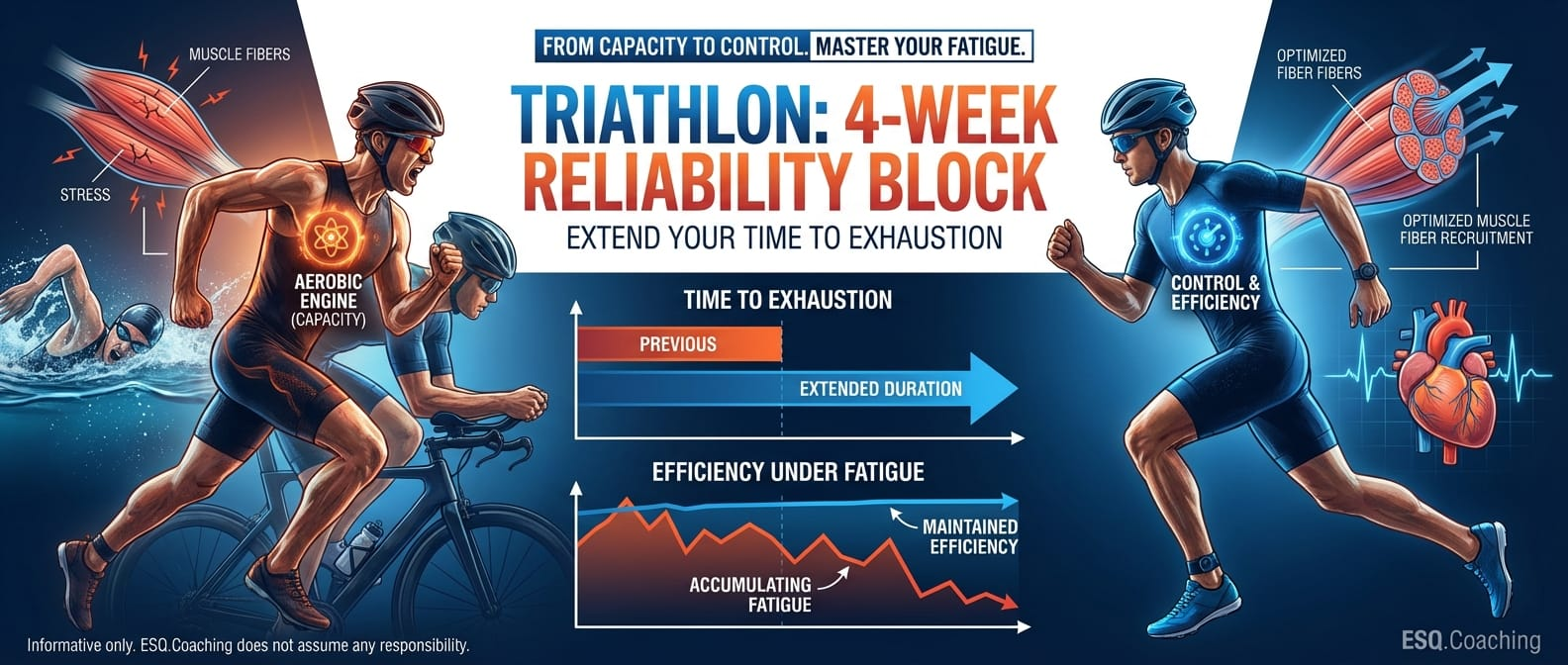
Fitness isn’t the problem. Durability is.
This 4-week triathlon block is built to improve how long you can hold quality across swim, bike, and run as fatigue accumulates. The goal is control, not maximal effort.
Use this when you feel fit, but execution falls apart late. View Plan here
What Your Score Means:
SWOLF 35-40 (Elite):
- Excellent technique
- Very efficient
- Competitive swimmer level
- Example: 14 strokes, 24 seconds
SWOLF 40-50 (Competitive):
- Good technique
- Efficient swimming
- Age-group competitive
- Example: 16 strokes, 30 seconds
SWOLF 50-70 (Recreational):
- Average efficiency
- Room for improvement
- Fitness swimmer
- Example: 20 strokes, 36 seconds
SWOLF 70+ (Developing):
- Learning technique
- Lots of wasted motion
- Focus on drills
- Example: 26 strokes, 45 seconds
How to Improve Your SWOLF:
Reduce Strokes (Better Technique):
- Longer stroke: Reach farther forward
- Better catch: "Feel" the water, don't slip
- Full extension: Finish each stroke completely
- Body rotation: Use core, not just arms
- Streamline: Reduce drag, smooth entry
Reduce Time (More Power):
- Stronger pull: More force per stroke
- Better kick: Stabilize body, add propulsion
- Faster turnover: Without shortening stroke
- Fitness: Improve conditioning
⚠️ Balance is key!
- Don't sacrifice technique for speed
- Don't swim so slow you glide forever
- Find optimal stroke rate for you
Tracking Progress:
Good tracking habits:
- Test same distance weekly
- Same pool (different pools vary!)
- Same warm-up protocol
- Track trends, not single swims
Example improvement:
Week 1: SWOLF 58 (20 strokes, 38 sec)
Week 4: SWOLF 54 (19 strokes, 35 sec) - Technique work
Week 8: SWOLF 50 (18 strokes, 32 sec) - Getting smoother
Week 12: SWOLF 46 (16 strokes, 30 sec) - Nice progress!
Advanced Usage:
Different Strokes:
- Freestyle: Lowest SWOLF (most efficient)
- Backstroke: Usually +5-10 SWOLF
- Breaststroke: Usually +15-20 SWOLF
- Butterfly: Highly variable
Different Distances:
- 25m: Easier to maintain technique
- 50m: More realistic for racing
- 100m: True endurance efficiency
Fatigue Test:
- SWOLF lap 1 vs lap 10
- Rising SWOLF = technique breakdown
- Target: <5 point increase
🔬 Scientific Basis
Key Research:
- Costill et al. (1985) - "Energy expenditure during front crawl swimming"
- Toussaint & Beek (1992) - "Biomechanics of competitive swimming"
- Kjendlie et al. (2004) - "The temporal pattern of the back crawl"
The SWOLF Formula:
SWOLF = Stroke Count + Time (seconds)

Example:
16 strokes + 30 seconds = SWOLF 46
Why This Works:
SWOLF combines two fundamental swimming metrics:
- Stroke Count = Efficiency
- Fewer strokes = longer, more effective strokes
- Indicates: Technique quality, stroke length
- Physics: Distance per stroke = 25m / strokes
- Time = Speed
- Faster time = more power output
- Indicates: Fitness, propulsion
- Physics: Velocity = distance / time
The Trade-off:
You can manipulate SWOLF artificially:
- Sprint: Fast time, many strokes (high SWOLF)
- Glide: Few strokes, slow time (high SWOLF)
- Optimal: Balance stroke length and rate (low SWOLF)
Example:
Scenario A (Sprinting):
12 strokes × 22 seconds = SWOLF 34 ✗ Not sustainable

Scenario B (Gliding):
10 strokes × 45 seconds = SWOLF 55 ✗ Too slow

Scenario C (Balanced):
14 strokes × 26 seconds = SWOLF 40 ✓ Efficient!
Strokes Per Meter:
Strokes per meter = Stroke count / Distance

Example (25m pool):
16 strokes / 25m = 0.64 strokes/meter

Conversions:
0.64 strokes/m = 1.56 meters/stroke (Distance per stroke)
Elite swimmers:
- 0.50-0.60 strokes/meter
- 1.67-2.00 meters/stroke
Recreational swimmers:
- 0.80-1.00 strokes/meter
- 1.00-1.25 meters/stroke
Pace Calculation:
Pace per 100m = (Time / Distance) × 100

Example:
(30 sec / 25m) × 100 = 120 seconds = 2:00 /100m
Energy Cost of Swimming:
Research shows:
- Energy cost ∝ Velocity³ (cubed!)
- Doubling speed = 8× energy cost
- Reducing drag = Huge energy savings
Drag reduction:
- Streamlined position: -30% drag
- Body rotation: -20% drag
- High elbow catch: -15% drag
- Result: Much lower SWOLF!
Stroke Rate vs. Stroke Length:
Optimal swimming = Balance
Velocity = Stroke Rate × Stroke Length

Example:
1.2 m/s = 0.75 strokes/sec × 1.6 m/stroke

Can achieve same speed with:
A) High rate, short stroke: 1.0 str/s × 1.2 m/str (tiring)
B) Low rate, long stroke: 0.6 str/s × 2.0 m/str (inefficient)
C) Optimal balance: 0.75 × 1.6 (best SWOLF!)
Individual Variation:
SWOLF standards vary by:
- Height: Taller swimmers = longer strokes
- Wingspan: Longer arms = lower stroke count
- Experience: Years swimming matters
- Age: Masters swimmers have higher SWOLF
- Pool: 25m vs 50m (more turns = higher SWOLF)
Using SWOLF for Training:
Technique sets:
- Swim 10×25m
- Focus: Reduce SWOLF by 2-3 points
- Method: Better streamline, catch, finish
Efficiency test:
- 400m for time
- Count strokes every 25m
- SWOLF should stay within 5 points
- If it rises >5: Technique breakdown
CSS (Critical Swim Speed) test:
- Swim 400m and 200m for time
- Calculate CSS (like FTP for swimming)
- Target SWOLF at CSS pace
- This is your "race efficiency"
Why Meters vs Yards Matters:
25 yards = 22.86 meters (10% shorter!)

Same swimmer:
16 strokes, 30 sec in 25m pool = SWOLF 46
16 strokes, 27 sec in 25yd pool = SWOLF 43

Not comparable! Always specify pool length.
Calculator accounts for this:
- Converts yards to meters
- Calculates accurate strokes/meter
- Shows pace per 100m (standard)
Disclaimer
The information provided in this newsletter is for educational purposes only and does not constitute medical advice. Exercise physiology is highly individual; what works for elite populations may not apply to everyone. Always consult with a physician before making significant changes to your training, nutrition, or supplementation protocols. The Scientist's Notebook and ESQ Coaching accept no liability for injuries or health issues arising from the application of these concepts.