Taper Advisor
🎯 What It Does
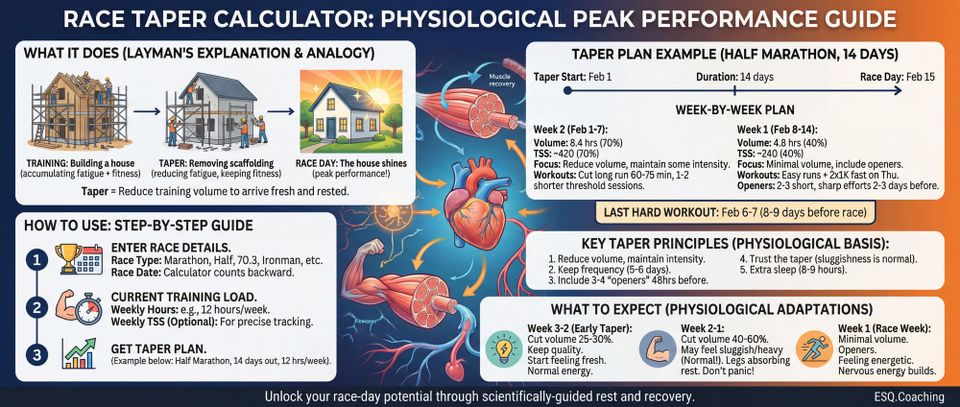
A taper is the period before a race where you reduce training to arrive fresh and rested. Think of it like:
- Training: Building a house (accumulating fatigue + fitness)
- Taper: Removing scaffolding (reducing fatigue, keeping fitness)
- Race Day: The house shines (peak performance!)
This calculator tells you exactly how to taper:
- When to start reducing volume
- How much to reduce each week
- When to do your last hard workout
- What to expect each week
📊 How to Use It
Step 1: Enter Race Details
Race Type:
- Choose from dropdown
- Examples: Marathon, Half Marathon, 70.3, Ironman, Road Race
Race Date:
- Select from calendar
- Calculator counts backwards to create your taper
Step 2: Current Training Load
Weekly Training Hours:
- Your normal training volume
- Example: 12 hours per week
- Include all sports for multisport
Weekly TSS (Optional):
- If you track TSS
- Makes recommendations more precise
Step 3: Get Your Taper Plan
Example Output (Half Marathon, 14 days out, 12 hrs/week):
TAPER PLAN FOR HALF MARATHON
─────────────────────────────
Taper starts: February 1
Race day: February 15
Duration: 14 days

WEEK-BY-WEEK PLAN:
─────────────────

Week 2 (Feb 1-7):
- Volume: 8.4 hours (70% of normal)
- TSS target: ~420 (70% of normal)
- Focus: Reduce volume, maintain some intensity
- Workouts: Cut long run to 60-75 min
- Include: 1-2 threshold sessions (shorter)

Week 1 (Feb 8-14):
- Volume: 4.8 hours (40% of normal)
- TSS target: ~240 (40% of normal)
- Focus: Minimal volume, include openers
- Workouts: Easy runs only + 2×1K fast on Thursday
- Openers: 2-3 short, sharp efforts 2-3 days before race

LAST HARD WORKOUT: Feb 6-7 (8-9 days before race)

KEY TAPER PRINCIPLES:
1. Reduce volume, maintain intensity
2. Keep frequency (still run 5-6 days)
3. Include 3-4 "openers" 48 hours before race
4. Trust the taper (feeling sluggish week 1 is normal)
5. Extra sleep: 8-9 hours per nightLong events don’t fail at the start. They fail late.
This 12-week Gran Fondo plan focuses on fatigue resistance, fueling under load, and holding power deep into long efforts. Not peak numbers, but repeatable performance when it counts.
Use this if you want to finish strong instead of just finishing. View Plan here

What to Expect Each Week:
Week 3-2 (Early Taper):
- Cut volume 25-30%
- Keep 1-2 quality sessions (shorter)
- Start feeling fresh
- Normal energy
Week 2-1:
- Cut volume 40-60%
- Might feel sluggish/heavy (NORMAL!)
- Legs "absorbing" the rest
- Don't panic!
Week 1 (Race Week):
- Minimal volume
- Openers: Short, fast efforts
- Feeling energetic, ready to race
- Nervous energy builds
🔬 Scientific Basis
Key Research:
- Mujika & Padilla (2003) - "Scientific bases for precompetition tapering"
- Bosquet et al. (2007) - "Effects of tapering on performance: meta-analysis"
- Le Meur et al. (2012) - "Evidence of neuromuscular fatigue after marathon"
The Science of Tapering:
What Happens Physiologically:
- Glycogen Supercompensation:
- Training depletes muscle glycogen
- Taper + normal eating = 20-40% more storage
- More fuel available for race
- Muscle Repair:
- Training causes micro-damage
- Taper allows complete repair
- Muscles stronger post-repair
- Neuromuscular Recovery:
- Nervous system fatigue clears
- Improved muscle recruitment
- Better coordination
- Blood Volume:
- Training = reduced plasma volume
- Taper = restored blood volume
- Better oxygen delivery
The Research Numbers:
Performance improvement from proper taper:
- 2-3% on average (huge in racing!)
- Range: 0.5% to 6% depending on sport/distance
- Example: 3:00 marathon → 2:54 with good taper
Optimal Taper Duration:
5K-10K: 7-10 days
Half Marathon: 10-14 days
Marathon: 14-21 days
70.3: 10-14 days
Ironman: 21-28 days
Volume Reduction Schedule:
Exponential Taper (Best for Most):
Week -3: 75% of normal
Week -2: 50% of normal
Week -1: 30% of normal
Linear Taper (Alternative):
Week -3: 66% of normal
Week -2: 50% of normal
Week -1: 33% of normal
Step Taper (For Short Events):
Week -2: 70% of normal
Week -1: 40% of normal (sharp drop)
What NOT to Reduce:
- Frequency: Keep running/riding most days
- 3x/week → 3x/week (just shorter)
- Maintains feel, routine
- Some Intensity: Include short efforts
- Maintains neuromuscular fitness
- Prevents feeling "flat"
- Example: 3×1K at race pace
The "Openers" Concept:
Short, intense efforts 48-72 hours before race:
- Purpose: Prime nervous system
- Examples:
- 4×100m strides
- 3×1 min at race pace
- 2×30sec all-out
- Timing: 2-3 days before race
- Recovery: Full recovery between
Common Taper Mistakes:
❌ Cutting too much too soon:
- Lose fitness rapidly
- Feel flat on race day
❌ Not tapering enough:
- Arrive tired
- Underperform
❌ Adding new workouts:
- "Testing" fitness
- Accumulating fatigue
❌ Changing diet drastically:
- GI issues
- Nutritional stress
✅ Perfect Taper:
- Progressive volume reduction
- Maintain some quality
- Trust the process
- Extra sleep
- Normal diet (maybe slightly more carbs)
The Math Behind Volume Reduction:
Target hours = Normal hours × Reduction %

Example (Marathon, Week -2):
Target = 12 hours × 0.50 = 6 hours

TSS target = Normal TSS × Reduction %
Example: 600 TSS × 0.50 = 300 TSS
Individual Variation:
Some athletes need:
- Longer taper: Masters, high training load
- Shorter taper: Young, moderate training load
- More intensity: Fast-twitch dominant
- Less intensity: Endurance specialists
Signs of Good Taper:
- Week 1: Feel normal, slight freshness
- Week 2: Might feel heavy/sluggish (NORMAL!)
- Race week: Energetic, ready, nervous
Signs of Bad Taper:
- Persistent fatigue
- Getting sick
- Feeling flat in openers
- Losing coordination
Disclaimer
The information provided in this newsletter is for educational purposes only and does not constitute medical advice. Exercise physiology is highly individual; what works for elite populations may not apply to everyone. Always consult with a physician before making significant changes to your training, nutrition, or supplementation protocols. The Scientist's Notebook and ESQ Coaching accept no liability for injuries or health issues arising from the application of these concepts.