Session Load: Quantifying Training Stress
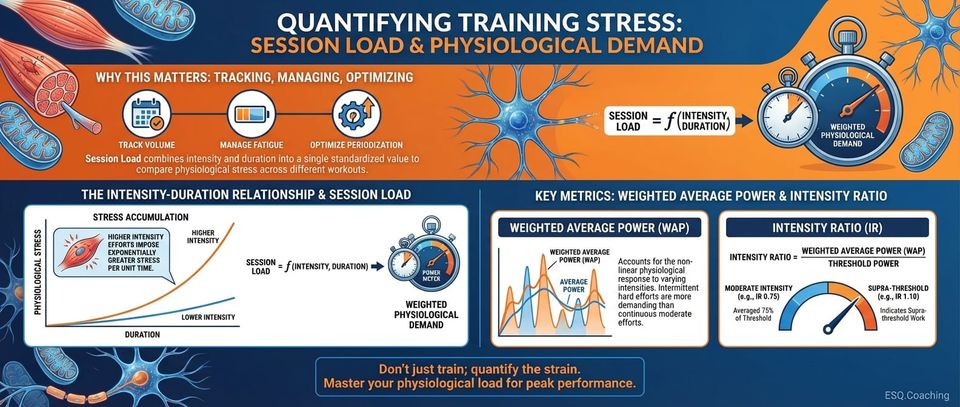
Quantifying Training Stress
Why This Matters
Session Load is a metric that quantifies the physiological stress imposed by a training session, enabling athletes to track training volume, manage fatigue, and optimize periodization. By combining exercise intensity and duration into a single value, Session Load provides a standardized way to compare sessions across different workout types and intensities.
The Research
The Intensity-Duration Relationship
Training stress is fundamentally determined by two variables:
- Intensity: How hard you work relative to your physiological ceiling
- Duration: How long you sustain that intensity
Session Load captures both dimensions by weighting time spent at each intensity level according to its physiological demand. The underlying principle is that higher-intensity efforts impose exponentially greater stress per unit time than lower-intensity work.
Weighted Average Power and Intensity Ratio
For cycling workouts, Session Load calculations use two derived metrics:
Weighted Average Power (WAP): A power-duration weighted average that accounts for the non-linear physiological response to varying intensities. WAP adjusts for the fact that intermittent hard efforts are more demanding than continuous moderate efforts of the same average power.
Intensity Ratio (IR): The ratio of Weighted Average Power to Threshold Power, representing the fractional intensity of the session relative to the athlete's sustainable ceiling.
Intensity Ratio = WAP / Threshold Power
An Intensity Ratio of 0.75 indicates the session averaged 75% of threshold intensity; an IR of 1.10 indicates supra-threshold work.
Session Load Formula
Session Load is calculated as:
Session Load = (seconds of exercise) × IR²
The squared relationship reflects the exponential increase in physiological stress as intensity rises. A session at IR = 1.0 for one hour yields a Session Load of 100, while the same duration at IR = 0.8 yields 64 (not 80), because intensity increases stress non-linearly.
For running workouts, Pace Load substitutes pace-based intensity (Pace Intensity Ratio) for power-based IR, using threshold pace as the reference anchor.
Practical Application
Training Volume Tracking
Session Load enables quantitative tracking of training volume across weeks and months. A typical week might accumulate 300–600 Session Load units, with periodization varying this range through build, peak, and taper phases.
Acute:Chronic Workload Ratio
Comparing recent training stress (acute load, typically 7 days) to longer-term baseline (chronic load, typically 28 days) identifies periods of rapid load increases, which correlate with injury risk. An acute:chronic ratio between 0.8–1.3 is generally considered safe; ratios above 1.5 indicate excessive load progression.
Session Comparison
Session Load provides a common currency for comparing workouts:
- 2-hour endurance ride at IR 0.65: ~150 Session Load
- 90-minute tempo ride at IR 0.85: ~174 Session Load
- 60-minute threshold intervals at IR 0.95: ~162 Session Load
The tempo ride, despite being shorter, imposes more stress than the endurance ride. The interval session is highest in intensity but brief enough to yield moderate total stress.
Periodization Planning
Coaches and athletes use Session Load to structure training phases:
- Base phase: High volume, low intensity (IR 0.60–0.75), weekly load 400–600
- Build phase: Moderate volume, moderate-high intensity (IR 0.75–0.90), weekly load 500–700
- Peak phase: Lower volume, high intensity (IR 0.85–1.05), weekly load 400–550
- Taper: Reduced volume maintaining intensity, weekly load 200–350
Chronic Load, Acute Load, and Form
Chronic Load
Chronic load represents long-term fitness accumulation, calculated as an exponentially weighted moving average of daily Session Load over approximately 42 days. Each day's Session Load contributes to chronic load, with recent sessions weighted more heavily than distant ones.
Interpretation: Higher chronic load indicates greater fitness and work capacity. Elite athletes often maintain chronic load values of 100–150+ during peak training blocks, while recreational athletes typically range from 40–80.
Acute Load
Acute load represents short-term fatigue, calculated as an exponentially weighted moving average over approximately 7 days. Acute load responds rapidly to recent training and decays quickly during rest.
Interpretation: High acute load indicates accumulated fatigue from recent hard training. During intense training blocks, acute load often exceeds chronic load temporarily.
Form (Fitness − Fatigue)
Form quantifies the balance between fitness and fatigue:
Form = Chronic Load − Acute Load
Interpretation:
- Negative form: Fatigue exceeds fitness (normal during training blocks; -10 to -30 is typical)
- Positive form: Fitness exceeds fatigue (indicates freshness; +5 to +25 optimal for racing)
- Form near zero: Balanced state between fitness and fatigue
Practical use: Athletes deliberately drive form negative during build phases to accumulate fitness, then taper to bring form positive for key events. A well-executed taper might shift form from -25 to +15 over 10–14 days.
Managing Chronic Load, Acute Load, and Form
Progressive overload: Gradually increase chronic load by 3–8 points per week during build phases. Rapid increases (>10 points/week) elevate injury risk.
Taper strategy: Reduce training volume (Session Load) by 40–60% while maintaining intensity. Acute load drops rapidly, chronic load declines slowly, and form rises into positive territory.
Injury prevention: Monitor acute:chronic ratio (acute load ÷ chronic load). Ratios above 1.5 indicate excessive acute load relative to chronic fitness base.
Limitations
Individual Variability
Session Load does not account for:
- Recovery capacity: Two athletes with identical Session Load values may experience different fatigue levels
- Training history: Novice athletes fatigue more rapidly at a given Session Load than experienced athletes
- External stressors: Sleep, nutrition, life stress all modulate the physiological impact of a given Session Load
Power-Based Assumptions
For cycling, Session Load assumes:
- Threshold Power is accurately determined and current
- Power meter data is accurate and calibrated
- The athlete's power-to-fatigue relationship aligns with the quadratic intensity model
For athletes with non-standard physiological profiles (e.g., highly developed anaerobic capacity), Session Load may under- or over-represent actual stress.
Metabolic Pathways
Session Load is agnostic to metabolic pathway recruitment. A 200 Session Load ride performed entirely at aerobic intensity differs physiologically from a 200 Session Load ride with significant anaerobic contributions, yet both yield the same numeric score. Athletes should supplement Session Load with qualitative training descriptors (e.g., VO2max intervals, threshold work, aerobic endurance).
ℹ️ IMPORTANT DISCLAIMER
This calculator is for educational purposes only and does NOT constitute medical advice. Consult qualified professionals before making changes. Individual physiology varies. You assume all risk. Must be 18+.
Integration with Other Metrics
Session Load is most effective when combined with complementary metrics:
- Heart rate variability (HRV): Provides autonomic recovery status
- Perceived exertion (RPE): Subjective fatigue assessment
- Performance markers: Power at threshold, VO2max testing results
- Sleep quality: Recovery adequacy indicator
- Resting heart rate: Overtraining/illness early warning
References
- Coggan AR. Training and racing using a power meter: an introduction. Cycling Performance Tips 2003.
- Allen H, Coggan AR. Training and Racing with a Power Meter. VeloPress, 2010.
- Gabbett TJ. The training-injury prevention paradox: should athletes be training smarter and harder? Br J Sports Med 2016;50:273-280.
- Blanch P, Gabbett TJ. Has the athlete trained enough to return to play safely? The acute:chronic workload ratio permits clinicians to quantify a player's risk of subsequent injury. Br J Sports Med 2016;50:471-475.
- Sanders D, Heijboer M. Physical demands and power profile of different stage types within a cycling grand tour. Eur J Sport Sci 2019;19(6):736-744.
- Wallace LK, Slattery KM, Coutts AJ. The ecological validity and application of the session-RPE method for quantifying training loads in swimming. J Strength Cond Res 2009;23(1):33-38.
Calculator Reference
Use the Session Load Calculator to compute Session Load, Intensity Ratio, and Weighted Average Power for individual workouts. Input average power, Threshold Power, and duration to receive comprehensive training stress metrics including chronic load, acute load, and form tracking.
This article is for educational purposes and does not constitute medical or coaching advice. Consult qualified professionals before modifying training programs.