Training Zones
Understanding Training Zones
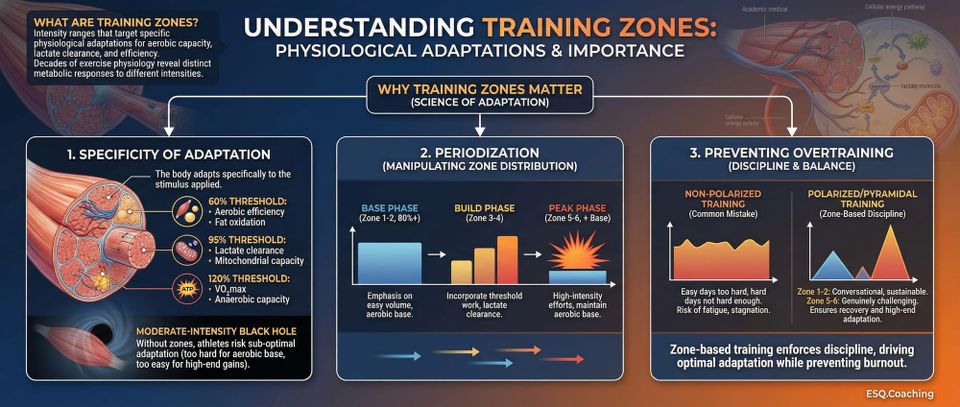
Training zones are intensity ranges that target specific physiological adaptations. Training at different intensities builds aerobic capacity, lactate clearance, neuromuscular power, and efficiency.
The science of training zones emerged from decades of exercise physiology research, revealing that different exercise intensities trigger distinct metabolic and cardiovascular responses. Training exclusively at moderate intensity produces suboptimal adaptations compared to polarized or pyramidal intensity distributions that incorporate easy, threshold, and high-intensity work.
Why Training Zones Matter
Specificity of Adaptation:
The body adapts specifically to the stimulus applied. Training at 60% of threshold primarily develops aerobic efficiency and fat oxidation. Training at 95% of threshold enhances lactate clearance and mitochondrial capacity. Training at 120% develops VO₂max and anaerobic capacity. Without structured zones, athletes risk training in a "moderate-intensity black hole" that's too hard to build aerobic base and too easy to drive high-end adaptations.
Periodization:
Effective training programs manipulate zone distribution across training phases. Base periods emphasize Zone 1-2 work (80%+ of training time). Build phases incorporate more Zone 3-4 threshold work. Peak phases include high-intensity Zone 5-6 efforts while maintaining aerobic base.
Preventing Overtraining:
Well-defined zones prevent the common mistake of making easy days too hard and hard days not hard enough. Zone-based training enforces discipline: Zone 1-2 work must remain conversational and sustainable, while Zone 5-6 work must be genuinely challenging.
Zone Models Available
This calculator offers multiple validated zone models, each with distinct philosophical and scientific foundations:
Cycling Zones: Coggan Model (7 Zones)
The Coggan zone system, popularized by Dr. Andrew Coggan and Hunter Allen, divides power-based training into seven zones anchored to Threshold Power (TP) or Critical Power (CP). This model is the gold standard in cycling coaching.
Zone 1 - Active Recovery (< 55% TP)
- Purpose: Recovery between hard efforts, active rest days
- Physiology: Minimal cardiovascular stress, promotes blood flow for recovery
- Duration: 15-90 minutes
- Perceived exertion: Very easy, conversational
- Adaptations: Recovery enhancement, aerobic efficiency at lowest intensities
Zone 2 - Endurance (55-75% TP)
- Purpose: Aerobic base building, long rides, fat oxidation development
- Physiology: Predominantly fat metabolism, low lactate production, high mitochondrial stimulus
- Duration: 2-6+ hours
- Perceived exertion: Easy, can maintain conversation
- Adaptations: Mitochondrial biogenesis, capillary density, fat oxidation, aerobic efficiency
Zone 3 - Tempo (76-90% TP)
- Purpose: Extended moderate-intensity efforts, gran fondo pace
- Physiology: Mixed fat/carbohydrate metabolism, moderate lactate production
- Duration: 20-90 minutes
- Perceived exertion: Moderate effort, conversation becomes difficult
- Adaptations: Lactate clearance capacity, muscular endurance, economy
Zone 4 - Lactate Threshold (91-105% TP)
- Purpose: Threshold development, time trial pace, sustained climbing
- Physiology: Near-maximum lactate steady state, high carbohydrate flux
- Duration: 8-30 minutes per interval
- Perceived exertion: Hard, focused effort required
- Adaptations: Lactate threshold increase, buffering capacity, threshold power/pace improvement
Zone 5 - VO₂max (106-120% TP)
- Purpose: Maximum aerobic power development, VO₂max improvement
- Physiology: Near-maximal oxygen uptake, significant lactate accumulation
- Duration: 3-8 minutes per interval
- Perceived exertion: Very hard, conversation impossible
- Adaptations: VO₂max increase, cardiac output, stroke volume, oxygen extraction
Zone 6 - Anaerobic Capacity (121-150% TP)
- Purpose: Anaerobic power, ability to repeat hard efforts
- Physiology: Glycolytic energy system dominance, severe lactate accumulation
- Duration: 30 seconds to 3 minutes
- Perceived exertion: Extremely hard, maximal sustainable effort
- Adaptations: Anaerobic capacity, buffering, glycolytic enzyme activity
Zone 7 - Neuromuscular Power (> 150% TP)
- Purpose: Sprint power, neuromuscular recruitment, explosive efforts
- Physiology: ATP-PCr system, maximal power output
- Duration: < 30 seconds
- Perceived exertion: All-out maximal effort
- Adaptations: Neuromuscular power, fast-twitch fiber recruitment, peak power
Running Zones: Daniels Model (5 Zones)
Dr. Jack Daniels' zone system, detailed in "Daniels' Running Formula," anchors zones to vVO₂max (velocity at VO₂max) or race-derived VDOT scores. This model emphasizes race-specific pacing and has guided countless runners to personal bests.
Zone 1 - Easy (< 76% vVO₂max)
- Purpose: Recovery runs, easy long runs, base building
- Physiology: Aerobic metabolism, minimal stress, promotes recovery
- Duration: 30-120+ minutes
- Pace: Conversational, typically 60-90 seconds per mile slower than threshold
- Adaptations: Aerobic development, mitochondrial density, running economy
Zone 2 - Marathon (76-85% vVO₂max)
- Purpose: Marathon race pace, long tempo runs
- Physiology: Predominantly aerobic, sustainable carbohydrate metabolism
- Duration: 40-180 minutes
- Pace: Comfortably hard, controlled breathing
- Adaptations: Lactate clearance, fuel economy, marathon-specific endurance
Zone 3 - Threshold (86-92% vVO₂max)
- Purpose: Lactate threshold development, tempo runs, half-marathon pace
- Physiology: Maximum lactate steady state, high aerobic metabolism
- Duration: 20-60 minutes total (intervals or continuous)
- Pace: Hard but controlled, 15-30 seconds per mile slower than 10K pace
- Adaptations: Lactate threshold velocity increase, buffering capacity
Zone 4 - Interval (93-100% vVO₂max)
- Purpose: VO₂max development, 3K-5K race pace
- Physiology: Near-maximal oxygen uptake, accumulating lactate
- Duration: 3-5 minutes per interval, typically 5-8 intervals
- Pace: Hard, focused effort, ~10K to 5K pace
- Adaptations: VO₂max improvement, running economy at high speeds
Zone 5 - Repetition (> 100% vVO₂max)
- Purpose: Speed development, running economy, anaerobic capacity
- Physiology: Anaerobic contribution significant, neuromuscular development
- Duration: 30 seconds to 2 minutes per repetition
- Pace: Fast, 1500m to 3000m race pace
- Adaptations: Speed, anaerobic power, economy, leg turnover
Polarized Training: Seiler Model (3 Zones)
Dr. Stephen Seiler's research on elite endurance athletes revealed a consistent pattern: approximately 80% of training at low intensity, minimal time at moderate intensity, and 15-20% at high intensity. This polarized distribution optimizes the stimulus-recovery balance.
Zone 1 - Low Intensity (< ~82% of threshold heart rate or < 2 mmol/L lactate)
- Purpose: Build aerobic base without accumulating fatigue
- Physiology: Fully aerobic, low stress, high sustainability
- Duration: Majority of training volume (80%+)
- Perceived exertion: Easy, conversational
- Adaptations: Mitochondrial volume, capillarization, fat oxidation, aerobic enzymes
Zone 2 - Moderate Intensity (82-87% threshold HR or 2-4 mmol/L lactate)
- Purpose: Minimal time spent here - the "black hole" to avoid
- Physiology: Mixed metabolism, moderate stress
- Duration: < 5-10% of training time
- Perceived exertion: Moderate, neither easy nor hard
- Adaptations: Limited specific adaptations, high fatigue cost
Zone 3 - High Intensity (> 87% threshold HR or > 4 mmol/L lactate)
- Purpose: High-intensity interval training, race pace work
- Physiology: Lactate accumulation, high cardiovascular stress
- Duration: 15-20% of training time (including recoveries)
- Perceived exertion: Hard to very hard
- Adaptations: VO₂max, lactate threshold, economy, buffering capacity
Swimming Zones (5 Zones)
Swimming zones follow similar physiological principles but account for the unique demands of aquatic exercise: horizontal body position, pressure on the chest wall, and technical efficiency's dominant role.
Zone 1 - Recovery (< 65% CSS)
- Purpose: Warm-up, cool-down, recovery between sets
- Intensity: Very easy, focus on technique
- Duration: 100-800m segments
- Stroke count: Low, relaxed
- Adaptations: Technical refinement, active recovery
Zone 2 - Aerobic Endurance (65-80% CSS)
- Purpose: Base aerobic development, long continuous swimming
- Intensity: Comfortable, sustainable for extended periods
- Duration: 400-3000m segments
- Stroke count: Moderate, efficient
- Adaptations: Aerobic capacity, swimming economy, endurance
Zone 3 - Threshold (80-90% CSS)
- Purpose: Lactate threshold development, race pace for distance events
- Intensity: Moderately hard, controlled breathing pattern
- Duration: 100-400m repeats
- Stroke count: Elevated but controlled
- Adaptations: Lactate clearance, threshold pace, muscular endurance
Zone 4 - VO₂max (90-95% CSS)
- Purpose: Maximum aerobic power, 200-400m race pace
- Intensity: Hard, near-maximal effort
- Duration: 50-200m repeats with rest intervals
- Stroke count: High, maintaining technique under fatigue
- Adaptations: VO₂max, cardiac output, high-intensity tolerance
Zone 5 - Speed (> 95% CSS)
- Purpose: Sprint speed, starts, turns, race-specific intensity
- Intensity: Maximal or near-maximal
- Duration: 12.5-50m repeats with full recovery
- Stroke count: Maximal while maintaining technique
- Adaptations: Power, speed, neuromuscular recruitment, technique under stress
Determining Your Threshold Values
Accurate zone prescription requires valid threshold testing. Each sport offers multiple testing protocols:
Cycling Threshold Testing
20-Minute Field Test (Most Common):
- Warm-up: 15-20 minutes progressive, including 2-3 × 1-minute efforts
- Rest: 5 minutes easy spinning
- Test: 20 minutes all-out maximal sustainable effort
- Threshold Power estimate: Average power × 0.95
Ramp Test (Indoor Trainers):
- Progressive increase in power every minute until failure
- Threshold Power = 75% of maximum 1-minute power achieved
Critical Power Test (Most Accurate):
- Two maximal efforts: 5 minutes and 20 minutes
- Mathematical calculation yields CP (see Critical Power Calculator)
- Threshold Power ≈ CP for most athletes
Laboratory Testing:
- Lactate threshold testing (gold standard)
- Threshold Power = power at 4 mmol/L lactate (varies individually)
Running Threshold Testing
Jack Daniels VDOT:
- Input recent race time (5K, 10K, half-marathon, marathon)
- Calculator estimates vVO₂max and threshold pace
- Most accessible method for runners with race data
30-Minute Time Trial:
- Warm-up: 15 minutes easy plus strides
- Test: 30 minutes maximal effort on flat course/track
- Threshold pace = average pace for the 30 minutes
- vVO₂max = threshold pace × 1.08-1.10
Critical Velocity Test:
- Two maximal efforts: 3-4 minutes and 12-15 minutes
- Mathematical calculation yields CV (see Critical Power Calculator)
Laboratory Testing:
- VO₂max test with lactate sampling
- Threshold = velocity at lactate threshold (~4 mmol/L)
Swimming Threshold Testing
Critical Swim Speed (CSS) Test:
- Warm-up: 400-800m progressive
- Test 1: 400m all-out maximal, record time
- Recovery: 15-20 minutes easy
- Test 2: 200m all-out maximal, record time
- CSS = (400-200) / (T400 - T200)
T-30 Test:
- 30-minute continuous maximal effort
- CSS = total distance / 30 minutes
- Simple but requires excellent pacing
Lactate Testing:
- Progressive step test with lactate measurement
- CSS = pace at lactate threshold
Heart Rate Zones
While power and pace provide objective intensity metrics, heart rate remains widely used and valuable when power/pace data is unavailable or for cross-training activities.
Heart Rate Zone Calculation Methods
Percentage of Threshold Heart Rate (Recommended):
- Zones calculated as % of LTHR (lactate threshold heart rate)
- Most accurate for training zone prescription
- Example: Zone 2 = 70-83% LTHR
Percentage of Maximum Heart Rate:
- Zones calculated as % of HRmax
- Less accurate due to individual variation in HRmax relative to threshold
- Still useful when LTHR is unknown
Heart Rate Reserve (Karvonen Method):
- Zones = ((HRmax - HRrest) × intensity) + HRrest
- Accounts for resting heart rate
- Slightly more individualized than %HRmax
Heart Rate Limitations
Cardiac Drift:
During prolonged exercise, heart rate rises even at constant power/pace due to dehydration, heat stress, and fatigue. A 60-minute Zone 2 ride may start at 130 bpm but finish at 145 bpm despite constant power.
Lag Time:
Heart rate responds slowly to intensity changes. At the start of an interval, power/pace may be in Zone 5 while heart rate remains in Zone 3 for 30-90 seconds.
Individual Variation:
Two athletes with identical Threshold Power may have vastly different heart rate responses. One may reach threshold at 155 bpm, another at 185 bpm.
Environmental Sensitivity:
Heat, altitude, humidity, and caffeine all affect heart rate independent of physiological stress. Power and pace remain more stable.
Best Practice:
Use heart rate as secondary verification, but prioritize power (cycling) or pace (running/swimming) for precise zone adherence.
Training Zone Distribution Strategies
Polarized Training (80/20 Model)
Distribution:
- 80% Zone 1-2 (easy, aerobic)
- < 5% Zone 3 (moderate)
- 15-20% Zone 4-5+ (hard, high-intensity)
Rationale:
Elite endurance athletes consistently follow this pattern. Low-intensity volume builds aerobic foundation without excessive fatigue. High-intensity work drives VO₂max and threshold adaptations. Avoiding the moderate "Zone 3 black hole" optimizes stimulus-recovery balance.
Example Weekly Structure (Cycling):
- Monday: 90 min Zone 1-2
- Tuesday: 60 min Zone 1-2 + 4 × 5 min Zone 5 (15 min easy recovery between)
- Wednesday: 60 min Zone 1 recovery
- Thursday: 90 min Zone 1-2
- Friday: Rest or 45 min Zone 1
- Saturday: 3-4 hour Zone 1-2 endurance ride
- Sunday: 90 min Zone 1-2 + 3 × 10 min Zone 4
Total: ~12-14 hours, with ~10-11 hours easy, 1.5-2 hours hard
Pyramidal Training
Distribution:
- 70-75% Zone 1-2 (easy)
- 15-20% Zone 3 (moderate/tempo)
- 10% Zone 4-5+ (hard)
Rationale:
Incorporates more threshold and tempo work than polarized training. May suit athletes who respond well to sustained threshold efforts or who race at sustained threshold intensities (time trials, half-marathons).
Example Weekly Structure (Running):
- Monday: Rest
- Tuesday: 60 min easy (Zone 1)
- Wednesday: 45 min with 20 min tempo (Zone 3)
- Thursday: 60 min easy (Zone 1)
- Friday: Track workout: 6 × 1000m Zone 4, 2-3 min recovery
- Saturday: 90 min easy (Zone 1)
- Sunday: 120 min long run (Zone 1-2)
Total: ~8 hours, with ~5.5 hours easy, 1.5 hours moderate, 1 hour hard
Threshold-Based Training
Distribution:
- 65-70% Zone 1-2 (easy)
- 25-30% Zone 3-4 (moderate to threshold)
- 5% Zone 5+ (VO₂max and above)
Rationale:
Emphasizes threshold development. Suitable during build phases preparing for threshold-dominant events (40K time trial, half-marathon). Higher fatigue cost requires careful recovery management.
Example Weekly Structure (Cycling):
- Monday: Rest
- Tuesday: 90 min Zone 1-2 + 3 × 15 min Zone 4
- Wednesday: 60 min Zone 1
- Thursday: 90 min Zone 1-2 + 2 × 20 min Zone 3-4
- Friday: 45 min Zone 1
- Saturday: 120 min with 60 min Zone 3
- Sunday: 180 min Zone 1-2
Total: ~10 hours, with ~6.5 hours easy, 3+ hours moderate-threshold, minimal VO₂max work
Base Period (Off-Season)
Distribution:
- 90-95% Zone 1-2
- 5-10% Zone 3
- Minimal Zone 4+
Purpose:
Build aerobic foundation, allow mental/physical recovery, develop fat oxidation, increase training volume tolerance.
Duration: 8-16 weeks
Build Period (Pre-Competition)
Distribution:
- 75-80% Zone 1-2
- 10-15% Zone 3-4 (threshold work)
- 5-10% Zone 5+ (VO₂max intervals)
Purpose:
Develop race-specific fitness, increase threshold power/pace, build VO₂max, maintain aerobic base.
Duration: 6-12 weeks
Peak/Taper Period
Distribution:
- 70-80% Zone 1-2
- 5-10% Zone 3-4
- 10-15% Zone 5-7 (high-intensity, low-volume)
Purpose:
Sharpen race readiness, reduce volume, maintain intensity, optimize recovery.
Duration: 1-3 weeks before key events
Sport-Specific Zone Applications
Cycling: Power-Based Training
Why Power is Optimal:
Power is instantaneous, objective, and unaffected by environmental factors (unlike heart rate or perceived exertion). A watt is a watt whether climbing in heat or descending in rain.
Zone 2 Endurance Rides:
- 2-6 hour rides at 55-75% TP
- Primary adaptation: mitochondrial biogenesis, fat oxidation
- Key: discipline to stay in zone (common error: riding too hard)
Sweet-Spot Training (Zone 3-4 overlap, 88-94% TP):
- Maximizes training stress while maintaining sustainability
- Typical session: 2-3 × 20 minutes at 90% TP
- Highly effective for Threshold Power improvement
VO₂max Intervals (Zone 5):
- 4-6 × 5 minutes at 110-120% TP, 5 min recovery
- Drives VO₂max and aerobic power
- Perform 1-2 times per week during build phase
Running: Pace and Heart Rate
Zone 1 Easy Runs:
- Majority of training volume
- Conversational pace, typically 60-90 sec/mile slower than threshold
- Duration: 30-120+ minutes
- Adaptation: aerobic base, running economy, injury prevention
Threshold Runs (Zone 3):
- Continuous tempo: 20-40 minutes at threshold pace
- Cruise intervals: 3-4 × 8-10 minutes at threshold, 2-3 min jog recovery
- Adaptation: lactate threshold increase
Interval Training (Zone 4-5):
- 5-6 × 1000m at 5K pace, 2-3 min recovery (Zone 4)
- 8-10 × 400m at 1500m pace, 90 sec recovery (Zone 5)
- Adaptation: VO₂max, speed endurance
Swimming: CSS and Pace
Aerobic Endurance Sets (Zone 2):
- 10 × 200m at 70-75% CSS on short rest (15-20 sec)
- 3-4 × 800m at 75-80% CSS on 20-30 sec rest
- Adaptation: aerobic capacity, efficiency
Threshold Sets (Zone 3):
- 8-12 × 100m at 85% CSS on 10-15 sec rest
- 5 × 300m at 85-90% CSS on 30 sec rest
- Adaptation: lactate tolerance, threshold pace
VO₂max Sets (Zone 4-5):
- 10-15 × 50m at 95%+ CSS on 15-20 sec rest
- 6-8 × 100m at 92-95% CSS on 20-30 sec rest
- Adaptation: high-end speed, anaerobic capacity
Common Training Zone Mistakes
The Moderate Intensity "Black Hole"
The Problem:
Athletes spend excessive time in Zone 3 (moderate intensity): too hard to build aerobic base efficiently, too easy to drive high-end adaptations.
Why It Happens:
- Group rides naturally drift to Zone 3 pace
- "Comfortably hard" feels productive
- Easy days become too hard, hard days insufficiently intense
The Solution:
Enforce strict discipline: make easy days truly easy (Zone 1-2, conversational), and hard days genuinely hard (Zone 4-5, focused efforts).
Ignoring Recovery
The Problem:
Consecutive hard days without adequate recovery lead to accumulated fatigue, decreased adaptation, and overtraining risk.
Best Practice:
Follow hard days with easy/recovery days. Typical pattern: 2-3 hard days per week separated by easy days.
Excessive High-Intensity Volume
The Problem:
More Zone 5-6 work doesn't equal better results. Excessive high-intensity volume increases injury and overtraining risk while limiting aerobic base development.
Best Practice:
High-intensity work should comprise 10-20% of total training time. Focus on quality over quantity.
Neglecting Zone 1-2 Base
The Problem:
Insufficient low-intensity volume limits mitochondrial development, capillary density, and fat oxidation capacity - the foundation of endurance performance.
Best Practice:
Base period: 90%+ Zone 1-2. Build/peak: still 70-80% Zone 1-2.
Misinterpreting Heart Rate Zones
The Problem:
Using generic %HRmax zones or outdated threshold heart rate values leads to incorrect intensity prescription.
Best Practice:
Test threshold heart rate every 6-8 weeks. Use power/pace as primary metric, heart rate as secondary verification.
Individual Responses and Customization
Fiber Type Influence
Athletes with predominantly slow-twitch (Type I) fibers often:
- Excel at Zone 1-2 training
- Recover quickly from easy training
- Benefit from high volume
- May need more high-intensity work to develop top-end
Athletes with predominantly fast-twitch (Type II) fibers often:
- Respond well to high-intensity training
- Fatigue more from extensive Zone 1-2 work
- Benefit from lower volume, higher intensity
- May need more aerobic base work to balance
Training Age and Experience
Novice Athletes (< 1 year consistent training):
- Focus heavily on Zone 1-2 (80-90% of training)
- Minimize high-intensity work (5-10%)
- Build general aerobic fitness and movement patterns
Intermediate Athletes (1-3 years):
- Polarized or pyramidal distribution
- Introduce structured interval training
- Begin periodization (base-build-peak cycles)
Advanced Athletes (3+ years):
- Highly individualized distribution based on response
- Fine-tuning of zone boundaries
- Micro-periodization and advanced training strategies
Age Considerations
Masters Athletes (40+ years):
- Recovery capacity decreases with age
- May benefit from more polarized distribution (avoid moderate zone stress)
- Maintain intensity for VO₂max preservation
- Increase recovery time between hard sessions
Monitoring and Adjusting Zones
When to Retest
- Every 6-8 weeks during base training
- Every 4-6 weeks during build phase
- After significant training block completion
- Following illness or injury with extended time off
- When perceived exertion at given zones feels significantly different
Signs Your Zones Need Updating
Zones Too Easy:
- Heart rate lower than expected for given power/pace
- Perceived exertion lower than typical
- Recovery faster than normal
- Threshold efforts feel comfortable
Zones Too Hard:
- Unable to complete prescribed intervals
- Heart rate higher than expected
- Excessive fatigue
- Performance declining despite adherence to plan
Training Load Monitoring
Beyond zones, monitor overall training stress:
Weekly Training Load:
Calculate total Session Load for the week. Typical ranges:
- Recreational: 200-400 Session Load/week
- Trained: 400-700 Session Load/week
- Elite: 700-1200+ Session Load/week
Acute:Chronic Workload Ratio:
- Acute load: Average training load last 7 days
- Chronic load: Average training load last 28 days
- Optimal ratio: 0.8-1.3
- Injury risk increases when > 1.5 (too rapid load increase)
Integrating Zones with Periodization
Classic Periodization
Base Phase (8-16 weeks):
- Volume emphasis: 90%+ Zone 1-2
- Minimal intensity: occasional Zone 3 tempo
- Goal: Build aerobic foundation
Build Phase (6-12 weeks):
- Introduce threshold work: 10-15% Zone 3-4
- Add VO₂max intervals: 5-10% Zone 5
- Maintain aerobic base: 75-80% Zone 1-2
Peak Phase (3-6 weeks):
- Maintain intensity, reduce volume
- Race-specific work: Zone 4-5 at race intensities
- Easy aerobic work: Zone 1-2
Taper (1-3 weeks):
- Volume reduction: 40-60% of peak week
- Intensity maintenance: short Zone 5-6 efforts
- Recovery emphasis: Zone 1
Block Periodization
Concentrated blocks of specific training focus:
Accumulation Block (3 weeks):
- High volume Zone 1-2
- Minimal intensity
- Build aerobic capacity
Intensification Block (2 weeks):
- Reduce volume
- High percentage Zone 4-5
- Develop race-specific intensity
Realization Block (1-2 weeks):
- Low volume
- Race-specific intensity
- Taper and compete
Advanced Zone Concepts
Fractional Utilization
Elite athletes sustain higher percentages of threshold for given durations:
- Recreational: might sustain 90% TP for 60 minutes
- Elite: might sustain 98-100% TP for 60 minutes
This improves with training and dictates race pacing strategy.
Durability
Modern research emphasizes "durability" - the ability to maintain threshold power/pace when fatigued (after high volume or in hot conditions). Zone 2 endurance work, especially when fatigued, develops durability.
Decoupling
As aerobic fitness improves, the relationship between heart rate and power/pace at Zone 2 intensities stabilizes. "Decoupling" (heart rate rising >5% while power/pace stays constant) suggests insufficient aerobic fitness or accumulated fatigue.
Practical Workout Examples
Cycling: Sweet-Spot Intervals
Warm-up: 20 min Zone 1-2
Main Set: 3 × 20 min @ 90% TP (Zone 3-4 border), 5 min Zone 1 recovery
Cool-down: 15 min Zone 1
Running: VO₂max Intervals
Warm-up: 15 min easy + 4 strides
Main Set: 5 × 1000m @ Zone 4 (5K pace), 3 min jog recovery
Cool-down: 10 min easy
Swimming: Threshold Set
Warm-up: 400m easy
Main Set: 8 × 100m @ 85% CSS (Zone 3), 15 sec rest
Cool-down: 200m easy
Polarized Cycling Week
- Mon: Rest
- Tue: 90 min Zone 1-2
- Wed: 60 min Zone 1-2 + 4 × 5 min Zone 5
- Thu: 90 min Zone 1-2
- Fri: 45 min Zone 1
- Sat: 4 hour Zone 1-2 endurance ride
- Sun: 90 min Zone 1-2 + 3 × 10 min Zone 4
Conclusion
Training zones provide structure and precision to endurance training. Distributing training across intensity zones optimizes the stimulus-recovery balance, targets specific physiological adaptations, and avoids the pitfall of unstructured "moderate-intensity" training.
The key principles:
- Make easy days truly easy (Zone 1-2, conversational)
- Make hard days genuinely hard (Zone 4-5+, focused quality)
- Avoid excessive moderate-intensity (Zone 3 black hole)
- Prioritize aerobic base (70-90% Zone 1-2 across training year)
- Retest regularly (every 6-8 weeks to update zones)
- Individualize distribution (based on response, goals, training age)
Polarized, pyramidal, or threshold-based distribution all share the same goal: apply the right stimulus at the right time to drive adaptation without exceeding recovery capacity.
This calculator offers multiple validated zone models (Coggan, Daniels, Seiler, swimming-specific) to accommodate different sports, preferences, and coaching philosophies. Select the model aligned with your sport and training approach, test your threshold accurately, and apply the zones with discipline and consistency.
⚠️ HEALTH & SAFETY WARNING
This calculator involves training modifications that can affect your health and performance if misapplied. Consult qualified professionals before making changes.
Medical consultation required if: You have underlying health conditions, are taking medications, pregnant/nursing, under 18, or experience adverse symptoms during training.
ℹ️ IMPORTANT DISCLAIMER
This calculator is for educational purposes only and does NOT constitute medical advice. Consult qualified professionals before making changes. Individual physiology varies. You assume all risk. Must be 18+.
References and Further Reading
-
Coggan, A. R., & Allen, H. (2010). Training and Racing with a Power Meter (2nd ed.). VeloPress.
-
Daniels, J. (2013). Daniels' Running Formula (3rd ed.). Human Kinetics.
-
Seiler, S., & Tønnessen, E. (2009). Intervals, thresholds, and long slow distance: the role of intensity and duration in endurance training. Sportscience, 13, 32-53.
-
Stöggl, T. L., & Sperlich, B. (2015). The training intensity distribution among well-trained and elite endurance athletes. Frontiers in Physiology, 6, 295.
-
Laursen, P. B., & Jenkins, D. G. (2002). The scientific basis for high-intensity interval training: optimising training programmes and maximising performance in highly trained endurance athletes. Sports Medicine, 32(1), 53-73.
-
Billat, V. L. (2001). Interval training for performance: a scientific and empirical practice. Sports Medicine, 31(1), 13-31.
-
Esteve-Lanao, J., San Juan, A. F., Earnest, C. P., Foster, C., & Lucia, A. (2005). How do endurance runners actually train? Relationship with competition performance. Medicine & Science in Sports & Exercise, 37(3), 496-504.
-
Hydren, J. R., & Cohen, B. S. (2015). Current scientific evidence for a polarized cardiovascular endurance training model. Journal of Strength and Conditioning Research, 29(12), 3523-3530.
-
Buchheit, M., & Laursen, P. B. (2013). High-intensity interval training, solutions to the programming puzzle. Sports Medicine, 43(5), 313-338.
-
Seiler, K. S. (2010). What is best practice for training intensity and duration distribution in endurance athletes? International Journal of Sports Physiology and Performance, 5(3), 276-291.
-
Zapico, A. G., Calderón, F. J., Benito, P. J., González, C. B., Parisi, A., Pigozzi, F., & Di Salvo, V. (2007). Evolution of physiological and haematological parameters with training load in elite male road cyclists: a longitudinal study. Journal of Sports Medicine and Physical Fitness, 47(2), 191-196.
-
Muñoz, I., Seiler, S., Bautista, J., España, J., Larumbe, E., & Esteve-Lanao, J. (2014). Does polarized training improve performance in recreational runners? International Journal of Sports Physiology and Performance, 9(2), 265-272.
Validation Note: This calculator implements zone models validated in peer-reviewed literature and widely used in coaching practice. The Coggan power zones follow the framework established in Training and Racing with a Power Meter (Coggan & Allen, 2010). The Daniels running zones derive from Daniels' Running Formula (Daniels, 2013) and VDOT methodology. The Seiler polarized zones reflect research on elite endurance athletes' training intensity distribution (Seiler & Tønnessen, 2009; Stöggl & Sperlich, 2015). Swimming zones follow established lactate threshold and CSS-based frameworks used in competitive swimming. All calculations use scientifically grounded percentages of threshold values.