Vo2 Max Calculator
Introduction
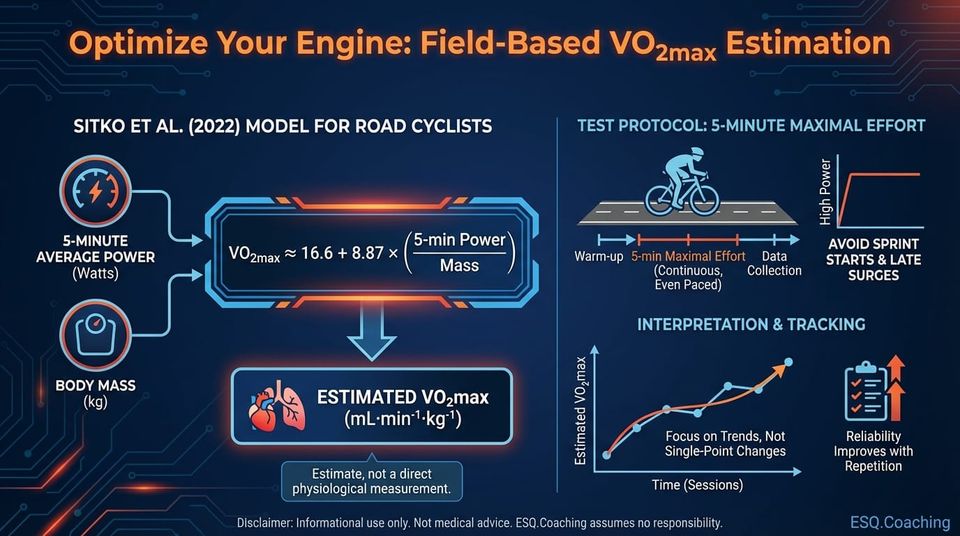
This calculator is based on the model described by Sitko et al. (2022) for estimating VO₂max in road cyclists using field data from a single 5-minute maximal effort.
In the original study, VO₂max measured during a graded laboratory test was compared with performance variables derived from a separate 5-minute maximal test. Average relative power over five minutes, expressed in watts per kilogram, emerged as the strongest predictor of VO₂max. Adding further variables did not materially improve prediction accuracy.
The resulting equation estimates VO₂max as a linear function of 5-minute relative power:
VO₂max = 16.6 + 8.87 × (5-minute power in W·kg⁻¹)
This calculator applies that equation directly. It provides an estimate rather than a physiological measurement and should be interpreted within the constraints of the testing protocol.
How to Test
- Perform a 5-minute maximal effort after an adequate warm-up. The effort should be continuous and evenly paced. Avoid sprint starts and late surges, as these alter the average power without reflecting sustainable aerobic output. The goal is to hold the highest power you can maintain steadily for the full five minutes.
- Record the average power over the full 5-minute interval and your body mass at the time of testing. Testing conditions should be kept as consistent as possible across sessions, including equipment, environment, and recovery status.
- A single test provides a usable estimate, but reliability improves with repetition. Results from the first one or two attempts are often affected by pacing errors. Repeating the test across multiple sessions allows pacing to stabilize and makes changes over time easier to interpret.
How to Use the Calculator
- Enter your 5-minute average power in watts and your body mass in kilograms.
- The calculator converts power to relative power output and applies the published equation to estimate VO₂max in mL·min⁻¹·kg⁻¹.
- Use the output as a field-based estimate. Absolute values should not be compared directly with laboratory measurements.
When tracking progress, focus on trends across repeated tests performed under similar conditions rather than on single-point changes.
If you want to see what I read to keep my own work sharp outside this newsletter, this is the list.
 Thomas Mortelmans
Reference
Sitko S, Cirer-Sastre R, Corbi F, López-Laval I. Five-minute power-based test to predict maximal oxygen consumption in road cycling. International Journal of Sports Physiology and Performance. 2022;17(1):9–15. doi:10.1123/ijspp.2020-0923.