VO2max: Maximal Aerobic Capacity
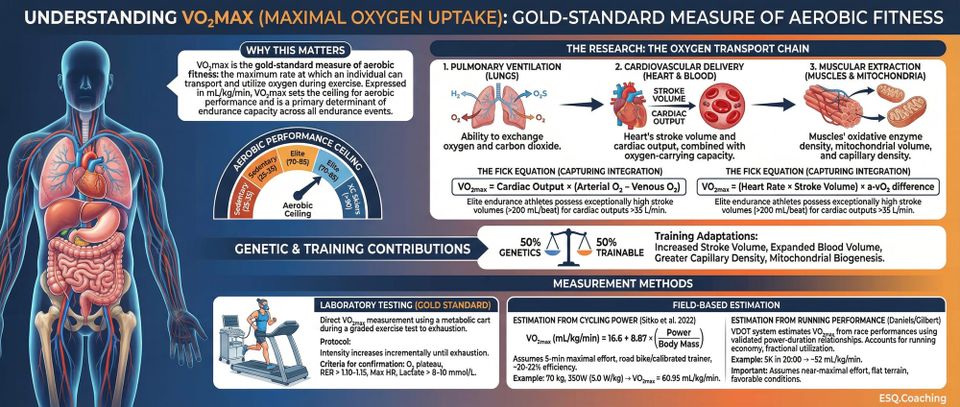
Why This Matters
VO2max (maximal oxygen uptake) is the gold-standard measure of aerobic fitness: the maximum rate at which an individual can transport and utilize oxygen during exercise. Expressed in milliliters of oxygen per kilogram of body mass per minute (mL/kg/min), VO2max sets the ceiling for aerobic performance and is a primary determinant of endurance capacity across running, cycling, swimming, and multisport events.
The Research
The Oxygen Transport Chain
VO2max is limited by the integrated capacity of three physiological systems:
- Pulmonary ventilation: The lungs' ability to exchange oxygen and carbon dioxide
- Cardiovascular delivery: The heart's stroke volume and cardiac output, combined with oxygen-carrying capacity of blood (hemoglobin concentration)
- Muscular extraction: The muscles' oxidative enzyme density, mitochondrial volume, and capillary density
The Fick equation captures this integration:
VO2max = Cardiac Output × (Arterial O2 − Venous O2)
VO2max = (Heart Rate × Stroke Volume) × a-vO2 difference
In trained endurance athletes, cardiovascular delivery (particularly stroke volume) is the primary limiting factor. Elite endurance athletes possess exceptionally high stroke volumes - up to 200 mL per beat - enabling cardiac outputs exceeding 35 liters per minute.
Genetic and Training Contributions
VO2max is approximately 50% genetically determined and 50% trainable. Sedentary individuals may have VO2max values of 25–35 mL/kg/min, while elite endurance athletes reach 70–85 mL/kg/min. Cross-country skiers, who engage the upper and lower body simultaneously, have recorded the highest VO2max values on record (>90 mL/kg/min).
Training adaptations that increase VO2max include:
- Increased stroke volume: Through enhanced left ventricular volume and contractility
- Expanded blood volume: Increasing oxygen delivery capacity
- Greater capillary density: Improving oxygen diffusion to muscle fibers
- Mitochondrial biogenesis: Enhancing oxidative capacity at the cellular level
Measurement Methods
Laboratory Testing (Gold Standard)
Direct VO2max measurement occurs in a laboratory using a metabolic cart during a graded exercise test to exhaustion. Athletes run on a treadmill or cycle on an ergometer while breathing through a mask that analyzes oxygen consumption and carbon dioxide production in real time.
Protocol: Intensity increases incrementally (e.g., 1 km/h per minute for running, 25 watts per minute for cycling) until the athlete reaches volitional exhaustion. VO2max is confirmed when:
- Oxygen consumption plateaus despite increasing workload
- Respiratory exchange ratio (RER) exceeds 1.10–1.15
- Heart rate reaches age-predicted maximum (220 - age)
- Blood lactate exceeds 8–10 mmol/L
Field-Based Estimation
When laboratory testing is unavailable, VO2max can be estimated from maximal-effort performances using validated physiological models.
Estimation from Cycling Power (Sitko et al. 2022)
Sitko and colleagues derived a regression model from trained cyclists performing 5-minute maximal power tests, with standard error of estimation (SEE) of approximately 3.5 mL/kg/min:
VO2max (mL/kg/min) = 16.6 + 8.87 × (Power / Body Mass)
This model assumes:
- Power represents a genuine 5-minute maximal effort
- Cyclist is on a road bike or calibrated trainer
- Gross efficiency approximates 20–22% (typical for trained cyclists)
Example: A 70 kg cyclist producing 350W for 5 minutes:
Power/Mass = 350 / 70 = 5.0 W/kg
VO2max = 16.6 + (8.87 × 5.0) = 16.6 + 44.35 = 60.95 mL/kg/min
Estimation from Running Performance (Daniels/Gilbert)
Jack Daniels' VDOT system estimates VO2max from race performances using empirically validated power-duration relationships:
VO2max ≈ f(race time, race distance)
The relationship accounts for:
- Running economy (oxygen cost per unit velocity)
- Fractional utilization (% of VO2max sustainable at race pace)
- Metabolic demand curves across race distances
Example: A runner completing 5K in 20:00 has an estimated VO2max of approximately 52 mL/kg/min, while 10K in 42:00 suggests ~51 mL/kg/min.
Important: Race-based estimates assume near-maximal effort, flat terrain, and favorable conditions. Hot weather, hills, or submaximal pacing reduce estimation accuracy.
vVO2max: Velocity at VO2max
vVO2max is the minimum running velocity at which VO2max is reached, typically sustainable for 5–7 minutes. It serves as a key training intensity marker:
vVO2max (m/s) = VO2max / Running Economy
For a runner with VO2max = 60 mL/kg/min and running economy of 200 mL/kg/km:
vVO2max = 60 / (200 / 60) = 18 km/h = 5:00 min/km
Lactate Threshold and Fractional Utilization
While VO2max defines the aerobic ceiling, endurance performance is more directly influenced by lactate threshold (the intensity at which lactate accumulation accelerates) and fractional utilization (the percentage of VO2max sustainable for prolonged periods).
An athlete with VO2max = 60 mL/kg/min and lactate threshold at 85% of VO2max (51 mL/kg/min) will outperform an athlete with VO2max = 65 mL/kg/min but lactate threshold at 75% (48.75 mL/kg/min) over marathon distances. VO2max alone does not fully predict endurance performance. Training must also target lactate threshold, running economy, and metabolic efficiency.
Training Applications
VO2max Interval Training
Intervals performed at 95–100% of VO2max velocity (vVO2max) or power elicit maximal cardiovascular stress and drive central adaptations. Typical protocols include:
- Classic intervals: 5 × 3 minutes at vVO2max with 3-minute active recovery
- Short intervals: 10–15 × 1 minute at 100–105% vVO2max with 1-minute recovery
- Long intervals: 3 × 5 minutes at 95% vVO2max with 4-minute recovery
Work intervals should be sufficiently long (≥2 minutes) to allow VO2 to reach near-maximal values, as oxygen consumption has a lag time of 1–2 minutes when transitioning to high intensity.
Periodization
VO2max training is highly fatiguing and cannot be sustained year-round. It is most effective when:
- Preceded by a base phase establishing aerobic foundation
- Performed in 4–8 week blocks during build or peak phases
- Limited to 1–2 sessions per week to allow recovery
- Reduced or eliminated during taper to promote freshness
Altitude Training
Exposure to moderate altitude (2000–2500 meters) stimulates erythropoietin (EPO) production, increasing red blood cell mass and oxygen-carrying capacity. "Live high, train low" protocols (sleeping at altitude while training at sea level) allow athletes to gain hematological benefits without compromising training intensity.
Normative Values
Recreational Athletes
- Male: 40–50 mL/kg/min
- Female: 35–45 mL/kg/min
Competitive Endurance Athletes
- Male: 55–70 mL/kg/min
- Female: 50–65 mL/kg/min
Elite/Professional Endurance Athletes
- Male: 70–85 mL/kg/min
- Female: 65–75 mL/kg/min
Sport-Specific Context
- Marathon runners: 70–80 mL/kg/min (male elite), 65–75 mL/kg/min (female elite)
- Cyclists: 65–80 mL/kg/min (male elite), 60–70 mL/kg/min (female elite)
- Triathletes: 65–75 mL/kg/min (male elite), 60–70 mL/kg/min (female elite)
- Cross-country skiers: 75–90 mL/kg/min (male elite), 65–75 mL/kg/min (female elite)
Age and Sex Differences
VO2max declines approximately 10% per decade after age 30 in sedentary individuals, though endurance training attenuates this decline to ~5% per decade. The reduction is attributed to:
- Decreased maximal heart rate (roughly 1 beat per year after age 30)
- Reduced stroke volume
- Decreased muscle oxidative capacity
Females typically have VO2max values 15–20% lower than males due to:
- Lower hemoglobin concentrations (12–14 g/dL vs. 14–16 g/dL)
- Higher essential body fat percentage
- Smaller heart and lung volumes
However, when expressed relative to lean body mass (excluding essential and storage fat), sex differences narrow considerably, suggesting much of the difference is structural rather than metabolic.
Limitations
VO2max ≠ Performance
While VO2max predicts performance potential, it does not fully explain competitive outcomes. Other critical factors include:
- Running economy: Oxygen cost per unit of velocity
- Lactate threshold: Sustainable fraction of VO2max
- Fatigue resistance: Ability to maintain economy and threshold during prolonged efforts
- Tactical and psychological skills: Pacing, drafting, race strategy, mental resilience
Among elite athletes with similar VO2max values (e.g., 75 ± 3 mL/kg/min), performance differences arise from lactate threshold, economy, and threshold sustainability.
Sport Specificity
VO2max is mode-specific. A cyclist with VO2max = 70 mL/kg/min on a bike may measure 65 mL/kg/min running due to unfamiliar muscle recruitment and lower mechanical efficiency. Training should emphasize the primary sport modality to maximize adaptations.
Body Composition Sensitivity
VO2max expressed in mL/kg/min is sensitive to body mass. A 70 kg athlete with VO2 = 4.2 L/min has VO2max = 60 mL/kg/min; if that athlete gains 5 kg of non-functional mass (fat), VO2max drops to 56 mL/kg/min despite unchanged absolute oxygen uptake. This makes VO2max comparisons across weight changes or between athletes of different sizes potentially misleading.
Estimation Accuracy vs. Laboratory Testing
Field-based estimates from power or pace provide useful approximations but cannot match laboratory precision. Sources of error include:
- Pacing variability: Uneven effort distribution skews calculations
- Environmental conditions: Wind, heat, altitude affect performance independently of VO2max
- Estimation model assumptions: Gross efficiency, economy, and fractional utilization vary individually
- Fatigue state: Prior training, recovery status, and glycogen levels influence maximal efforts
For critical applications (talent identification, medical screening, research), direct laboratory measurement remains essential.
Input Guardrails
The calculator enforces the following bounds:
- Cycling W/kg 1–10: Power/mass ratios outside this range are rejected as unrealistic. Values above 7 W/kg trigger an advisory that results approach the upper bound of the Sitko formula validation range and carry higher uncertainty.
- Cycling power 50–600W: Outside this range the Sitko regression has not been validated.
- Running pace 1.5–7 m/s: Speeds outside this range (~2:23/km to ~11:07/km) are flagged as unrealistic for distance running.
- Female sex advisory: The Sitko formula was validated on trained male cyclists only (n=35). Female estimates may be 5–15% higher than actual.
ℹ️ IMPORTANT DISCLAIMER
This calculator is for educational purposes only and does NOT constitute medical advice. Consult qualified professionals before making changes. Individual physiology varies. You assume all risk. Must be 18+.
Calculator Reference
Use the VO2max Calculator to estimate VO2max from:
- Cycling power data (Sitko 2022 model)
- Running race performances (Daniels/Gilbert VDOT system)
- Time trial results across various distances
The calculator provides estimated VO2max and vVO2max (for runners), enabling training intensity prescription based on individual aerobic capacity.
References
- Bassett DR, Howley ET. Limiting factors for maximum oxygen uptake and determinants of endurance performance. Med Sci Sports Exerc 2000;32(1):70-84.
- Jones AM, Carter H. The effect of endurance training on parameters of aerobic fitness. Sports Med 2000;29(6):373-86.
- Joyner MJ, Coyle EF. Endurance exercise performance: the physiology of champions. J Physiol 2008;586(1):35-44.
- Daniels J, Gilbert J. Oxygen Power: Performance Tables for Distance Runners. Oxygen Power 1979.
- Sitko S, Cirer-Sastre R, Lopez Laval I. Five-minute power-based test to predict maximal oxygen consumption in road cycling. International Journal of Sports Physiology and Performance 2022;17(1):9–15. https://doi.org/10.1123/ijspp.2020-0923
- Billat VL, Flechet B, Petit B, et al. Interval training at VO2max: effects on aerobic performance and overtraining markers. Med Sci Sports Exerc 1999;31(1):156-63.
This article is for educational purposes and does not constitute medical or coaching advice. Consult qualified professionals before modifying training programs or interpreting VO2max values.