Snippet #022: Exercise Alters DNA Packaging to Accelerate Future Muscle Adaptation
Core Insight
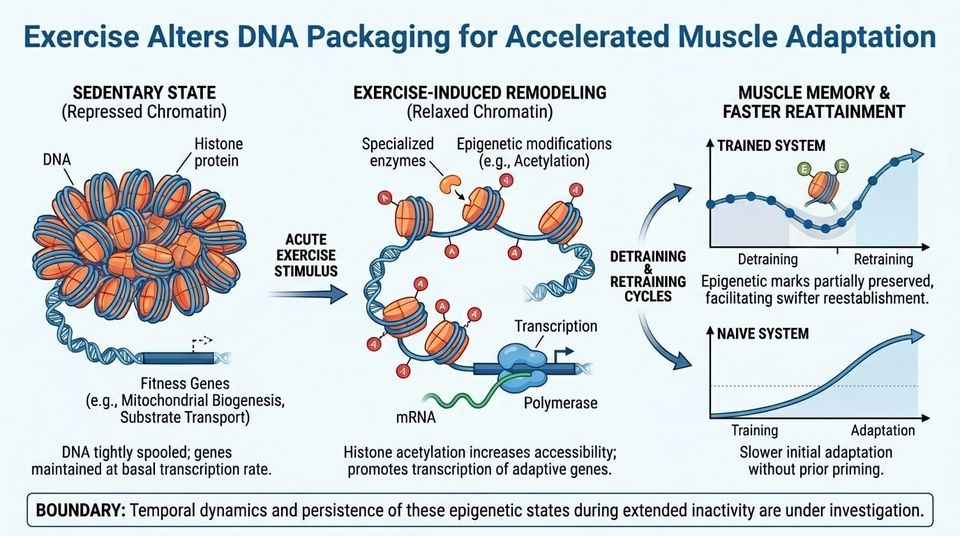
Inside muscle cells, DNA is tightly spooled around protein complexes called histones, a conformation that generally maintains certain adaptation-associated genes in a transcriptionally repressed state.
Exercise stimulates specialized enzymes to append chemical groups to these histones—such as through histone acetylation—which alters the chromatin structure to a more relaxed configuration. By increasing chromatin accessibility, these modifications expose specific promoter regions required to drive mitochondrial biogenesis and upregulate substrate transport.
This structural remodeling allows the working muscle to transcribe fitness-promoting genes much more readily.
Why It Matters
This shift in chromatin accessibility provides a plausible mechanistic framework for the phenomenon of transcriptional muscle memory during cycles of detraining and retraining.
Emerging evidence suggests that even after functional capacity declines during a training hiatus, specific epigenetic modifications and regions of open chromatin may remain partially preserved or are more swiftly reestablished upon resuming exercise.
Consequently, these primed transcriptional networks likely facilitate a previously trained system in regaining metabolic and structural adaptations significantly faster than a training-naive system.
Boundary Statement
While these alterations in chromatin accessibility reliably occur in response to both resistance and endurance training stimuli, researchers are still defining the precise temporal dynamics of these epigenetic marks and determining exactly how long these altered chromatin states persist during extended periods of complete physical inactivity.
References:
Found this useful?
Get articles like this and free training calculators in your inbox every week.
Recommended reads
If this was useful, these are the other research-driven newsletters I actually read.
Member discussion