OpenLab #002: How to start with fitness and weight training for the absolute beginner with Laura Van Baelen
The modern fitness landscape has become an echo chamber. Open any social feed and you’re met with metabolic “shortcuts,” hyper-specific routines, and nutritional protocols that read more like exam material than a starting point. For someone at the beginning of their journey, this complexity isn’t motivating—it’s paralysing.
So the real question is not which hack works best, but something far more fundamental:
How do you move from baseline physiology to a body that is resilient, functional, and sustainably lean?
For a beginner, the problem is rarely lack of effort. It is overload. Training plans, dietary rules, and optimization strategies are often presented as pre-requisites, when in reality they function as barriers. Early progress depends less on precision and more on feasibility.
The first objective is therefore not optimization, but routine construction. A routine that can be executed on low-motivation days. A routine that produces visible feedback within weeks. This early feedback loop matters because motivation is unstable by nature.
In this edition, we strip away ´influencer noise´ and anchor ourselves in what peer-reviewed data actually tells us about building capacity from the ground up.
To guide this discussion, we’re joined by Laura Van Baelen; a physiotherapist with extensive experience in fitness, lifestyle change, and long-term coaching. Her work sits at the intersection of clinical understanding and real-world application, making her uniquely positioned to translate physiology into practices that are both evidence-based and sustainable.
In addition to her coaching, she works as a physiotherapist at her own practice in Belgium: UNLOCKED.

Executive Summary
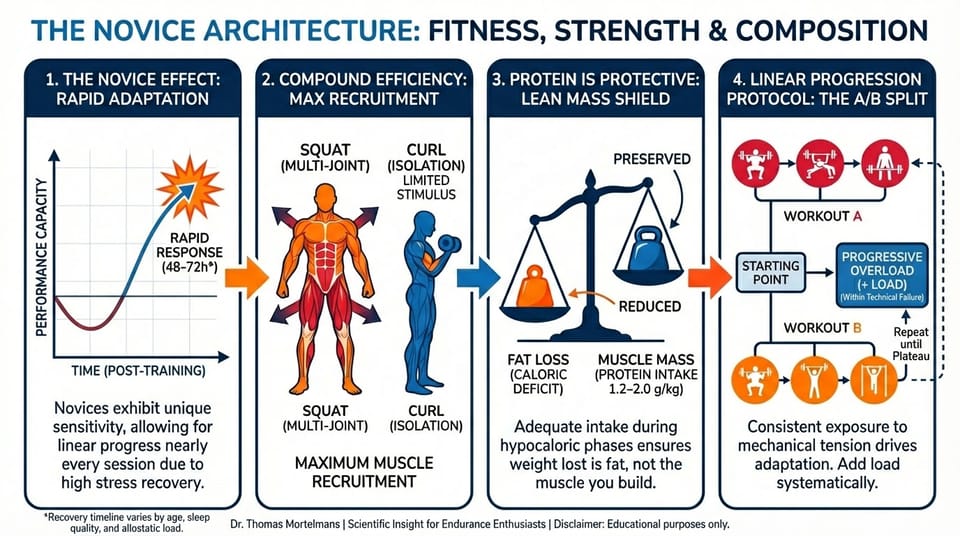
- The Novice Adaptation Rate: Beginners possess a high physiological sensitivity to stimulus, where a single dose of stress drives adaptation within 48–72 hours, allowing for linear progress almost every session.
- Routine Before Optimization: Early success depends on building a training and nutrition structure that is repeatable even when motivation is low. Physiological sensitivity is high, but adherence determines exposure.
- Compound Priority, but with Graduated Exposure: Multi-joint exercises remain the target, but initial exposure may require machines or reduced loads to build confidence, coordination, and tolerance.
- Energy Balance vs. Food Matrix: While a caloric deficit is the thermodynamic driver of weight loss, the quality of food (whole vs. processed) dictates satiety signaling and behavioral adherence.
- Protein is Protective: High protein intake (1.2–2.0 g/kg) is critical during a caloric deficit to stimulate muscle protein synthesis (MPS) and mitigate the loss of lean tissue.
- Non-Linear Progress: Stress, sleep disruption, and fluid balance frequently obscure fat loss in the short term. Education around this variability prevents premature behavioral changes.
 Thomas Mortelmans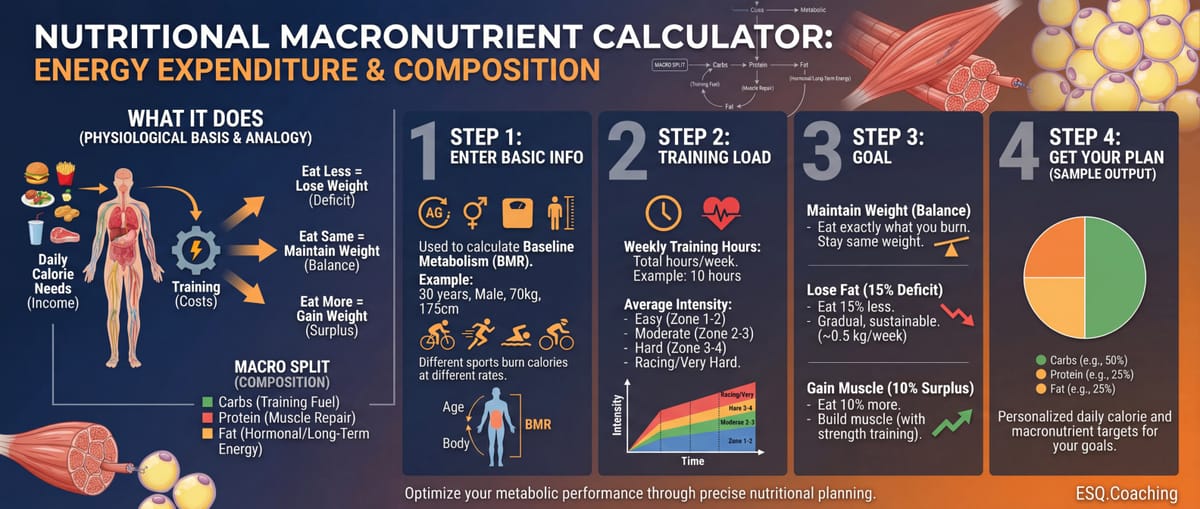
The Science at a Glance
The physiological reality of a beginner is vastly different from that of an elite athlete. Your body is highly sensitive to novel stimuli, meaning you do not need "optimal" complexity to grow; you need consistent exposure to mechanical tension:
| Feature | The "Tone & Burn" Myth | The Physiological Reality |
|---|---|---|
| Primary Driver | High reps, low weight, "feeling the burn" (metabolic stress). | Progressive Overload (Mechanical Tension). |
| Fatigue Cost | High local metabolic accumulation, low central stimulus. | Moderate systemic fatigue, high adaptation signal. |
| Dietary Focus | Aggressive caloric restriction & macro ratios. | High protein & whole food volume (Satiety). |
| Progression | Random variation (switching exercises constantly). | Linear progression (same exercises, more load). |
Foundational Principles
1. The Novice Linear Progression
The "Novice Effect" is a well-documented observation in strength physiology. An untrained individual disrupts homeostasis easily because they are unadapted to the specific stress of lifting. Unlike an elite lifter who requires weeks of accumulated volume to force a supercompensation effect, a novice recovers and adapts to a stressor in roughly 48 to 72 hours.
In practice, many beginners tolerate three shorter sessions better than two maximal ones. A common structure is one full-body session, one lower-body dominant session, and one upper-body dominant session. This preserves frequency while reducing session duration and psychological load.
"A novice is someone for whom the stress of a single workout is significant enough to drive a physical adaptation but also allow for adequate recovery... creating a strength increase by the next workout."
Barbell Logic (Ref. 3)
2. The Hierarchy of Tissue Partitioning
Confusion often exists between "weight loss" and "fat loss." They are not synonymous. To lose weight, you simply need a caloric deficit. To lose fat while preserving the contractile tissue (muscle), you need two signals: mechanical tension (resistance training) to signal tissue retention, and adequate amino acid availability (protein). Research indicates that protein intakes between 1.2 and 2.0 g/kg of body weight are essential during hypocaloric phases to attenuate muscle atrophy.
3. Nutritional Intelligence & Satiety
We often overcomplicate diet with rigid tracking. However, data suggests that "nutritional intelligence"—the body's gut-brain signaling axis that regulates intake—functions optimally when fed unprocessed foods. Ultra-processed foods often bypass these satiety mechanisms, leading to passive overconsumption. A calorie is a calorie for thermodynamics, but food composition dictates hunger regulation and nutrient partitioning.
4. Load, Repetition Range, and Timing
Low-rep, high-load schemes demand technical consistency under fatigue. For many beginners, this threshold is not reached within the first eight to twelve weeks. Sets of five taken near failure amplify technical breakdown when experience is limited.
A higher repetition range during early phases allows skill acquisition under submaximal load while still generating sufficient tension. Heavier loading becomes appropriate only once movement patterns are stable across multiple weeks, not simply because a calendar phase changes.
Practitioner’s Note – Laura Van Baelen
For beginners, the goal is not to train perfectly. It is to train consistently. Motivation fluctuates, so the routine has to work even on low-energy days. Shorter, manageable sessions and early, visible progress build confidence. Once that foundation is in place, technique, load, and structure can be refined without losing adherence.
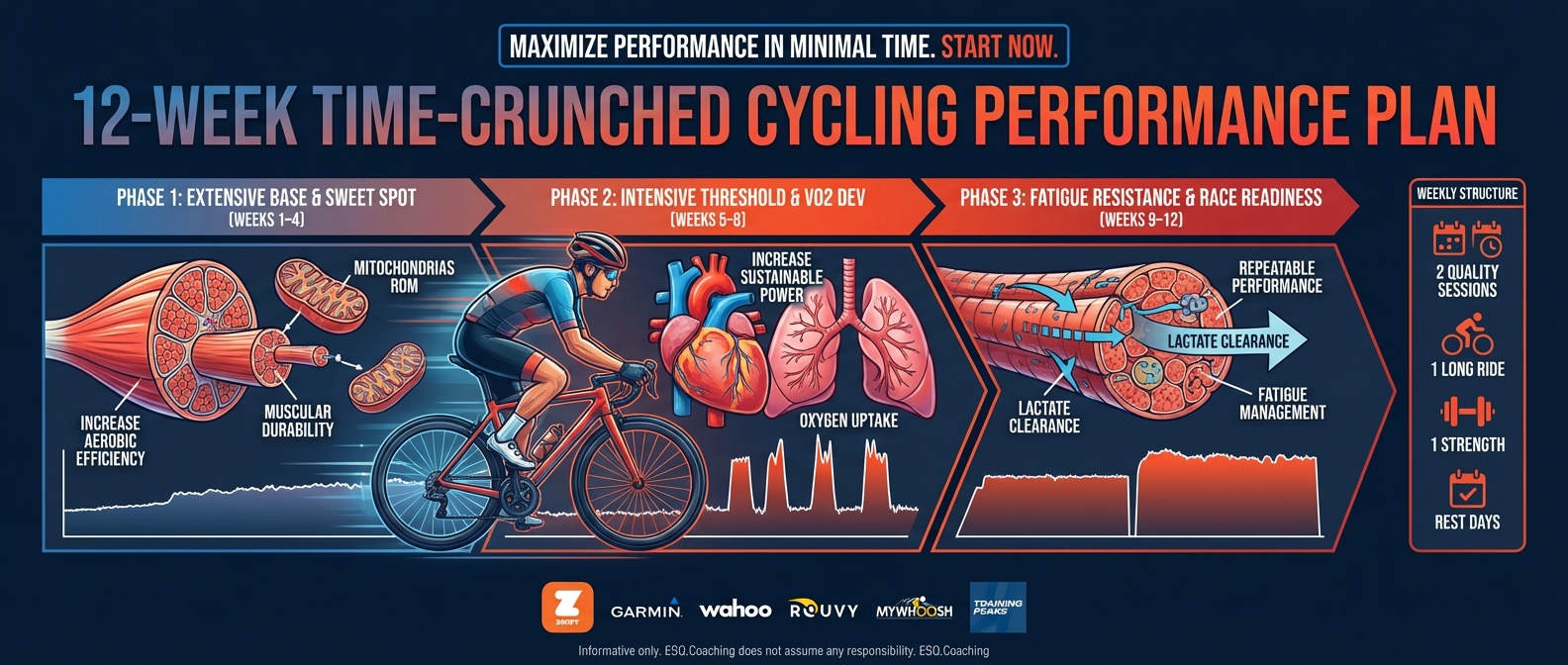
🚴♂️ Time-Crunched Cycling Performance Plan
You don’t need more hours. You need fewer, better ones.
This 12-week plan is built for riders with limited training time who still want measurable gains. Each week prioritizes the sessions that actually drive adaptation (including strength training) and cuts everything else.
If consistency is your bottleneck, not motivation, this plan fits real life. View Plan here.
The Decision Matrix
Where do you fit? Diagnose your starting point to select the correct architectural approach.
| Current State | The "Skinny Fat" Phenotype | The "Overweight" Phenotype | The "Sedentary/Deconditioned" |
|---|---|---|---|
| Primary Symptom | Normal weight, but low lean mass and relatively high adiposity. | High BMI, high body fat percentage, robust lower body strength (due to carrying load). | Low energy, poor mobility, aches/pains, poor aerobic base. |
| Physiological Goal | Recomposition. Build muscle primarily; fat loss is a secondary outcome of increased metabolic rate. | Fat Loss + Retention. Maximize fat oxidation while holding onto lean mass. | Neuromuscular Activation. Wake up the nervous system and restore range of motion. |
| The Fix | Eat at maintenance calories. Prioritize heavy compound lifting (3x/week). | Slight caloric deficit (-300 to -500 kcal). High protein (2.0g/kg). Lifting 2-3x/week. | Mobility work daily. Walk 30 mins daily. Bodyweight strength 2x/week. |
The Protocol
This is a prescriptive architecture for the first 12 weeks of training.
Phase 1: Neuromuscular Learning (Weeks 1–4)
Goal: Establish motor patterns and neural efficiency. Ignore the weight on the bar.
- Frequency: 2 days per week (e.g., Mon/Thu).
- The Movements:
- Squat Variation: Bodyweight Squat or Goblet Squat (3 sets x 10 reps).
- Push: Push-ups (knees if necessary) or Overhead Press (empty bar) (3 sets x 8-12 reps).
- Pull: Inverted Rows or Lat Pulldowns (3 sets x 10-12 reps).
- Hinge: Kettlebell Deadlift or Dumbbell RDL (3 sets x 10 reps).
- Progression: Do not add weight yet. Focus on range of motion, tempo, and control.
Phase 2: Linear Loading (Weeks 5–12)
Goal: Exploit the Novice Adaptation Rate.
- Frequency: 3 days per week (e.g., Mon/Wed/Fri).
- Split example:
- Day 1: Full body
- Day 2: Lower body dominant
- Day 3: Upper body dominant
- Loading Strategy
Primary compound lifts: 6–10 repetitions per set (focus on technique and execution)
Accessory or machine work: 8–12 repetitions
Progression rule: Increase load only if all sets are completed with stable technique and consistent tempo. If technique degrades, hold load constant until execution stabilizes.
Heavy sets of five should be introduced only after consistent technical proficiency is demonstrated over several weeks.
- Recovery: If you fail to hit the reps, keep the weight the same for the next session. If you fail twice, reduce weight by 10% and build back up.
The Nutrition Protocol
- Calculate Protein: Target bodyweight (kg) x 1.6g. This is your daily baseline for muscle synthesis.
- Hydration: Maintain clear urine color; typically 3–4 liters of water daily for active individuals.
- Food Selection: 80% of intake should be minimally processed foods (lean meats, tubers, vegetables, oats, eggs) to maximize nutrient density.
- Sleep: 7–9 hours. This is when hormonal rebalancing and tissue remodeling occur. Without this, the training is just catabolic stress without anabolic adaptation.
 Thomas Mortelmans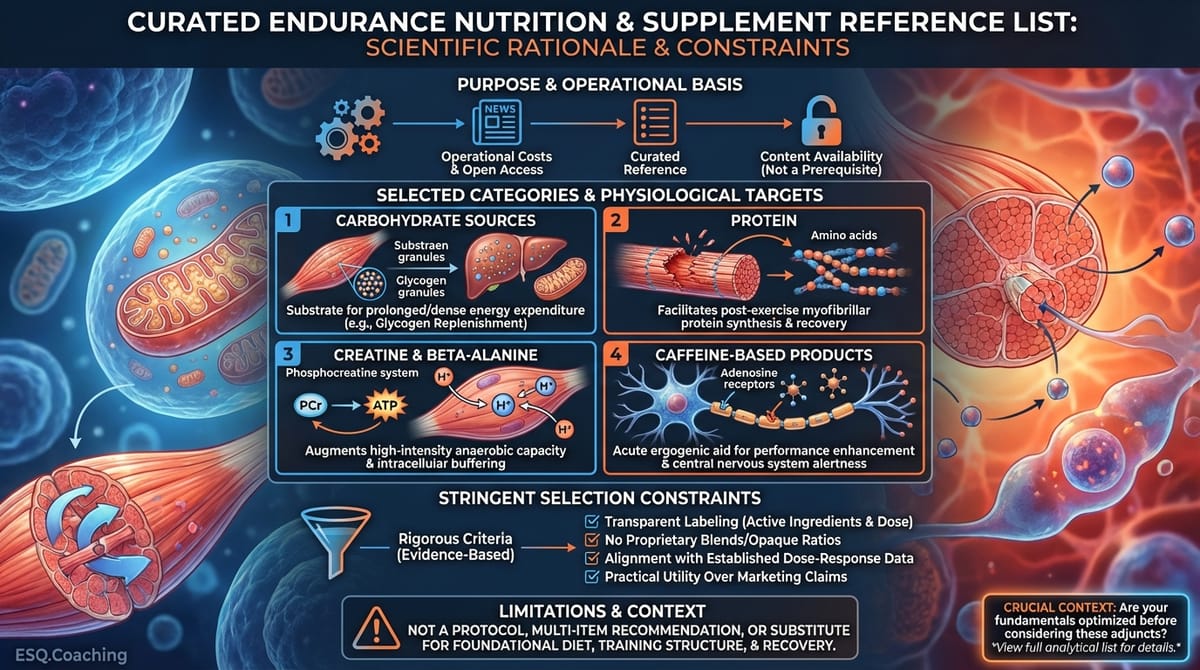
Case Study: The Non-Linear Reality
Meet "David" (42, Software Engineer).
Baseline: Sedentary, 95kg, high chronic stress.
The Start: David begins the Phase 1 protocol. Motivation is high. He loses 2kg in the first two weeks, largely due to glycogen depletion and water loss.
The "Noise": Week 4 hits. Work stress peaks, and sleep drops to 5 hours.
The Data: His scale weight stalls for 10 days. He feels weaker in the gym.
The Mistake: David assumes his metabolism has "crashed" and wants to cut calories to 1,200/day.
The Science-Based Correction:
Instead of cutting calories (which would elevate cortisol and risk muscle loss), we analyze his recovery data. His metabolic rate has not crashed; however, stress-induced fluid retention (edema) is likely masking fat loss, and his central nervous system fatigue is high (marked by a drop in heart rate variability over time).
The Adjustment:
- Diet: Maintain calories, increase protein to 2.0g/kg to buffer catabolism and support satiety.
- Training: Reduce volume (2 sets instead of 3) but keep intensity/load high to maintain the strength signal.
- Result: Two weeks later, as stress subsides, the weight drops suddenly (the "whoosh" effect as fluid balance normalizes), and strength numbers resume their linear climb.
Takeaway: Progress rarely follows a straight trajectory. Short-term plateaus often reflect stress, sleep loss, or fluid shifts rather than failed physiology. Education around this non-linearity protects the beginner from setting irrealstic expectations about the training impact. When beginners understand that outcomes lag behavior, adherence improves and unnecessary interventions decrease.
The barrier to entry is high only because we imagine it to be. The physiology of the beginner is primed for adaptation; it simply requires the correct mechanical signal and the fuel to support it. Start simple, prioritize consistency over intensity, and let the compound interest of biology do the rest.
Best regards,
Laura Van Baelen and Dr. Thomas Mortelmans
If you want to see what I read to keep my own work sharp outside this newsletter, this is the list.
 Thomas Mortelmans
Annotated References
- Kompf, J. M., Rhodes, R. E., & Lee, S. (2025). Selecting Resistance Training Exercises for Novices: A Delphi Study with Expert Consensus. A consensus study identifying 41 specific exercises suitable for beginners, prioritizing low technical complexity to reduce barriers to entry and injury risk while ensuring efficacy. Link
- Kim, J. Y. (2021). Optimal Diet Strategies for Weight Loss and Weight Loss Maintenance. A review confirming that while caloric deficit is the primary driver of weight loss, adherence and satiety are better supported by dietary patterns emphasizing whole foods rather than strict macronutrient ratios. Link
- Barbell Logic. (n.d.). Novice Linear Progression Program Explained. An analysis of the "novice effect," explaining how beginners can adapt to training stress within 48–72 hours, allowing for a linear increase in training load every session. Link
- Soares-Rodrigues, T., et al. (2024). Enhanced protein intake on maintaining muscle mass, strength, and physical function in adults with overweight/obesity. A systematic review and meta-analysis demonstrating that protein intake exceeding 1.3 g/kg is critical for preserving lean muscle mass during weight loss phases. Link
- Gardner, C. D., et al. (2018). DIETFITS Study: One Diet Does Not Fit All. A landmark randomized trial showing no significant difference in weight loss between healthy low-fat and healthy low-carb diets, emphasizing that adherence and caloric deficit are the true determinants of success. Link
- Martins, C., Gower, B. A., & Hunter, G. R. (2022). Metabolic adaptation delays time to reach weight loss goals. Research highlighting that metabolic adaptation (a slowing of metabolism during weight loss) is a real phenomenon but often temporary, reversing after a period of weight stabilization. Link
- Stull, K. (n.d.). The Importance of Sleep and Recovery. This article details the physiological necessity of sleep for tissue repair and anabolic signaling, identifying it as a non-negotiable component of any training program. Link
- Nerd Fitness. (2025). 5 Best Strength Training Workout Routines For Beginners. A practical guide emphasizing bodyweight and compound barbell movements as the most efficient starting point for building foundational strength and mobility. Link
- IronMaster. (n.d.). Mastering Compound Movements for Strength Training Success. Explains why multi-joint exercises (squats, presses) are superior to isolation movements for beginners due to higher motor unit recruitment and mechanical efficiency. Link
- Medical Xpress. (2026). Whole-food diet adherence means you really can eat much more and be well-nourished but still consume far fewer calories. Recent data suggesting that unprocessed diets allow for 57% greater food volume while spontaneously reducing caloric intake due to enhanced satiety signaling ("nutritional intelligence"). Link
- UAB Reporter. (n.d.). Does your body really fight against weight loss? This scientist explains why the research says no. An interview with researchers clarifying that while metabolic adaptation occurs, the body does not permanently "damage" its metabolism, and plateaus are often due to behavioral adherence rather than biological failure. Link
- Sinclair, G. (2025). Structured vs. Flexible Diet Plans: Finding Your Fit in 2025. A comparison of dietary approaches, finding that while structured plans reduce decision fatigue, flexible dieting improves long-term adherence and reduces disordered eating patterns. Link
- Gymshark Central. (n.d.). Progressive Overload: The Route To Results In Strength Training. Defines the principle of progressive overload, explaining that beginners should focus on adding reps or weight consistently to drive adaptation rather than seeking muscle "confusion." Link
- American Heart Association. (n.d.). Breaking Down Barriers to Fitness. Identifies common psychological and logistical barriers to exercise, such as perceived lack of time, and offers evidence-based strategies for integrating movement into daily life. Link
- NFPT. (2025). Coaching for Adherence and Consistency, Not Just Performance. Discusses the psychology of behavior change, arguing that establishing consistency through habit formation is more critical for long-term success than intensity or performance metrics. Link
Legal Disclaimer
The information provided in this newsletter is for educational purposes only and does not constitute medical advice, diagnosis, or treatment. Always seek the advice of your physician or other qualified health provider with any questions you may have regarding a medical condition or before starting any new fitness or nutrition regimen. The Scientist’s Notebook and ESQ Coaching are not liable for any injuries or damages that may occur from the application of the information contained herein.
Found this useful?
Get articles like this and free training calculators in your inbox every week.
Recommended reads
If this was useful, these are the other research-driven newsletters I actually read.
Member discussion