Snippet #005: The Immune System Coordinates Muscle Repair Following Endurance Stress
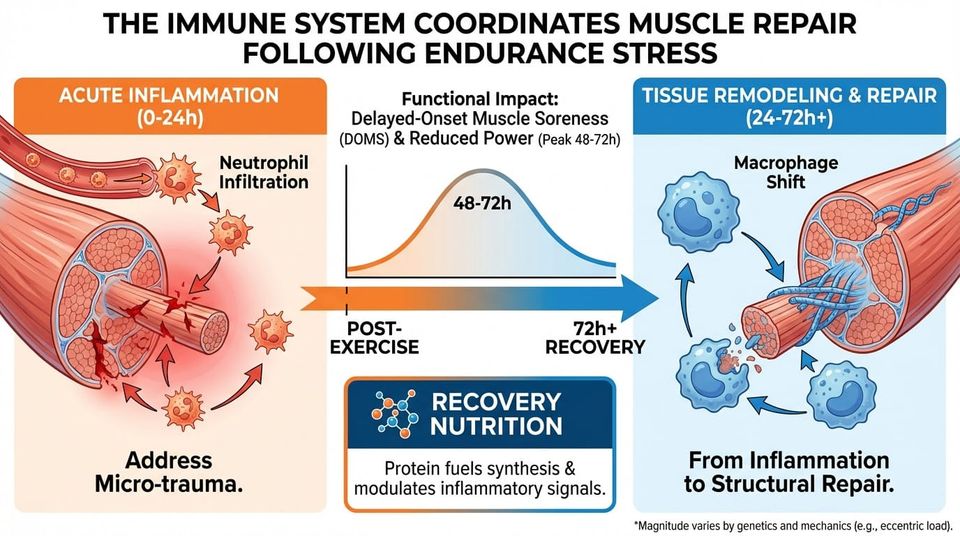
Prolonged endurance exercise triggers a distinct biological cleanup crew within the muscle fibers, often indicated by the release of intracellular proteins like creatine kinase into the bloodstream. Initially, immune cells known as neutrophils infiltrate the tissue within the first 24 hours to address micro-trauma caused by exertion. These are subsequently replaced by macrophages, specialized cells that shift the biological focus from active inflammation to tissue remodeling and structural repair. This sequential migration of leukocytes is not merely a side effect of fatigue but a necessary prerequisite for physiological adaptation.
This biological timeline aligns with the functional experience of delayed-onset muscle soreness and reduced power output, which often peak 48 to 72 hours post-exercise. It clarifies that recovery nutrition, particularly the inclusion of protein, plays a dual role by not only fueling muscle synthesis but also modulating these inflammatory signals to mitigate systemic stress.
Invite one friend who joins the newsletter and unlock a free 12-week Gran Fondo training plan, plus three endurance playbooks.
 Thomas Mortelmans
While this inflammatory cascade is a universal response to exertion, the magnitude of damage varies significantly based on individual genetics and specific mechanics, such as the high eccentric load incurred during downhill running.
This Margin Snippet is drawn from Entry #005 of The Scientist’s Notebook: Comparing whey protein and carbohydrate-based recovery strategies after endurance exercise.
PS: Your voice matters!Share your thoughts anonymously here. I read every response to ensure I'm hitting the mark.
Peake, J. M., Neubauer, O., Della Gatta, P. A., & Nosaka, K. (2017).
Muscle damage and inflammation during recovery from exercise.
Journal of Applied Physiology, 122(3), 559–570.
Kawamura, T., Muraoka, I. (2018).
Exercise-induced oxidative stress and the effects of antioxidant intake from a muscle damage and recovery perspective.
Antioxidants, 7(10), 127.
If you want to see what I read to keep my own work sharp outside this newsletter, this is the list.
 Thomas Mortelmans
Found this useful?
Get articles like this and free training calculators in your inbox every week.
Recommended reads
If this was useful, these are the other research-driven newsletters I actually read.

Member discussion