Entry #007: Comparative Architecture of Endurance Training Models: Polarized vs. Threshold vs. HIIT
Executive Summary: The Brief
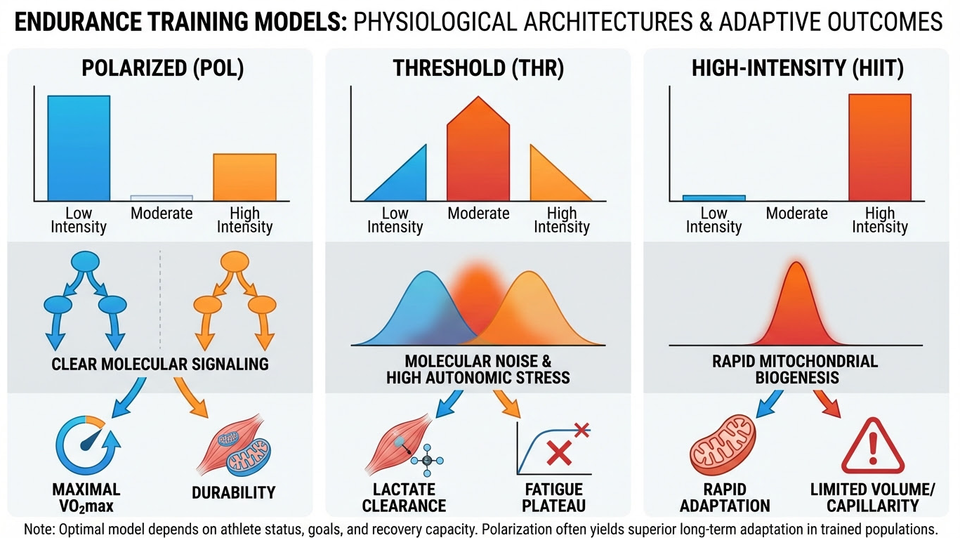
- The Signal-to-Noise Problem: Threshold training (moderate intensity) often creates a "physiological black hole" for well-trained athletes, generating high autonomic fatigue with diminishing returns on aerobic adaptation.
- Polarized Superiority: Current literature demonstrates that Polarized Training (POL)—characterized by ~80% low intensity and ~20% high intensity—consistently yields superior improvements in VO2max, Peak Power Output, and Time to Exhaustion compared to threshold-centric models in trained populations.
- The Efficiency Paradox: High-Intensity Interval Training (HIIT) offers the most potent stimulus for mitochondrial biogenesis per unit of time but fails to build durability and capillary density when used in isolation without sufficient low-intensity volume.
- Contextual Application: While POL is optimal for maximizing genetic potential, Threshold (THR) models remain effective for time-constrained athletes (<6 hours/week) or novices where "training monotony" has not yet blunted adaptation.
The Science at a Glance
The following comparison illustrates the physiological trade-offs between the three primary training intensity distributions (TID).
| Metric | Polarized (POL) | Threshold (THR) | High-Intensity (HIIT) |
|---|---|---|---|
| Intensity Distribution | Bimodal: ~80% Zone 1, ~20% Zone 3. Minimal Zone 2. | Pyramidal: Heavy emphasis on Zone 2 (85-90% HRmax). | High Zone 3 focus, low overall volume. |
| Primary Stimulus | Maximal aerobic power (VO2max) + Fatigue resistance. | Lactate clearance capacity (fractional utilization). | Rapid mitochondrial biogenesis + Stroke Volume. |
| Autonomic Stress | Low to Moderate. Clear separation allows recovery. | High. Cumulative fatigue often masks freshness. | Very High. Acute stress limits frequency. |
| Responder Profile | Well-trained to Elite athletes with >8hrs/week. | Time-crunched amateurs or novices. | Athletes in "shock" micro-cycles or severe time limits. |
| Risk Profile | Low (if easy days are truly easy). | Moderate (risk of "stale" overreaching). | High (injury/burnout if undulated incorrectly). |
Note: Zones refer to the 3-Zone Model: Zone 1 (<VT1/LT1), Zone 2 (VT1–VT2), Zone 3 (>VT2/LT2).
Foundational Principles
1. The Autonomic Stress Preservation Mechanism
The efficacy of Polarized Training relies on the preservation of autonomic balance. Research indicates that training at moderate intensity (Threshold) triggers a sympathetic stress response disproportionate to the adaptive signal it provides. By restricting training to the extremes, athletes maximize the signal for mitochondrial biogenesis (via HIT) and capillary density (via LIT) while minimizing the "middle ground" stress that suppresses Heart Rate Variability (HRV) and delays recovery.
2. Mitochondrial Biogenesis and Signal Clarity
Physiological adaptation requires clear molecular signaling. High-intensity bouts stimulate PGC-1α (the master regulator of mitochondrial biogenesis) via the AMP-activated protein kinase pathway. Conversely, high-volume low-intensity training stimulates calcium-calmodulin kinase pathways. Mixing these signals constantly in the Threshold domain creates "molecular noise." POL separates these signals, allowing for distinct up-regulation of both fast-twitch recruitment and slow-twitch oxidative capacity.
"The error most competitive athletes (> 12 hrs/week) make is not training too hard, but training 'kind of hard' too often. When intensity distribution regresses to the mean, we see a plateau in VO2max and threshold power despite increased effort. Polarization restores the adaptive pressure by ensuring hard days are sufficiently stressful to trigger adaptation, and easy days are sufficiently restorative to allow it."
Scientist’s Insight
If you want to see what I read to keep my own work sharp outside this newsletter, this is the list.
 Thomas Mortelmans
The Decision Matrix
Use this diagnostic framework to determine the optimal training architecture for your current phenotype and constraints.
| Current State / Symptom | Diagnosis | Recommended Architecture |
|---|---|---|
| Plateau in Performance: Power/pace at threshold has not moved in >12 weeks despite consistent "sweet spot" work. | Adaptation Blunt: You are likely in the "black hole" of training intensity. | Switch to Polarized. drastically reduce Z2 work. Increase volume of Z1 and intensity of Z3. |
| Time Restricted: You have <5 hours per week to train due to professional demands. | Volume Deficit: You cannot accumulate enough Z1 volume to drive capillary adaptations via polarization. | Threshold / HIIT Hybrid. Focus on density. Use Threshold intervals to maximize kilojoule expenditure per hour. |
| High Fatigue / Stalenness: Resting HR is elevated; motivation is low; legs feel "heavy" constantly. | Autonomic Overload: Cumulative stress from moderate intensity is exceeding recovery rates. | Strict Polarized (Recovery Focus). 90% Z1 for 3 weeks to restore autonomic balance before reintroducing Z3. |
| Novice / Base Phase: <2 years training history or returning from long layoff. | Aerobic Insufficiency: Central adaptations (Stroke Volume) are not yet the limiter. | Pyramidal (Base). High volume Z1 with moderate Z2. Complex polarization is premature. |
The Protocol: Implementing Polarized Architecture
This protocol outlines a standard "build" week for a well-trained athlete targeting physiological polarization. Note: It uses the three zone model.
Prerequisites:
- Accurate determination of VT1 (First Ventilatory Threshold) and VT2 (Second Ventilatory Threshold).
- Heart Rate monitor and/or Power Meter.
The Weekly Structure (6-Day Cycle):
- Monday (Recovery/Off): Complete rest or 30-min active recovery at <55% VO2max.
- Tuesday (High-Intensity - Zone 3):
- Warm-up: 20 min progressive.
- Work: 4 x 8 minutes at 105% of FTP (Seiler Intervals; Cycling) or 10k race pace (Running).
- Rest: 2 minutes passive recovery between intervals.
- Objective: Accumulate >30 mins near VO2max.
- Wednesday (Low Intensity - Zone 1): 60–90 mins at 65–70% HRmax. Strict ceiling at VT1 /LT1.
- Thursday (Low Intensity - Zone 1): 60–90 mins at 65–70% HRmax.
- Friday (Moderate/High - Zone 2/3 Mix or Specificity):
- Option A (Strict POL): 60 mins Zone 1 with 10 x 30sec micro-sprints to recruit motor units without metabolic cost.
- Option B (Race Prep): 3 x 15 mins at Threshold (Zone 2 upper limit). Only use in weeks 4-8 prior to competition.
- Saturday (Long Duration - Zone 1):
- 3–4 hours (Cyclists) or 90–120 mins (Runners).
- Crucial Metric: Cardiac Drift. If HR rises >5% for same output in the final hour, aerobic decoupling has occurred. Keep intensity low.
- Sunday (Low Intensity or Rest): Short aerobic session (<60 min) or full rest.
Adherence Check: At the end of the week, calculate time-in-zone. Target distribution: ~90% of total time <VT1, ~10% of total time >VT2. (Note: Session counts often look like 80/20, but time-in-zone will skew heavily toward low intensity).
VO₂ Max Development (8 Weeks):
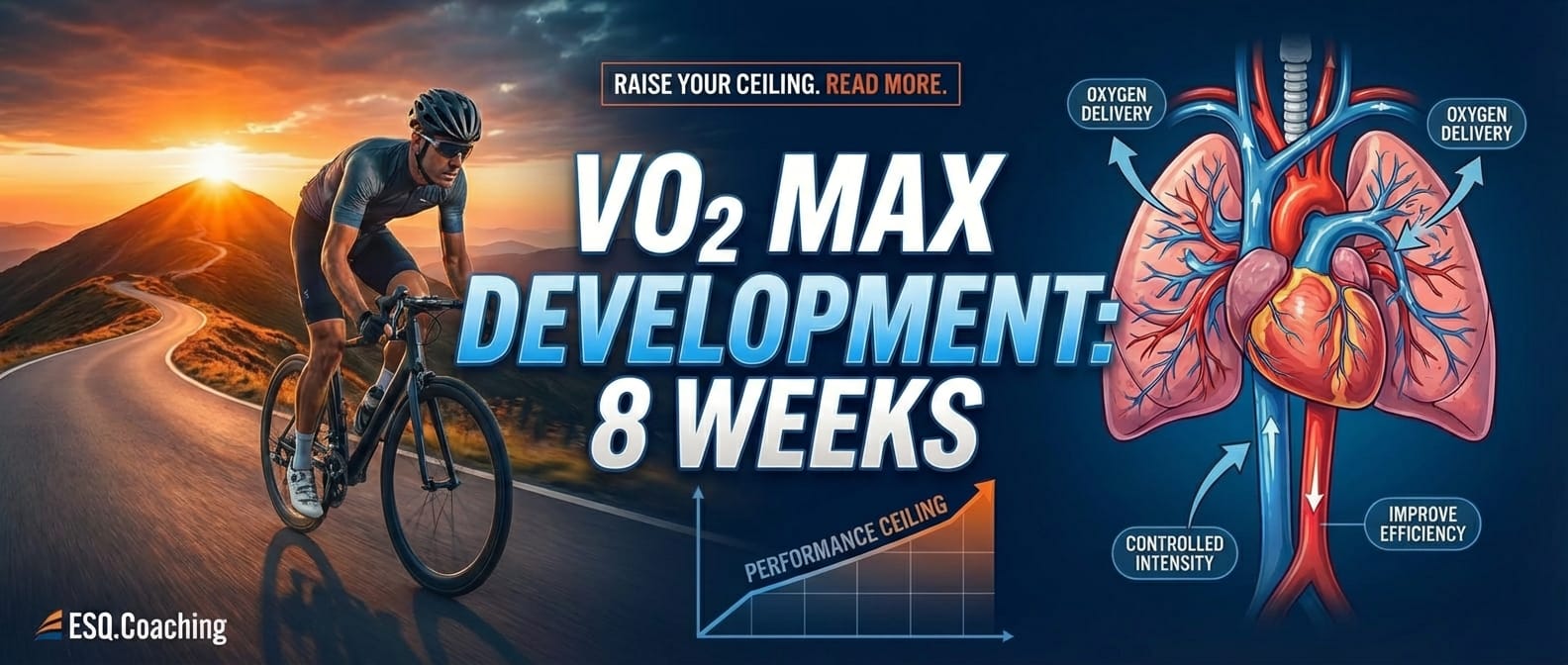
Your aerobic ceiling is limiting everything downstream.
This 8-week VO₂max block is for riders who already train consistently but feel capped in hard efforts above threshold. The goal is not “suffering better,” but increasing the amount of oxygen you can actually turn into power.
If long intervals feel fine but short, repeatable efforts keep breaking you, this is the block you’re missing. View plan here
Case Study: Non-Linear Adaptation in an Elite Age-Group Cyclist
Subject: Male, 38 years old. Competitive Gran Fondo cyclist.
Baseline: Plateaued FTP (285W) for 2 seasons using a "Sweet Spot" (Threshold) plan (10-14 hrs/week). Reported constant leg heaviness and sleep disturbances.
The Intervention:
- Weeks 1–4: all Threshold (Zone 2) sessions were eliminated. Replaced with extended Zone 1 rides (HR capped at 135 bpm). Two sessions per week targeted VO2max (4x4min at 120% FTP).
- The "Noise": In Week 3, work stress increased. The subject attempted to maintain intensity. HRV plummeted.
- Adjustment: We removed one HIT session, reverting to a 1-HIT/week frequency for 10 days to absorb life stress. This highlights that biological data is noisy; adherence to a spreadsheet must not override physiological feedback.
The Outcome (Week 12):
- FTP: Increased to 305W (+7%).
- VO2max: +4.5 ml/kg/min.
- Subjective: Reported feeling "fresh" for hard sessions for the first time in years.
The reduction in moderate-intensity "gray zone" training allowed for full autonomic recovery between key sessions. The subject actually trained fewer total kilojoules per week but achieved higher peak power outputs during the interval sessions, driving superior upstream adaptations.
Best regards,
Dr. Thomas Mortelmans
PS: I’m always looking to improve.Send me an anonymous tip here. It takes seconds and helps me immensely.
Invite one friend who joins the newsletter and unlock a free 12-week Gran Fondo training plan, plus three endurance playbooks.
 Thomas Mortelmans
Annotated References
- Stöggl, T., & Sperlich, B. (2014). Polarized training has greater impact on key endurance variables than threshold, high intensity, or high volume training.
Scientific Summary: A landmark randomized controlled trial demonstrating that polarized training resulted in superior improvements in VO2peak, time to exhaustion, and peak velocity compared to threshold and HIIT models in well-trained endurance athletes. - Seiler, S. (2010). What is best practice for training intensity and duration distribution in endurance athletes? (Linked via provided context: Int J Sports Physiol Perform)
Scientific Summary: A comprehensive review of elite training characteristics, establishing the "80/20" rule where elite performers accumulate the vast majority of volume at low intensity to support high-intensity adaptations. - Rosenblat, M. A., et al. (2019). Polarized vs. Threshold Training Effects on Endurance Performance: A Systematic Review and Meta-Analysis.
Scientific Summary: This meta-analysis confirms a moderate effect size favoring polarized training over threshold training for improving time-trial performance in trained athletes. - Granata, C., et al. (2016). Training-induced changes in mitochondrial content and respiratory function in human skeletal muscle. (Context via: Sports Med)
Scientific Summary: Mechanistic research highlighting that while HIIT is time-efficient for mitochondrial biogenesis, volume (LIT) is required to maximize mitochondrial volume and capillary interface. - Esteve-Lanao, J., et al. (2007). Impact of training intensity distribution on performance in endurance runners.
Scientific Summary: A study showing a negative correlation between time spent in Zone 2 (Threshold) and performance improvements in cross-country runners, supporting the efficacy of polarization.
Disclaimer: The content provided in this newsletter is for informational and educational purposes only and does not constitute medical advice, diagnosis, or treatment. Always seek the advice of a physician or other qualified health provider with any questions you may have regarding a medical condition or before beginning any new training protocol. The Scientist’s Notebook and ESQ Coaching are not liable for any injuries or damages that may occur from the application of this information.
Found this useful?
Get articles like this and free training calculators in your inbox every week.
Recommended reads
If this was useful, these are the other research-driven newsletters I actually read.




Member discussion