Snippet #024: Genetic Variants Modulate Mitochondrial Biogenesis and Threshold Gains
The Mechanism
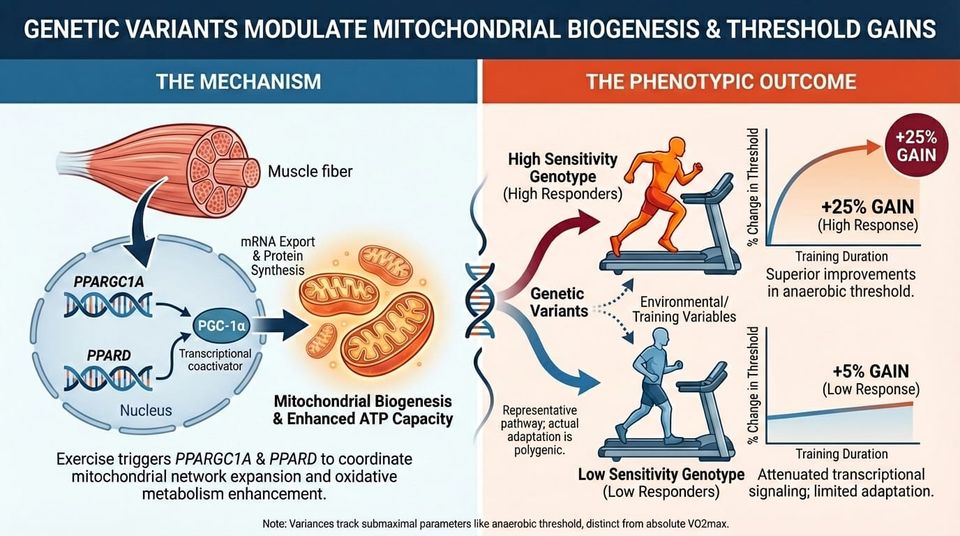
Mitochondrial biogenesis involves the expansion of the cellular mitochondrial network to enhance ATP production capacity. This adaptation is coordinated by the PPARGC1A gene, which encodes the transcriptional coactivator PGC-1α to regulate oxidative metabolism, and the PPARD gene, which influences fatty acid oxidation and oxidative muscle fiber specification.
These loci (gene locations) function within a network to influence the magnitude of cellular adaptation to training stress. Specific polymorphisms (local genetic differences) appear to enhance transcriptional sensitivity to aerobic stimuli, potentially accelerating the upregulation of oxidative capacity and mitochondrial density.
The phenotypic outcome manifests as significant inter-individual variability in training responsiveness. In select longitudinal interventions, carriers of responsive genotypes demonstrated superior improvements in anaerobic threshold—up to 120% in high responders—contrasted with modest gains (approximately 11%) in those with less favorable variants.
The Training Consequence
- Identical training loads yield highly variable metabolic adaptations; mechanical input does not guarantee a uniform metabolic output.
- "Low responders" likely possess specific variants that attenuate the transcriptional signaling pathways required for optimal increases in mitochondrial density.
- Refractory periods in threshold improvement may reflect a genetically constrained adaptive ceiling or diminished sensitivity to stimuli, rather than solely insufficient training volume or intensity.
Boundary
These variances were quantified in carriers of specific polymorphisms (such as the PPARGC1A Gly482Ser variant) following longitudinal aerobic interventions.
The reported divergence in adaptation (120% vs 11%) specifically tracks changes in submaximal parameters like anaerobic threshold, which can dissociate from changes in absolute VO2max.
References:
- Stefan et al. 2007, Genetic Variations in PPARD and PPARGC1A Determine Mitochondrial Function and Change in Aerobic Physical Fitness and Insulin Sensitivity During Lifestyle Intervention
- Lira et al. 2010, PGC-1α Regulation by Exercise Training and Its Influences on Muscle Function and Insulin Sensitivity
- Lucia et al. 2005, PPARGC1A Genotype Predicts Exceptional Endurance Capacity in European Men
PS: If you have 60 seconds, I’d value your anonymous feedback here: https://forms.gle/9BJy78gBpszUnoY76
Found this useful?
Get articles like this and free training calculators in your inbox every week.
Recommended reads
If this was useful, these are the other research-driven newsletters I actually read.
Member discussion