#OpenLab 005: The Mind as a Performance Tool: Ultra-Endurance Cycling with Jack Thompson

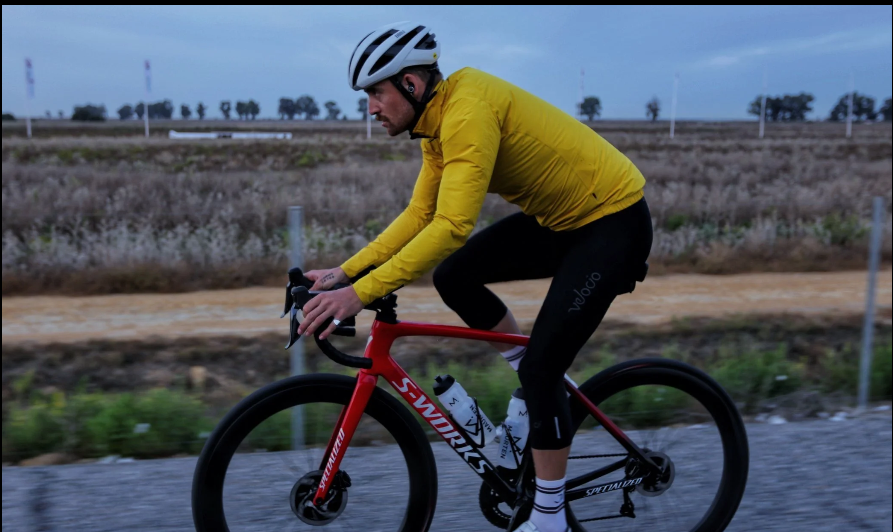
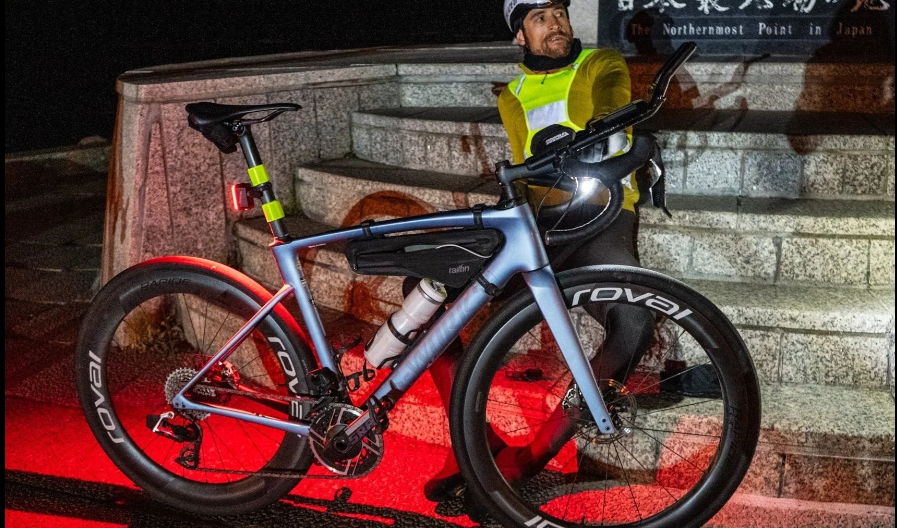
Jack Thompson is a world-record ultra-endurance cyclist who rode one million meters of elevation in 52 weeks during 2022, raising more than 500,000 euros for mental health charities. He holds the world record for crossing Japan north-to-south, and he rode the full Tour de France route solo at roughly 400 km per day for six consecutive days.
Jack was diagnosed with ADHD in 2024, a finding he credits with reframing how he understands his own performance under pressure. He relocated to Spain in 2019, and in 2025 co-founded OVERCOME Labs with former Special Forces operator Andy Williams.
His newsletter, Beyond the Bike, reaches athletes, coaches, and leadership teams. Before cycling became his craft, Jack worked in construction management, then in the corporate sector, before a period of rehabilitation in 2017 that he now calls a hard reset.
He speaks openly about addiction recovery, dopamine regulation, and neurodivergence as performance variables, not obstacles.
It is an absolute honor to have such an incredible human being on today`s #OpenLab and I hope you thoroughly enjoy this read.


Why this topic
The night before a big ride, you walk into the bathroom, look yourself in the mirror, and make a promise out loud. It's a handshake with yourself. Thirty-six hours later, somewhere on a mountain road with one eye hallucinating in the treeline and the other watching for traffic, that promise is the only thing holding the ride together.
The watts are what we write about. The handshake is what we under-write. This piece pairs the peer-reviewed ultra-endurance literature with what one of the most decorated ultra-cyclists on Earth has learned by living inside the 40th hour, and it tries to treat the mental architecture with the same seriousness we reserve for an FTP test.

Executive Summary: The Brief
The claim: mental architecture decides who finishes an ultra. Physiology decides who starts one.
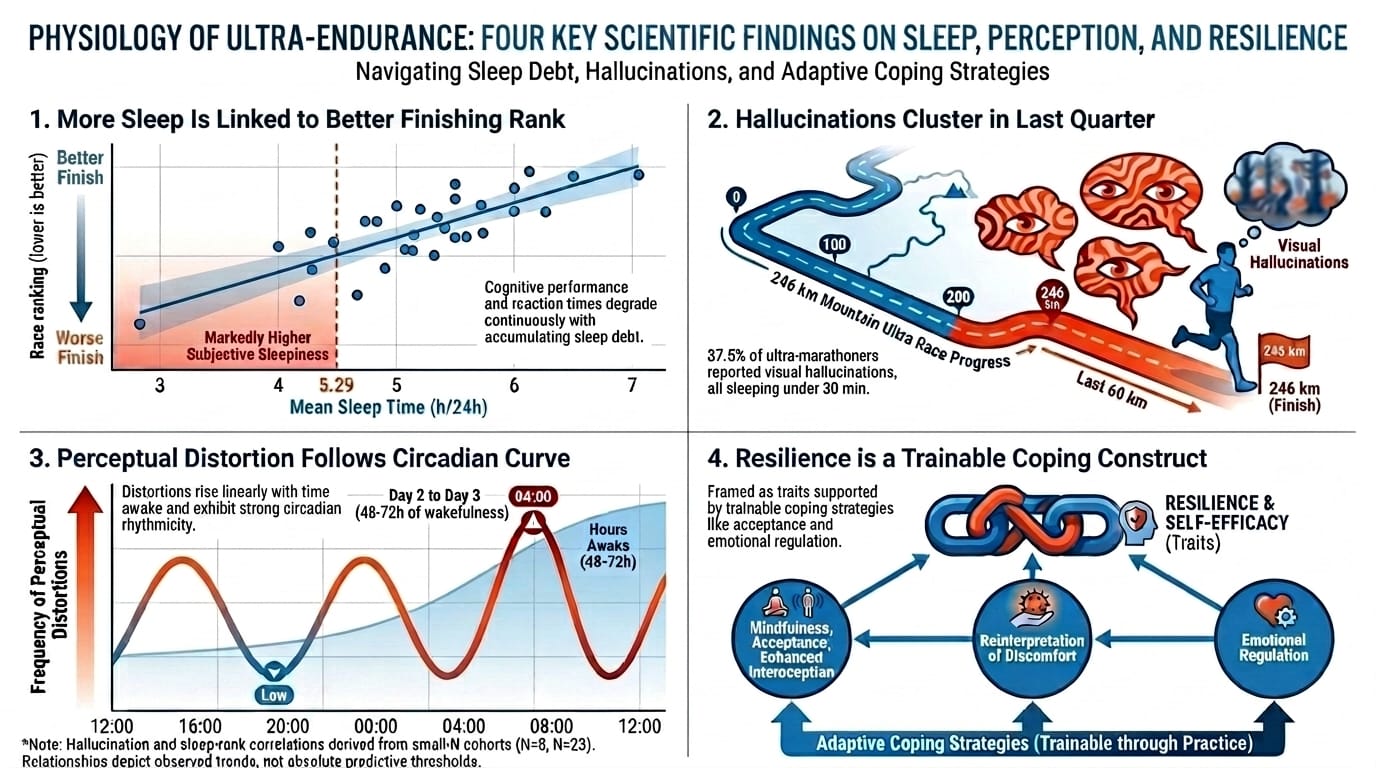
• Sleep above roughly 5.3 hours per 24-hour block tracks higher finishing rank; below that, sleepiness climbs and cognition degrades continuously, not in steps.
• Hallucinations are a plausible late-race output of a sleep-deprived brain; in one 246 km ultra, 3 of 8 subjects (37.5 percent) reported them, all clustered in the last 60 km, after altitude, heat, hypoglycaemia and dehydration were ruled out.
• Perceptual distortion under sleep deprivation rides a circadian wave, most frequent around 04:00 and least frequent between 16:00 and 20:00.
• Resilience is a trainable coping construct, acceptance, mindfulness, emotional regulation, enhanced interoception, layered on top of trait-level resilience and self-efficacy.
• Ultra-endurance populations carry a non-trivial baseline mental-health load: 18.6 percent depressive symptoms, 24.5 percent sleep disturbance, and a third or more with eating-disorder features.
What follows pairs each finding with what Jack has learned by living inside the event.
The Science at a Glance
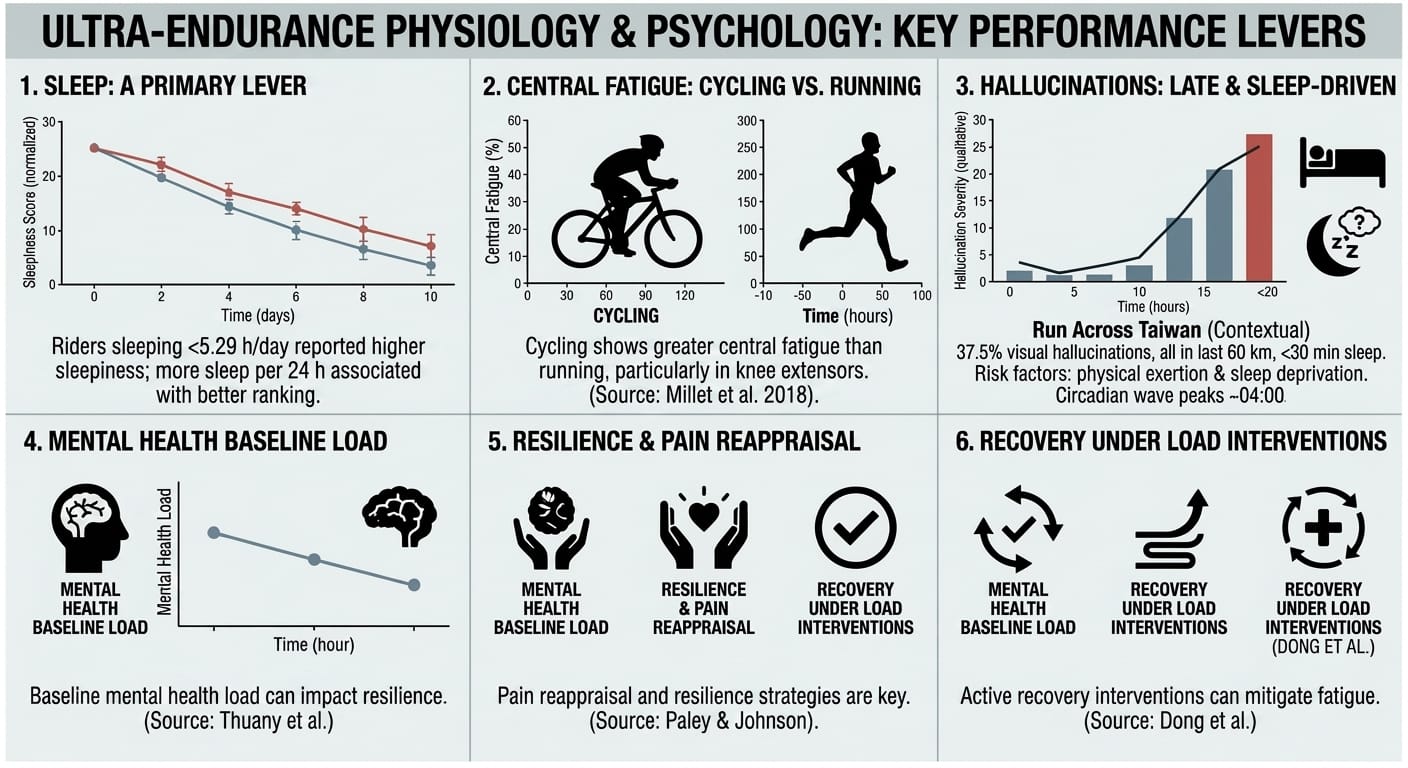
Sleep debt interacts with cognitive load, circadian timing, and pain-reappraisal skills that decide whether the rider keeps pedalling when the brain misreports the outside world.
Sleep is a dominant lever, not the tiebreaker:
In a 2026 cohort of 23 Race Across France riders, higher mean sleep per 24-hour block was associated with higher finishing rank. Riders averaging under 5.29 hours per day reported markedly more sleepiness and cognitive degradation.
A four-rider RAAM relay measured daily energy expenditure at 6,420 kcal against intake of 4,918 kcal, a deficit of 1,503 kcal per rider per day. Sleep debt and caloric debt stack.
Central nervous system fatigue behaves differently on a bike
After ultra-endurance running, voluntary muscle activation drops substantially. In ultra-endurance cycling at comparable intensity and duration, that drop is attenuated. Sleep deprivation doesn't drive central fatigue, but it elevates how hard the same effort feels.
At hour 30, you feel worse than you are, and the feeling distorts the decisions that keep the rider fuelled, warm, and on course.
Hallucinations are late, sleep-associated, and circadian:
In the 246 km Taiwan mountain ultra, three of eight subjects (37.5 percent) reported visual hallucinations, all in the last 60 km, with all eight sleeping less than 30 minutes. After altitude, thermal stress, hypoglycaemia, and dehydration were ruled out, the hallucinations were associated with sleep deprivation and excessive exertion.
Under controlled 48-to-72-hour sleep deprivation, perceptual distortions show both linear and circadian components, most frequent around 04:00 and least frequent between 16:00 and 20:00.
Mental health is a baseline variable
A systematic review pooled 11 studies and 3,670 ultra-endurance runners. Eating-disorder features ran 32.0 to 62.5 percent. Depressive symptoms 18.6 percent. Sleep disturbance 24.5 percent. This load interacts with multi-day stress in ways the acute performance literature mostly ignores.
Resilience and pain reappraisal are trainable
Elite ultra-endurance athletes reframe pain as part of the achievement reward system. Coping strategies (acceptance, reinterpretation of discomfort, mindfulness, enhanced interoception, emotional regulation) are skills layered on trait-level resilience and self-efficacy.
Under induced mental fatigue, moderate-intensity aerobic exercise, fast-paced music, and their combination have each restored working-memory performance through alertness modulation, the mechanism behind the music block at hour 30.
Scientist's Insight: The ultra-cyclists usually arrives already carrying load. Train the coping skills the same way you train watts: deliberately, repeatedly, with a rehearsed plan.
The Decision Matrix
Four levers move an ultra outcome, ranked by likely effect size and rider control.
1.Sleep time and timing
In training, protect 7 to 8 hour nights for the final 2 to 3 weeks. In the event, plan sleep blocks that keep mean per-24-hour sleep above roughly 5.3 hours, and avoid tactical calls during the 03:00 to 06:00 circadian trough.
Expected impact: higher finishing rank, cleaner night decisions, fewer wrong turns.
2.Cognitive load minimisation
Rehearse fuelling and pacing as rules that execute under a fatigued prefrontal cortex, not decisions remade every hour. Pre-program the route, let the crew navigate, and cut non-essential communication after hour 20.
The rider at hour 28 is thinking slower; decisions must be written down three weeks prior.
3.Psychological resilience and pain reappraisal
Rehearse self-talk, reframing, process goals, and explicit acceptance of discomfort. These are trainable coping strategies layered on trait-level resilience. Expect the late-race window when hallucinations cluster and name them out loud.
Misinterpretation of weirdness as pathology leads to stopping and inability to restart.
4.Music and alertness rescue
Don't rely on music in every training session. Let the nervous system generate arousal naturally, so you have that lever when you need it. Deploy music or crew-led novelty in the 04:00 trough. Habituated athletes lose the rescue effect entirely.
The Protocol and Case Study
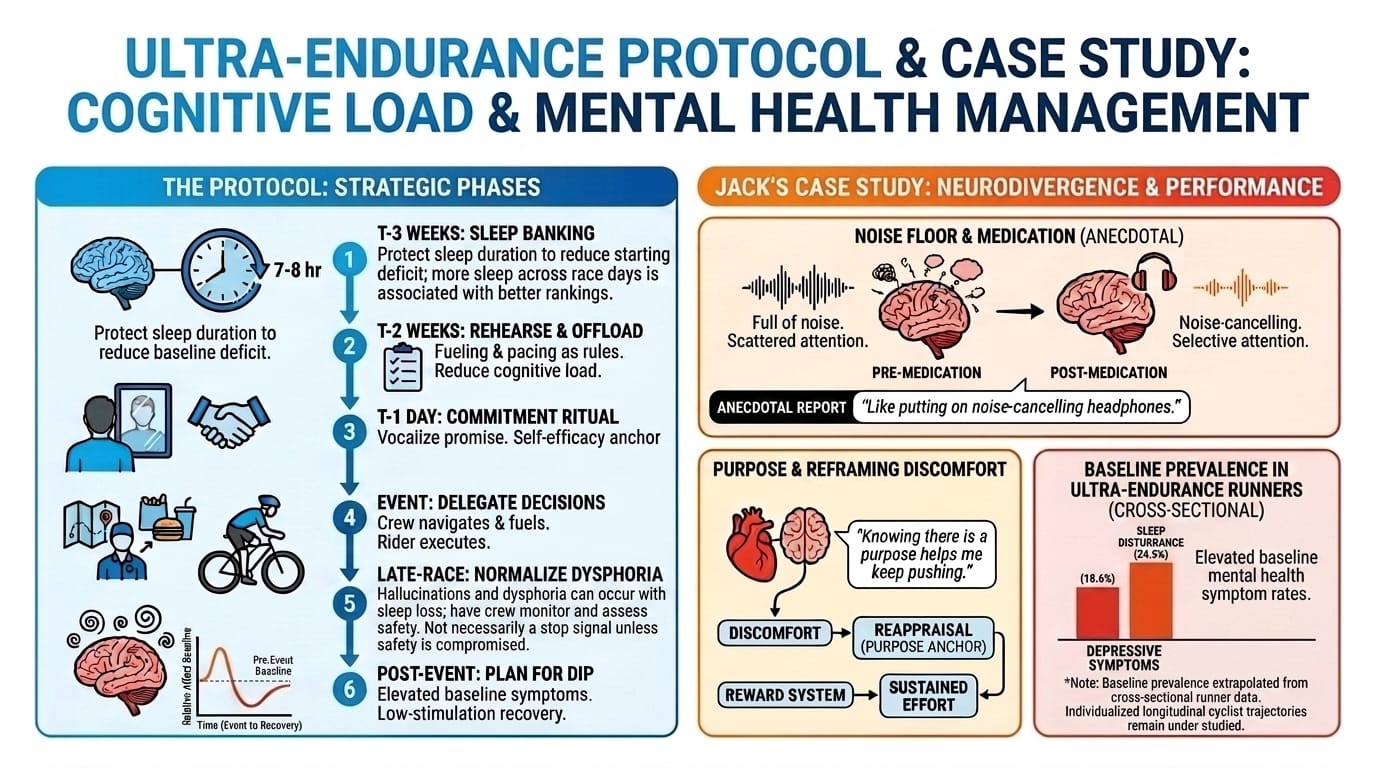
The Ultra-Protocol, in plain language
1. Three weeks out, start sleep banking. Protect 7 to 8 hour nights. Reduce the starting deficit so every night of racing costs less than the last.
2. Two weeks out, rehearse fuelling and pacing as rules. Write them down. The version of you at hour 28 is worse at math than the version writing the list today.
3. The day before, commit out loud. A mirror, a voice note, a sentence on tape stuck to the top tube. Move the promise from thought into action before the rider is tired enough to negotiate with it.
4. In the event, delegate decisions early. The crew navigates and fuels. You pedal and eat. Every decision handed off before the ride is one the fatigued brain doesn't have to make.
5. At the late-race window, name what is happening. Hallucinations are possible. Dysphoria is possible. Neither is an automatic signal to stop. Naming them keeps the executive brain in the room with the experience.
6. Post-event, plan for the blues. The ultra-running population carries elevated baseline rates of depressive symptoms and sleep disturbance. Build a low-stimulation recovery week before the next thing enters the calendar.
Jack's case
Jack has ridden 1,000,000 meters of elevation in 52 consecutive weeks, crossed Japan end-to-end solo for a world record, and ridden the Tour de France route solo at roughly 400 km per day for six days. Most of it before the 2024 ADHD diagnosis. What follows is his personal experience of "going Utra"

On the pre-medication baseline:
Before the 2024 diagnosis, I didn't have a name for what was happening. What I had was a way of managing it — and that way was structure imposed from the outside. A world record attempt is, among other things, an environment so demanding that it forces the kind of singular focus my brain had always needed but couldn't reliably generate.
Honestly, looking back, I think I was self-medicating with difficulty. The bigger the event, the quieter everything else got. At the time I read that as resilience. Now I understand it differently.
On how medication changed the noise floor:
Before the diagnosis, my brain was a busy highway. Constant traffic — thoughts, inputs, half-finished loops — running at a volume I couldn't turn down and had never known any different. I'd learned to function inside that noise because it was all I had. What medication did wasn't enhance anything. It brought me back to baseline.
The analogy I use is noise-cancelling headphones — not because they make you hear better than everyone else, but because everyone else was never dealing with the noise in the first place. It's a performance leveler, not a performance enhancer.
For the first time, I understood what it felt like to just be in a room without the highway running through it.
On cognitive load management:
I plan at a level most people don't, because I knew that by hour 30 the capacity to make good decisions would be gone, and I needed everything already resolved before that window arrived. Every system, every contingency, every logistical question — handled weeks out. By the time I lined up, there was nothing left to think about.
That gave me something more valuable than a checklist: it gave me self-trust. And self-trust, sustained over enough events, becomes genuine confidence. The other thing that planning did was clear the runway for hyperfocus — one of the genuine advantages of the way my brain works.
When the noise is low and the environment is controlled, I can lock onto a task with an intensity that most people don't have access to. I went into every major event trying to have as little unresolved noise as possible. What could be done, had been done. What was left was just riding.
On the commitment ritual:
The morning of the event, I stand in front of the mirror, look myself in the eyes, and say out loud what I'm committing to. It's one of the few controllables I have. In the hours before a major attempt, almost nothing is within my control — the weather, the road, the mechanical unknowns, how my legs will actually feel at hour 20. But the ritual is mine completely. It grounds me.
And it does something else: it creates a reference point I can return to mid-event. When things get hard — and they always get hard — I can close my eyes and see that version of myself from six hours earlier, staring back, making that contract. It's not motivation.
It's a reminder of a decision already made. You're not asking yourself whether to keep going. You're just honouring something you already agreed to.
On what the inside of the event feels like:
Around hour 30 to 35, the experience stops being athletic and becomes something closer to psychological.
Your perception of effort becomes unreliable — you feel worse than you are, and at the same time, the things that would normally tell you to stop (discomfort, fatigue, the rational voice that says this is enough) get quieter.
What I've learned is that this window is predictable, which means it's manageable. I know it's coming. I name it when it arrives. In the Taiwan hallucination data, the researchers noted that misinterpreting perceptual distortion as pathology was the biggest risk factor for stopping. That tracks with my experience exactly.
If you can look at something strange happening in your brain and think I know what this is, this is what happens at hour 35 — you stay in the event. If you treat it as a signal that something has gone wrong, you're done.
On purpose as the load-bearing variable:
Watts get you to the start line. Purpose is what decides whether you finish. The clearer and more specific the reason — not a vague sense of wanting to achieve something, but an actual named purpose tied to something outside yourself — the more load-bearing it becomes when everything else is failing.
For the Everesting year, that purpose was connected to mental health fundraising and to people who needed proof that things could get better. That's not an abstraction at hour 40. It's a real person.
It's a conversation you've had. It's weight you've chosen to carry, which makes it easier to carry than weight that's simply happening to you.
On what happens after:
I rely on routine. My morning looks the same whether I'm deep in training or in full recovery — 5am, stretch, a glass of water with electrolytes, coffee, then I open the gate and let the animals out into the field. The sameness of it is the point. It tells my nervous system that the day has started, that there's structure, regardless of what the calendar says. Beyond the routine, I focus on the parts of my life that genuinely give me joy.
Time with my wife on the farm. Working on the land, gardening, fixing fences. Things that have nothing to do with performance. For a long time my identity was almost entirely tied to Jack the cyclist — the records, the events, the next thing.
What I've come to understand is that tying your entire identity to one expression of yourself is a vulnerability. I'm Jack. He rides bikes. He has a family, he works with his hands, he enjoys simple things. That shift — genuinely making it, not just saying it — has given me more resilience than any training block I've ever done.
Take home message
Four things carry forward from this piece. Higher mean sleep per 24-hour block was associated with higher finishing rank in the best ultracycling cohort to date; riders averaging under 5.3 hours reported markedly more sleepiness and finished lower.
Hallucinations are late-race, sleep-associated, and circadian, with 37.5 percent of eight subjects reporting them and distortion most frequent between 03:00 and 06:00.
Baseline mental-health load in ultra-runners is non-trivial: 18.6 percent depressive symptoms and nearly a quarter with sleep disturbance, so the post-event dip may sit on top of a load already there.
The adaptive coping cluster (acceptance, mindfulness, reinterpretation of discomfort, emotional regulation) is trainable. Train it like you train watts.
Jack`s take home message:
The mental architecture isn't the soft part. It's the load-bearing part. And honestly, in my experience, mental training — the mindset techniques, the strategy, the deliberate work on how you think under pressure — is the most undervalued part of any athlete's preparation. We obsess over power and pacing. We track watts and heart rate and sleep quality.
But even with the strongest legs and the biggest lungs in the world, if things inside your mind aren't settled, none of it matters. Purpose, self-trust, the ability to reframe discomfort, to manage your own cognitive load, to hold onto something real when the rational brain has checked out — these are trainable. You build them the same way you build the engine.
Deliberately, repeatedly, and with a plan written down before you need it.
Scientific limits and caveats
The strongest ultracycling cohort is 23 riders. The hallucination cohort is eight subjects on a running event, so the 37.5 percent number is directional, not prescriptive.
The controlled perceptual-distortion work is from 1989, small-n, and not cycling-specific. The ADHD-in-endurance literature is thin, so Jack's framing is personal rather than an established-effect claim.
"Through his experiences, Jack has developed a strong interest in how the mind operates under pressure and how structure, discipline and purpose can help people navigate difficult periods."
We hope you enjoyed this edition of the OpenLab and we highly encourage you to go out of your comfort zone, challenge yourself and be a pioneer in your endeavours.
Cheers,
Jack Thompson and Dr. Thomas Mortelmans
References
1. Quesnel DA, et al. The Cognitive Costs of Sleep Deprivation in Ultra-Endurance Cycling: Insights From the Race Across France. J Sleep Res. 2026. PMID 41622427. . Tracked 23 Race Across France cyclists with wrist accelerometry and cognitive tests at four checkpoints; higher mean sleep per 24 hours predicted better finishing rank, and cognition degraded continuously with accumulating sleep debt.
2. Paley CA, Johnson MI. Human Resilience and Pain Coping Strategies: A Review of the Literature Giving Insights from Elite Ultra-Endurance Athletes. Sports Med. 2025;55(9):2137-2146. PMID 40676392. . Reviews how elite ultra-endurance athletes reframe pain as part of the achievement reward system, with mindfulness, acceptance, emotional regulation, and enhanced interoception as trainable coping layers on top of trait resilience and self-efficacy.
3. Hsu CC, et al. Visual hallucinations in 246-km mountain ultra-marathoners: An observational study. Chin J Physiol. 2021. PMID 34708714. . Observational study of 8 runners in the 2018 Run Across Taiwan; 3 of 8 (37.5 percent) hallucinated in the last 60 km after altitude, thermal stress, hypoglycaemia, and dehydration were ruled out, pointing to sleep deprivation and excessive exertion.
4. Babkoff H, Sing HC, Thorne DR, Genser SG, Hegge FW. Perceptual distortions and hallucinations reported during the course of sleep deprivation. Percept Mot Skills. 1989;68(3 Pt 1):787-98. PMID 2748294. . Controlled 48 to 72 hour sleep-deprivation protocol; perceptual distortions rose linearly with hours awake and peaked around 04:00, with the lowest frequency between 16:00 and 20:00.
5. Thuany M, Viljoen C, Gomes TN, Knechtle B, Scheer V. Mental Health in Ultra-Endurance Runners: A Systematic Review. Sports Med. 2023;53(10):1891-1904. PMID 37535248. . Systematic review of 11 studies covering 3,670 ultra-endurance runners; eating-disorder features ran 32.0 to 62.5 percent, depressive symptoms 18.6 percent, and sleep disturbance 24.5 percent.
6. Millet GY, Martin V, Temesi J. The role of the nervous system in neuromuscular fatigue induced by ultra-endurance exercise. Appl Physiol Nutr Metab. 2018;43(11):1151-1157. PMID 29726694. . Review showing large voluntary-activation drops after ultra-endurance running but attenuated drops in ultra-endurance cycling; sleep deprivation does not drive central fatigue but elevates perceived exertion.
7. Knechtle B, Wirth A, Knechtle P, Rüst CA, Rosemann T. A comparison of ultra-endurance cyclists in a qualifying ultra-cycling race for Paris-Brest-Paris and Race Across America-Swiss cycling marathon. Percept Mot Skills. 2012;114(1):96-110. PMID 22582679. . Compared qualifiers for Paris-Brest-Paris and Race Across America-Swiss, finding the longer race drew riders whose training emphasised intensity over raw volume.
8. Hulton AT, Lahart I, Williams KL, Godfrey R, Charlesworth S, Wilson M, Pedlar C, Whyte G. Energy expenditure in the Race Across America (RAAM). Int J Sports Med. 2010;31(7):463-7. PMID 20455193. . Doubly labelled water measurement in a 4-rider RAAM relay team; mean daily expenditure hit 6,420 kcal against 4,918 kcal intake, a 1,503 kcal per rider per day deficit.
9. Garrido E, Hüfner K. An Episode of "Third Person" Phenomenon Involving Somesthetic and Visual Hallucinations in a World-Class Extreme Altitude Climber. Wilderness Environ Med. 2023;34(4):549-552. PMID 37620238. . Case report of an elite climber experiencing a 3-hour felt-presence and visual hallucination episode at roughly 7,500 m; sleep deprivation, exhaustion, and dehydration were among the listed contributors alongside hypoxia.
10. Dong W, Hu L, Hu Q. The recovery effect of acute aerobic exercise and music intervention on working memory under mental fatigue. Exp Brain Res. 2025;243(9):194. PMID 40824498. . Tested three interventions after induced mental fatigue; moderate-intensity aerobic exercise, fast-paced music, and their combination each restored working-memory performance, attributed to alertness modulation.
11. Thompson J (interview). Beyond the Bike: Jack the Ultra Cyclist's battle with ADHD and mental health. Neurospicy Founder. 2025. . Long-form interview in which Jack discusses his 2024 ADHD diagnosis, medication experience, and how neurodivergence shapes his ultra-endurance work.
12. Thompson J. Mental health page. jackultracyclist.com. Accessed 2026-04-21. . Jack's public statement on mental health advocacy, charity fundraising totals, and the role of cycling in his recovery narrative.
13. Thompson J. About page. jackultracyclist.com. Accessed 2026-04-21. . Biographical page covering Jack's relocation to Spain, pre-cycling career, 2017 reset, and current work as a speaker and athlete.
14. OVERCOME Labs. Co-founded by Jack Thompson and Andy Williams. 2025. . Landing page for the resilience and performance consultancy Jack co-founded with former Special Forces operator Andy Williams.
15. Thompson J. Projects and records. jackultracyclist.com. Accessed 2026-04-21. . Public log of Jack's records including the 1,000,000 m elevation year, the Japan north-to-south crossing, and the solo Tour de France route ride.
---
If you have 60 seconds, I would value your anonymous feedback: [link](https://forms.gle/9BJy78gBpszUnoY76).
---
Health disclaimer
This post discusses endurance-training science for educational purposes. It is not medical advice, not a diagnosis, and not a substitute for clinical care. Individual response to training, sleep deprivation, and multi-day exertion varies substantially, and what applies to a research cohort or a world-class athlete may not apply to you.
Consult a qualified physician, sports medicine specialist, or registered dietitian before changing your training, fuelling, or sleep strategy if you have a cardiovascular, metabolic, psychiatric, or sleep-related condition; are recovering from injury or illness; are pregnant; are on medication that affects heart rate, hydration, glucose regulation, or sleep; or have concerns about exercise tolerance.
Ultra-endurance events impose real physiological and psychological loads. Persistent chest pain, fainting, acute confusion beyond the predictable late-race window, severe dehydration, sustained loss of coordination, or any mental-health symptoms that outlast the immediate post-event dip warrant professional care and are not signals to push through.
No outcome is guaranteed. The protocols, anchors, and case material in this post are descriptive, drawn from peer-reviewed evidence and a guest contributor's lived experience, and should be treated as inputs to an informed conversation with your own coach and clinicians, not as prescriptions.
Found this useful?
Get articles like this and free training calculators in your inbox every week.
Recommended reads
If this was useful, these are the other research-driven newsletters I actually read.


Member discussion