Journal Club #001: Challenging Zone 2 Optimality for Mitochondrial Health and Fitness in General Population
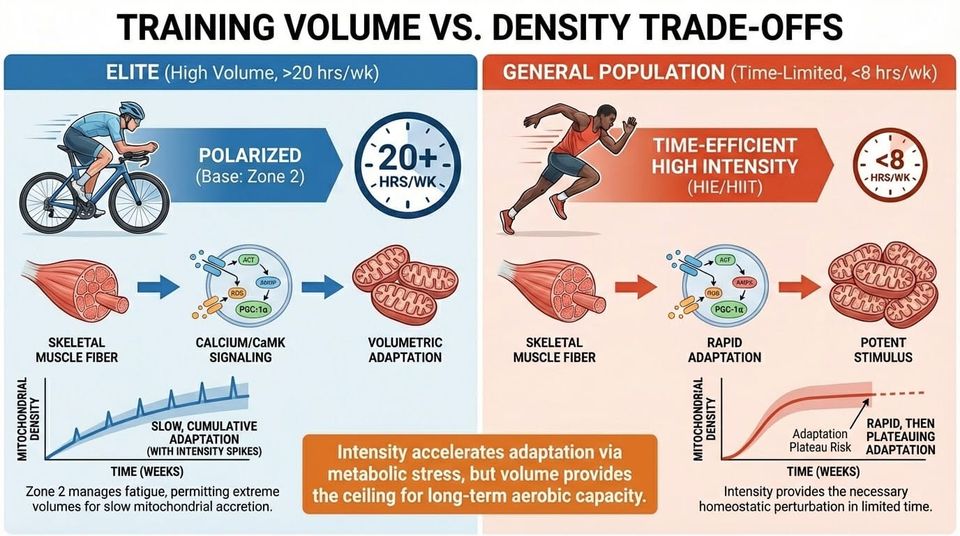
It is not often that a research paper arrives specifically to critically audit a trend currently dominating the applied physiology landscape (and social media), but this week’s selection does exactly that. If you consume fitness media or coaching literature, you are likely aware of the prevalence of "Zone 2" (low-intensity, steady-state exercise) as a proposed requisite for optimizing metabolic health, lipid oxidation, and longevity.
The prevailing narrative suggests that high-intensity exercise is excessively stressful and that the majority of training volume should be performed at a conversational pace to develop "mitochondrial capacity." This specific paper, published recently in Sports Medicine, challenges the universality of that paradigm.
The authors argue a fundamental physiological constraint: Training protocols optimized for professional cyclists accumulating 25 hours per week are not directly scalable to individuals training five hours per week. We have selected this paper for the Notebook because it addresses a critical question of dose-response and resource allocation:
For the time-limited individual, does low-intensity exercise provide a sufficient physiological stimulus to induce adaptation, or is it an inefficient application of elite training principles?
Executive Summary
- The "Zone 2" Extrapolation Error: The current popularity of Zone 2 training relies heavily on observations of elite endurance athletes. Because elites possess exceptional aerobic capacity and train predominantly at low intensity, it is often inferred that low intensity caused the capacity. This review argues that elites perform Zone 2 largely to manage fatigue and sustain total volumes exceeding 20 hours/week, not because it provides a superior per-unit-time stimulus.
- Intensity Efficiency for Time-Crunched Populations: For the general population (training <8–10 hours/week), evidence does not support Zone 2 as "optimal" for mitochondrial biogenesis. High-intensity exercise (HIE) appears to stimulate mitochondrial adaptations more rapidly and potently per minute of exercise than low-intensity work.
- Acute Oxidation vs. Chronic Adaptation: While the relative contribution of fat to energy expenditure is highest during Zone 2 exercise, this does not inherently translate to superior chronic improvements in mitochondrial fat oxidation capacity. High-intensity intervals improve oxidative enzymatic activity (e.g., CS, β-HAD) as effectively as, or more effectively than, moderate-intensity continuous training.
- The Threshold of Adaptation: Muscle fibers require sufficient homeostatic perturbation to initiate adaptive signaling. Zone 2 provides a low-magnitude stimulus. To compensate for low intensity, duration must be significantly extended (often >2 hours). For durations typical of the general population (45–60 minutes), the stimulus may be insufficient to drive further adaptation in fit individuals.
- Cardiorespiratory Fitness (VO2max): If the primary objective is increasing VO2max—a strong predictor of mortality risk—evidence consistently favors higher-intensity exercise over low-intensity steady state in time-matched comparisons.
- Recommendation: Individuals with low training volumes should prioritize intensity to compensate for lack of duration. Replacing high-intensity sessions with Zone 2 may blunt physiological adaptations if total volume remains low.
The Hypothesis & Methodology
The Question
The researchers evaluated whether Zone 2 training is mechanistically superior to higher-intensity training for enhancing mitochondrial density (content) and whole-body fat oxidation rates in non-elite populations.
The Subjects
This paper is a Narrative Review analyzing existing physiological literature. Crucially, the authors contrasted training responses between two distinct phenotypes:
- Elite Endurance Athletes: Individuals sustaining high training loads (15–25 hours/week).
- The General Population: Individuals (untrained to recreationally active) adhering to standard guidelines of roughly 150 minutes of activity per week.
The Comparison
The authors evaluated the molecular signaling and phenotypic outcomes generated by two primary training modalities:
- Zone 2 (Moderate Intensity): Exercise performed below the first lactate/ventilatory threshold (LT1/VT1). Characterized by stable blood lactate concentrations (<2.0 mmol/L) and sustainable effort.
- High-Intensity Exercise (HIE): Exercise performed above the maximal steady state, including threshold training and high-intensity interval training (HIIT/SIT).
They specifically examined whether Zone 2 provided unique mitochondrial adaptations that high intensity could not elicit.
If you want to see what I read to keep my own work sharp outside this newsletter, this is the list.
 Thomas Mortelmans
Data & Results
As a review, this paper synthesizes findings across multiple studies. The authors compared the physiological potency of Zone 2 versus High Intensity for individuals with limited training availability (<5 hours/week).
Key Finding on "Cellular Signaling":
The review highlights that exercise adaptation is driven by the disruption of cellular homeostasis.
- High Intensity creates significant metabolic perturbations (AMP/ATP ratio changes, ROS production). These signals rapidly activate PGC-1α, the "master regulator" of mitochondrial biogenesis.
- Zone 2 relies primarily on calcium signaling (CaMKII) derived from repetitive muscle contraction.
- Result: A 45-minute Zone 2 session may fail to reach the threshold of metabolic stress required to upregulate mitochondrial gene expression in individuals who are already conditioned, whereas HIE achieves this threshold rapidly.
So What?
This paper serves as a mechanism-based "reality check" for exercise prescription. Practitioners and time-constrained athletes often avoid higher intensities due to misconceptions that intensity impairs mitochondrial function. The evidence suggests that for the non-elite, intensity is a necessary catalyst for adaptation.
Implications for your Monday Workout:
If training time is limited to 60 minutes, exercising at a low metabolic rate (Zone 2) yields a diminished return on investment. You are likely not replicating the physiological state of an elite athlete on a 5-hour ride; rather, you are providing a sub-threshold stimulus. To approximate the total work and metabolic stress of a long-duration session within one hour, intensity must increase.
Do not avoid the "Grey Zone" or Threshold:
While "Polarized Training" (approx. 80% low intensity / 20% high intensity) is well-validated in elites, the "Sweet Spot" or Threshold training (Zone 3/4) is likely more efficacious for the general population (depending on total hours trained per week, of course). It provides a robust composite of mechanical and metabolic stress sufficient to drive adaptation within limited timeframes.
The "Time-Crunched Engine Builder" Protocol
Based on evidence that intensity drives mitochondrial biogenesis through AMPK and p38 MAPK pathways, here is a protocol designed to maximize the adaptive signal in a short window:
- Total Time: 50 Minutes
- Warm-Up: 10 minutes progressive ramping (easy to moderate).
- The Work (4 x 4-minute Intervals):
- Perform 4 minutes at a high aerobic intensity (above LT2/Critical Power). RPE ~8/10.
- Recovery: 3 minutes of active recovery (low watts) between reps.
- Cool Down: 10 minutes easy spinning.
Why this works: This session accumulates 16 minutes of high-turnover metabolic stress. This recruits higher-threshold motor units (Type II fibers) and triggers potent upstream regulators of mitochondrial biogenesis (such as PGC-1α isoforms) that a comparable duration of low-intensity exercise would fail to activate.
The plans you find here are built on a simple truth: Adaptation only happens when you apply the right stress, at the right time, in the right dose.
 Thomas Mortelmans
The Scientific Nuance
Of course, we should also shortly discuss the limitations of this review. While the mechanistic arguments are strong, the following context is essential:
- Narrative vs. Systematic: This is a "Narrative Review," meaning the authors selected literature to support a thesis rather than conducting a statistical meta-analysis of all available data. Selection bias regarding inclusion of intensity-favorable studies is possible.
- Definition of "General Population": The review aggregates a wide demographic—from sedentary individuals to recreational athletes. The "crossover point" where volume becomes high enough to make Zone 2 effective varies by individual training history.
- Stress Management: The paper focuses on peripheral physiological adaptation (skeletal muscle and cardiovascular). It does not account for autonomic nervous system balance. While HIE is physiologically potent, it imposes higher sympathetic stress. Zone 2 retains value for recovery and parasympathetic modulation.
- Orthopedic Load: High-intensity training generally imposes higher mechanical impact forces per step/revolution. While metabolically superior for time-crunched fitness, the risk of musculoskeletal injury may be higher compared to low-intensity volume, particularly in running.
Case Study: "The Lab in the Real World"
Let us apply this research to a hypothetical athlete named Mark, a 42-year-old accountant.
The Profile:
- History: Mark competed in cycling in his 20s.
- Current Status: He has 5 hours per week to train.
- The Problem: Influenced by longevity media, Mark adopted a 100% Zone 2 approach. He rides 1 hour, 5 days a week, capping heart rate at 135 bpm.
- The Outcome: After 6 months, Mark’s physiological markers (FTP and VO2max) have plateaued or declined. This is consistent with a failure of progressive overload.
The Intervention:
Applying the Storoschuk et al. framework, we identify that Mark’s total volume (5 hours) is insufficient for Zone 2 to act as the primary driver of mitochondrial expansion. The metabolic perturbation is too low to induce further adaptation.
We adjust Mark’s schedule:
- Tuesday/Thursday: We introduce High-Intensity Interval Training (HIIT) or Threshold work to maximize motor unit recruitment and metabolic stress.
- Saturday: We maintain one longer ride (2 hours) at Zone 2, as this duration begins to approach the threshold required for calcium-signaling efficacy.
- Sunday: Rest or active recovery.
The Result:
While the perceived exertion of the HIIT sessions is higher, the total volume remains manageable. Within 6 weeks, Mark’s VO2max likely increases due to increased stroke volume and peripheral oxygen extraction. His capacity to oxidize fat improves as a consequence of increased mitochondrial density driven by intensity, rather than substrate manipulation during training.
This paper validates the efficacy of intensity for the time-constrained athlete. While the polarized, high-volume model is optimal for the professional specialist, the general population must rely on the metabolic efficiency of higher-intensity training. Adaptation requires a potent signal; for those on a limited schedule, intensity provides that signal.
Best regards,
Dr. Thomas Mortelmans
Referral program

To grow a community of endurance athletes who care about the how and the why behind training, we will be starting a referral program for The Scientist’s Notebook.
If you find the newsletter useful and know someone who trains with intent and wants to understand mechanisms instead of slogans, you can share your personal link. Subscriptions through that link are tracked automatically.
When a referral threshold is reached, the corresponding reward unlocks without manual steps.
If this helps you think more clearly about training, feel free to pass it on. Your referral link and progress tracker are below.
Referral

Referrals

Referrals

Referrals

Referrals

Referrals
Annotated References
Primary Source:
Storoschuk, K. L., Moran‑MacDonald, A., Gibala, M. J., & Gurd, B. J. (2025). Much Ado About Zone 2: A Narrative Review Assessing the Efficacy of Zone 2 Training for Improving Mitochondrial Capacity and Cardiorespiratory Fitness in the General Population. Sports Medicine.
- Gibala, M. J., et al. (2006). Short-term sprint interval versus traditional endurance training: similar initial adaptations in human skeletal muscle and exercise performance.
Summary: A seminal study demonstrating that low-volume sprint interval training can induce mitochondrial adaptations comparable to high-volume endurance training in the short term. - Seiler, S. (2010). What is best practice for training intensity and duration distribution in endurance athletes?
Summary: This paper characterized the "80/20" polarized distribution in elite athletes, emphasizing that such distributions are necessitated by extremely high total training volumes. - Bishop, D. J., et al. (2019). High-intensity exercise and mitochondrial biogenesis: current controversies and future research directions.
Summary: A comprehensive review of cellular mechanisms, indicating that exercise intensity is a key determinant of PGC-1α activation and mitochondrial biogenesis, particularly when volume is matched or limited.
Found this useful?
Get articles like this and free training calculators in your inbox every week.
Recommended reads
If this was useful, these are the other research-driven newsletters I actually read.
Member discussion