Snippet #023: Heavy Resistance Training Increases Tendon Stiffness to Reduce Running Metabolic Demand
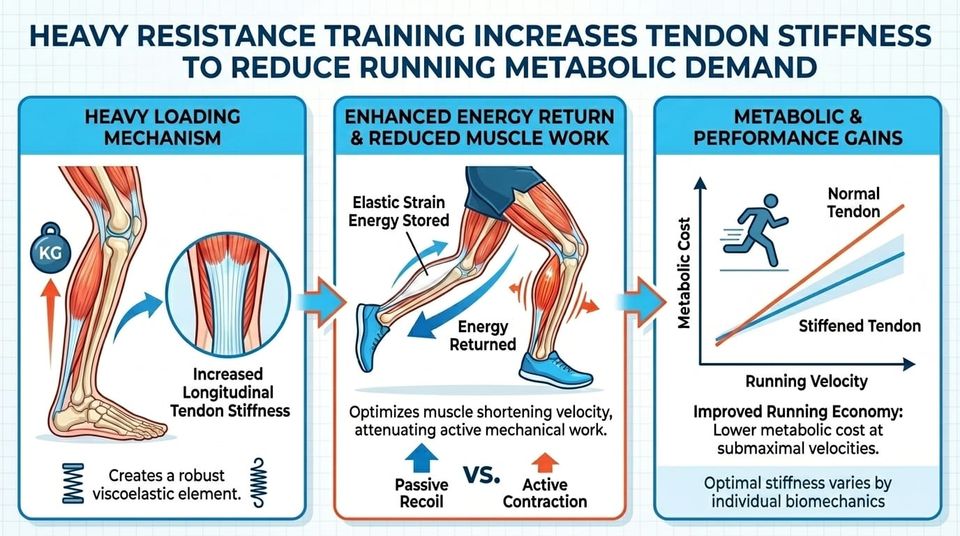
Maximal-strength training involving heavy loads alters the mechanical properties of connective tissue, specifically increasing the longitudinal stiffness of the Achilles tendon. Rather than restricting joint excursion, this increased stiffness allows the tendon to function as a more robust viscoelastic element. During the stance phase of the running stride, these stiffened tendons store and return elastic strain energy more favorably.
This mechanism optimizes the shortening velocity of the associated muscle fascicles, decreasing the amount of active mechanical work the muscle fibers must perform.
By increasing the relative contribution of passive elastic recoil to total external work, the metabolic cost of active muscle contraction is attenuated, which frequently manifests as improved running economy.
Gradescale: Your physiology, decoded. Join the waitlist now.
 Thomas Mortelmans
This physiological adaptation means the body expends less metabolic energy to maintain a given submaximal velocity, potentially delaying peripheral neuromuscular fatigue during prolonged endurance efforts.
Evidence suggests these specific economy improvements are often most pronounced in well-trained athletes with high baseline aerobic capacities running at faster, race-relevant speeds, rather than in moderately trained recreational runners.
References
- Fletcher et al. 2010, Changes in Tendon Stiffness and Running Economy in Highly Trained Distance Runners
- Støren et al. 2008, Maximal Strength Training Improves Running Economy in Distance Runners
- Balsalobre-Fernández et al. 2016, Effects of Strength Training on Running Economy in Highly Trained Runners: A Systematic Review With Meta-Analysis of Controlled Trials
Found this useful?
Get articles like this and free training calculators in your inbox every week.
Recommended reads
If this was useful, these are the other research-driven newsletters I actually read.
Member discussion