Entry #025: Training load metrics — Fitness/fatigue balance, acute:chronic workload ratio, decoupling.
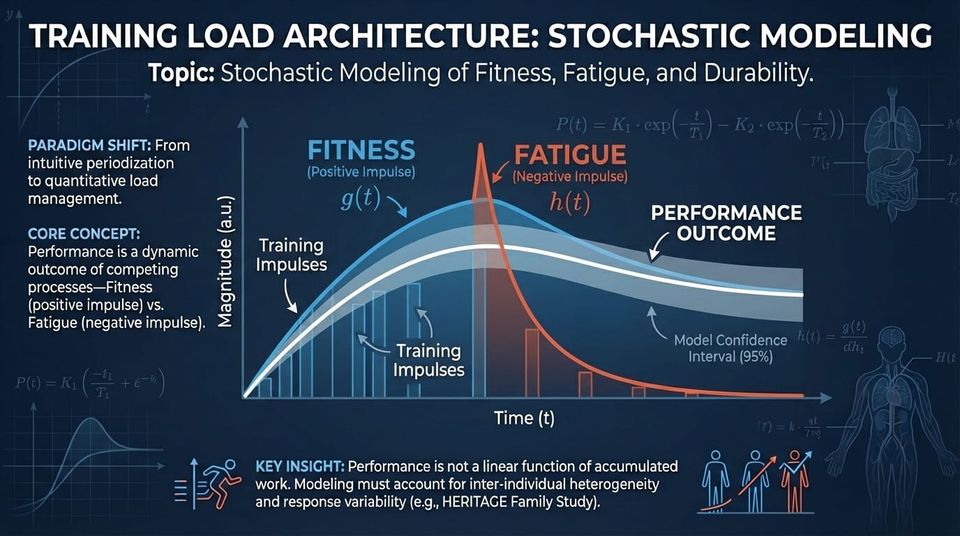
The transition from intuitive periodization to quantitative load management represents a paradigm shift in high-performance physiology. While the foundational premise—that training stress induces homeostatic disturbance followed by supercompensation—remains valid, the mathematical modeling of these dynamics has revealed significant complexity.
We now understand that performance is not a linear function of accumulated work, but a dynamic outcome of competing processes: fitness (positive impulse) and fatigue (negative impulse), each governed by distinct decay kinetics.
This briefing dissects the Banister impulse-response model, the statistical properties of the Acute:Chronic Workload Ratio (ACWR), and the physiological mechanics of internal-external load decoupling. The objective is to move beyond reductive "traffic light" systems toward a multivariate understanding of adaptation, acknowledging the substantial inter-individual heterogeneity and response variability demonstrated in large-scale cohorts like the HERITAGE Family Study.
Executive Summary – The Brief
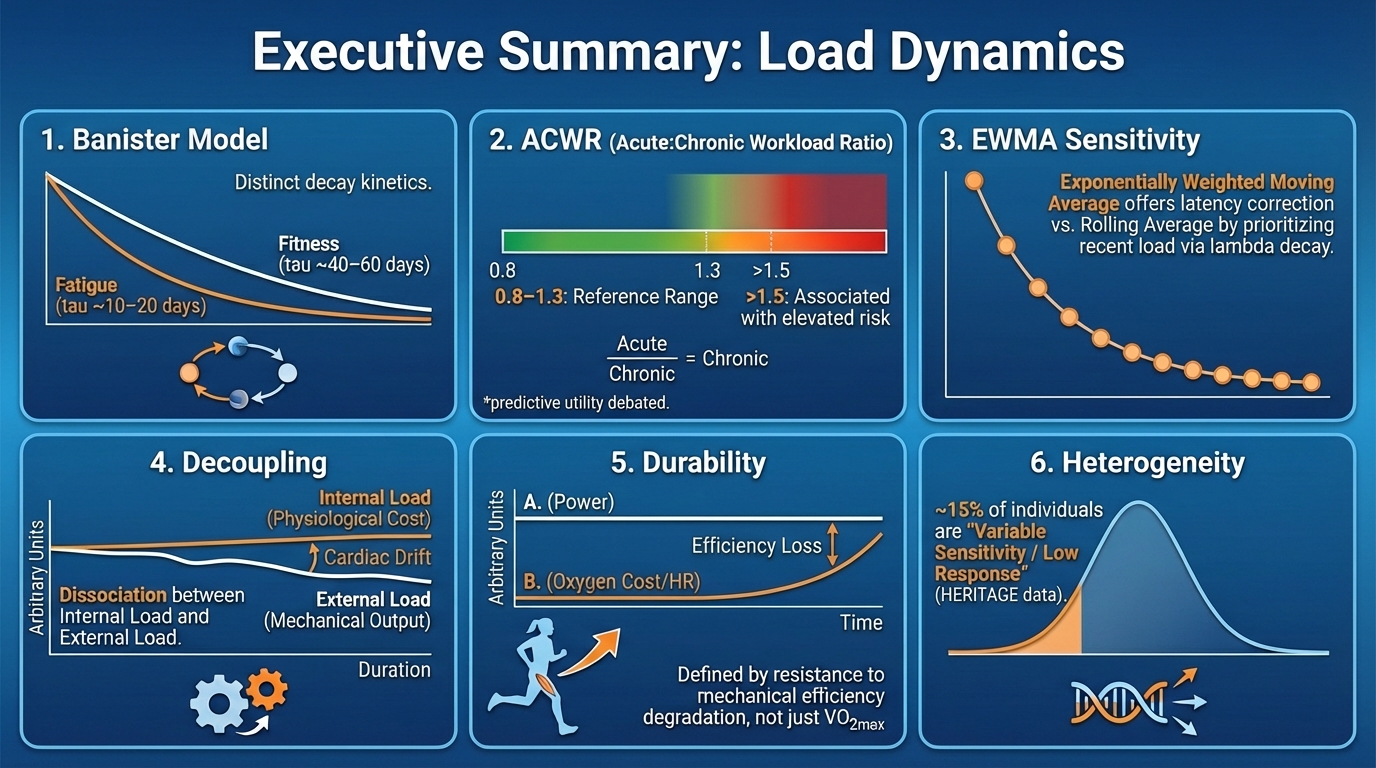
• The Fitness-Fatigue Model (Banister) mathematically decomposes training effects into two antagonistic vectors: fitness and fatigue.
• Fitness is characterized by a time constant of ~40–60 days. Fatigue is characterized by a time constant of ~10–20 days, necessitating distinct management strategies.
• The Acute:Chronic Workload Ratio (ACWR) operationalizes the relationship between recent and cumulative load. While a range of 0.8–1.3 is statistically associated with lower risk. Values >1.5 correlate with non-linear increases in injury probability, though this is population-dependent.
• Exponentially Weighted Moving Average (EWMA) calculations provide superior sensitivity to Rolling Average (RA) models by accounting for the temporal decay of biological stress, prioritizing recent load via a decay factor (lambda).
• Decoupling represents the dissociation between internal load (physiological cost) and external load (mechanical output); in marathon runners, performance variance is often better predicted by the magnitude of decoupling (durability) than by $\text{VO}_2\text{max}$ alone.
• Mechanical efficiency degradation drives decoupling: research indicates significant declines in speed at fixed heart rates post-threshold, implicating neuromuscular fatigue and Type II fiber recruitment rather than sole cardiorespiratory drift.
• Genetic heterogeneity is a critical confounder.
• Data suggests approximately 15% of individuals are "low responders" to standardized aerobic stimuli, necessitating individualized dose-response calibration beyond population means.
Gradescale: Your physiology, decoded. Join the waitlist now.
 Thomas Mortelmans
The Science at a Glance
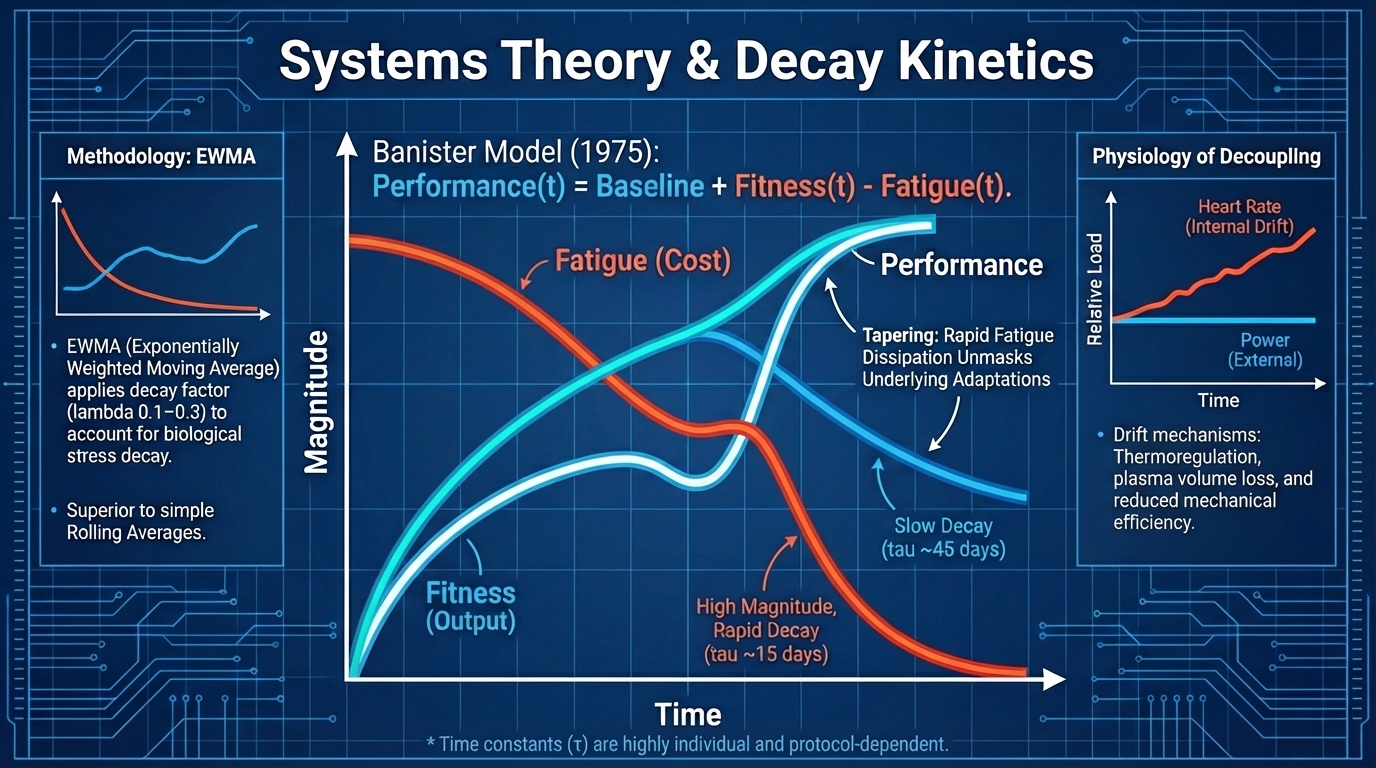
The theoretical bedrock of modern load monitoring is the systems theory framework introduced by Banister (1975). This model posits that performance at any time (t) is the result of a baseline capacity plus the convolution of training impulses through two transfer functions: a fitness term and a fatigue term.
The critical physiological insight is the temporal asymmetry of these curves: fatigue is high-magnitude but short-duration (decaying rapidly, 15 days). Fitness is lower-magnitude but persistent (decaying slowly, 45 days). This asymmetry allows for tapering, where the rapid dissipation of fatigue unmasks the underlying fitness adaptations.
• Contemporary application has coalesced around the ACWR, which compares acute load (typically a 7-day weighted load) to chronic load.
• Chronic load is typically a 28-day weighted load.
Distinct from load magnitude is the concept of "decoupling." In a fresh state, internal load (Heart Rate) and external load (Power/Speed) maintain a linear relationship. Under fatigue, this relationship dissociates. Research on large cohorts indicates that high decoupling is driven primarily by a loss of mechanical efficiency—likely due to progressive recruitment of less efficient Type II muscle fibers and kinematic degradation—rather than cardiac drift alone.
This makes decoupling a proxy for "durability," defined as the capacity to attenuate the deterioration of economy over time.
Table 1 — The Decision Matrix
The Protocol
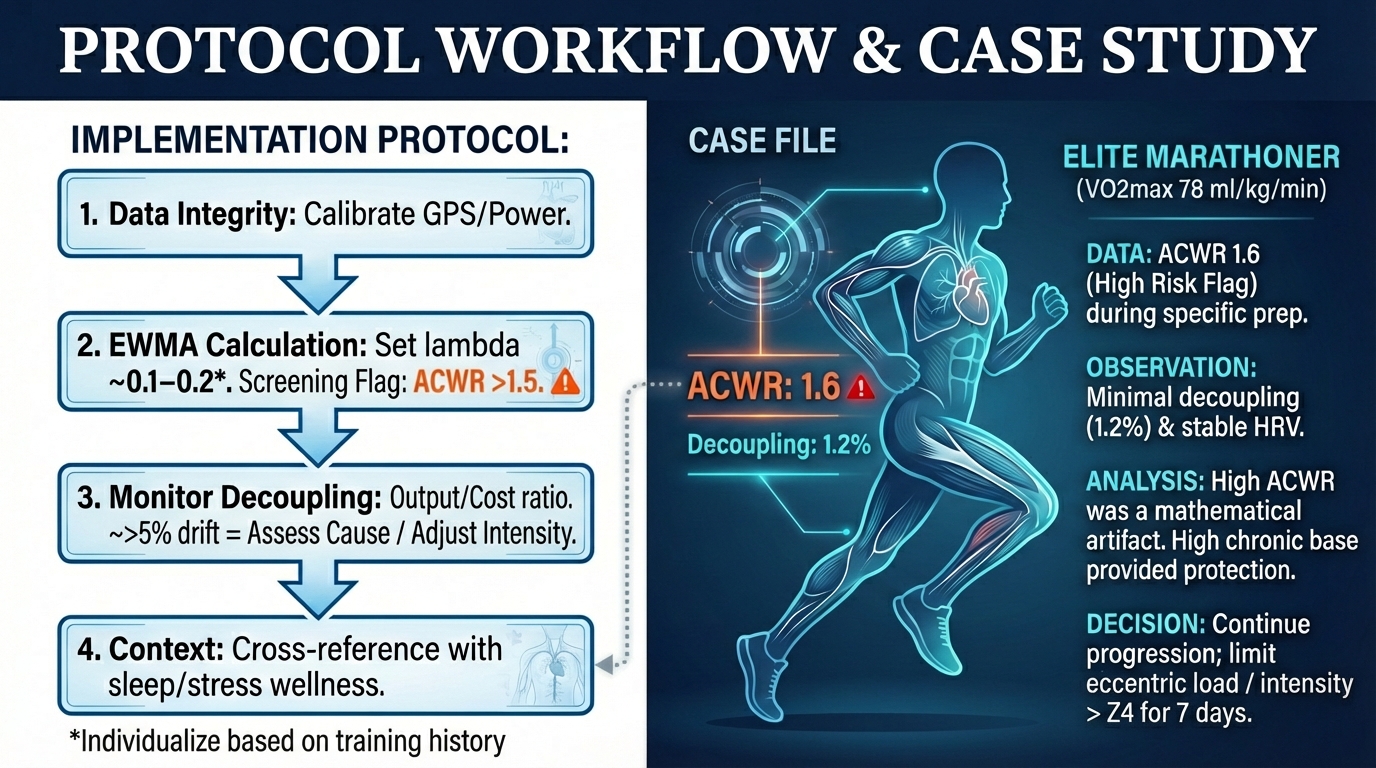
1. Establish Data Integrity: Standardize external load measurement (GPS/Power) and internal load (HR/sRPE). Ensure consistent device calibration to minimize signal-to-noise ratio errors.
2. Calculate EWMA ACWR: Use a lambda appropriate for the time constant (e.g., approx 0.1-0.2 for chronic load). Flag values <0.8 (detraining risk). Flag values >1.3–1.5 (overreaching risk).
3. Monitor Decoupling: In steady-state sessions >60 minutes, calculate the ratio of Output (Power/Speed) to Cost (HR). Quantify the percentage drift in the second half relative to the first half.
4. Contextualize with Wellness: Cross-reference load metrics with subjective wellness (sleep, stress). A high ACWR is tolerated differently in a low-allostatic-load context versus a high-stress context.
5. Autoregulate: If Decoupling exceeds 5% significantly earlier than established baselines, terminate the session or reduce intensity. This indicates a failure of mechanical efficiency potentially preceding metabolic failure.
Limits of Application
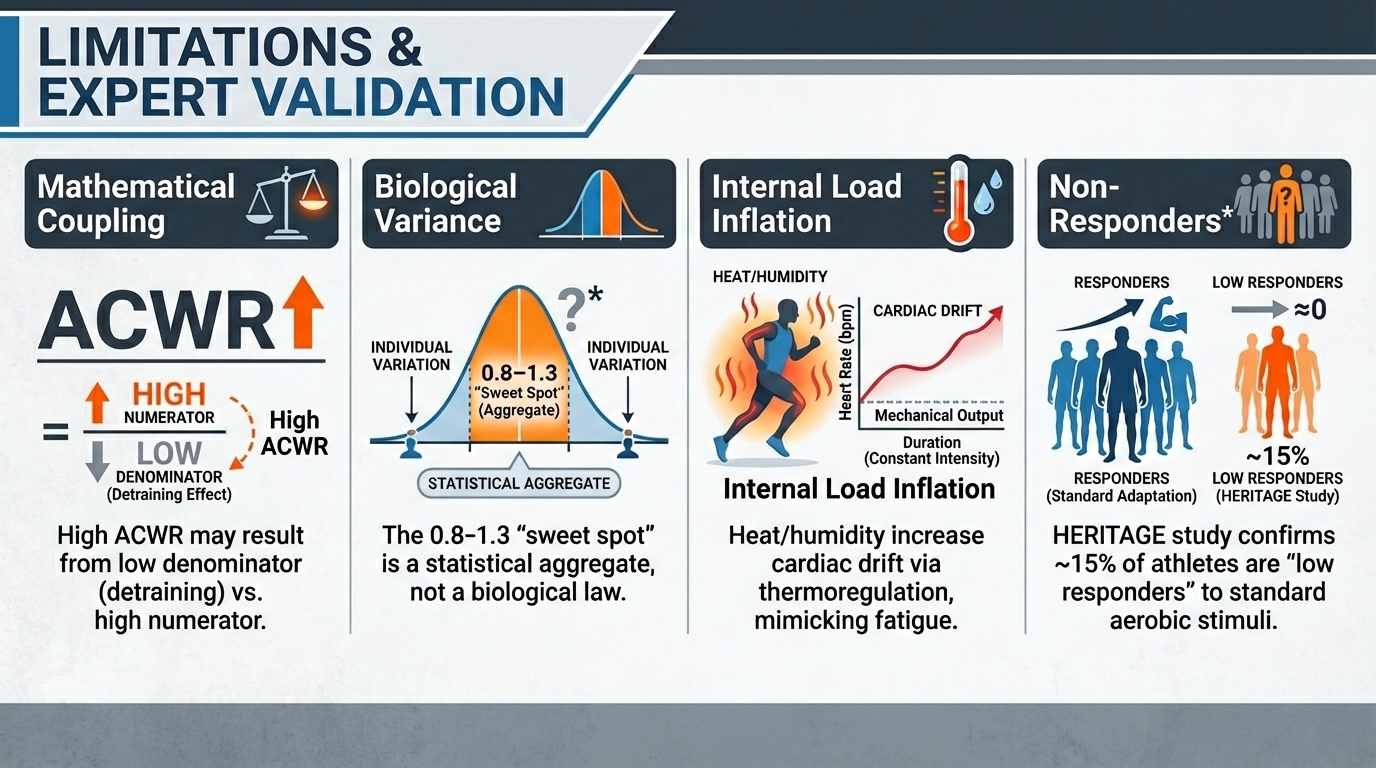
The models discussed possess inherent limitations. The ACWR is subject to mathematical coupling and spurious correlations; a high ratio can result from a low denominator (detraining) rather than a critically high numerator. Furthermore, the "sweet spot" (0.8–1.3) is a statistical aggregate, not a biological law; elite athletes often tolerate higher ratios due to superior genetic robustness and training history.
Decoupling metrics are strongly influenced by environmental confounders (heat/humidity), which increase cardiac drift via thermoregulatory blood flow redistribution independent of neuromuscular fatigue.
Finally, the HERITAGE study confirms that ~15% of athletes are "low responders" to standard aerobic stimuli, implying that standardized load management may still yield negligible physiological adaptation in specific genotypic subpopulations.
Best regards,
Dr. Thomas Mortelmans
Disclaimer
The information provided in this newsletter is for educational purposes only and does not constitute medical advice. Exercise physiology is highly individual; what works for elite populations may not apply to everyone. Always consult with a physician before making significant changes to your training, nutrition, or supplementation protocols. The Scientist's Notebook and ESQ Coaching accept no liability for injuries or health issues arising from the application of these concepts.
References
- Monitoring Training Load to Understand Fatigue in Athletes
- Overtraining Syndrome: A Practical Guide
- Training Load and Fatigue Marker Associations with Injury and Illness
- Cold-water immersion for preventing and treating muscle soreness after exercise
- Training Load and Its Role in Injury Prevention, Part I: Back to the Future
- Current Concepts in Periodization of Strength and Conditioning for the Sports Physical Therapist
- Trends Assessing Neuromuscular Fatigue in Team Sports
- Assessing the limitations of the Banister model in monitoring training
- The Sleep and Recovery Practices of Athletes
- Blood-Based Biomarkers for Managing Workload in Athletes
- Inter-individual variation in adaptations to endurance training
- Heart Rate Variability Applications in Strength and Conditioning
- Decoupling of Internal and External Workload During a Marathon
- Methods of Monitoring Internal and External Loads in Adolescent Athletes
- Monitoring Resistance Training in Real Time with Wearable Technology
Found this useful?
Get articles like this and free training calculators in your inbox every week.
Recommended reads
If this was useful, these are the other research-driven newsletters I actually read.



Member discussion