One Rep Max Calculator
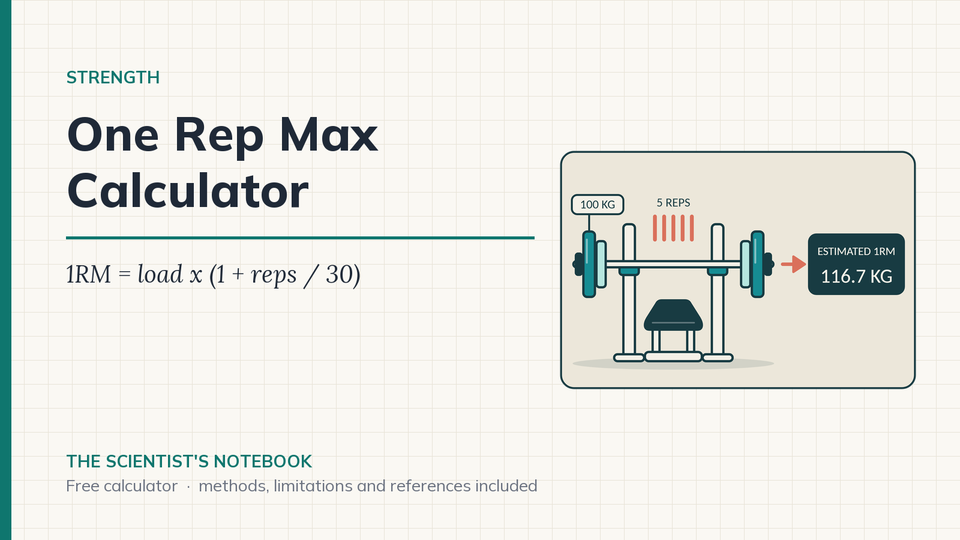
You do not need to grind out a true max to know roughly where your strength sits. This calculator takes one hard set, runs it through seven published repetition-based equations, and gives you an estimated one rep max in kilograms with a table of working loads.
In short: A one rep max calculator turns one hard set into an estimate of the heaviest load you could lift once. It uses seven published rep-based equations and shows the mean of Epley, Brzycki and Lombardi. A set of about 5 reps close to failure gives the best estimate, and accuracy falls above 10 reps.
How does the calculator estimate a one rep max?
Every equation turns the load you lifted w (kg) and the repetitions you completed r into an estimate of the load you could lift once. The headline value is the mean of the three most widely used: Epley, Brzycki and Lombardi. The other four are shown so you can see the spread.
- Epley:
1RM = w x (1 + r / 30) - Brzycki:
1RM = 36 x w / (37 - r) - Lombardi:
1RM = w x r0.10 - Mayhew:
1RM = 100 x w / (52.2 + 41.9 x e-0.055 r) - O'Conner:
1RM = w x (1 + 0.025 x r) - Wathan:
1RM = 100 x w / (48.8 + 53.8 x e-0.075 r) - Lander:
1RM = 100 x w / (101.3 - 2.67123 x r)
With one rep, the load you lifted is the 1RM, so every equation returns it unchanged. The percentage table runs from 100 % down to 50 % of 1RM in 5 % steps. It multiplies the mean by each percentage and estimates the repetitions you could do at that load by inverting Epley (r = 30 x (1/p - 1)) and Brzycki (r = 37 - 36 x p), where p is the fraction of 1RM.
Worked example. You squat 100 kg for 5 clean reps, finishing close to failure. Epley gives 116.7 kg, Brzycki 112.5 kg and Lombardi 117.5 kg. The mean is 115.5 kg, which is what the calculator shows. The other four equations range from 112.5 to 119.0 kg, so the honest statement is "about 115 kg, give or take a few". At 80 % of 115.5 kg you would load 92.4 kg, which both inverse equations put at about 8 reps.
How should I use my estimated 1RM?
- Set loads for a heavy strength block. If your plan calls for heavy sets of low reps, use the percentage table to turn a target percentage into a load for each lift, then redo a hard set every few weeks to update the estimate.
- Track strength without testing a max. A 5-rep set at a known load gives you an estimated 1RM you can compare from month to month. Keep the exercise, depth, rest time and time of day the same, because the estimate is only as repeatable as the set behind it.
- Check strength against body mass. Divide the estimated 1RM by your body mass to see how your leg strength compares across a season of weight change. Pair it with the weight impact calculator when a mass change might cost you more strength than it saves you on climbs.
How accurate is a 1RM estimated from reps?
- Accuracy falls with reps. In 70 adults, a 5RM predicted the 1RM best, and the authors concluded that no more than 10 repetitions should be used in linear equations for the bench press and leg press (Reynolds 2006). The calculator warns above 10 reps and again above 15, and accepts sets of 1 to 30 reps with a load above 0 and up to 1,000 kg.
- The equations disagree. At 5 reps they differ by about 6 %. At 20 reps, an 80 kg set gives anywhere from 108 to 169 kg depending on the equation. That spread is the real uncertainty.
- Reps at a given percentage depend on the lift. More repetitions are possible with the leg press than the bench press at the same percentage of 1RM. In a meta-regression of 7289 people, sex, age and training status had little influence on that relationship (Nuzzo 2024). In trained and untrained men, 60 % of 1RM allowed more reps in the back squat than in the bench press or arm curl (Shimano 2006).
- The set must end near failure. If you stopped with 4 reps left, the estimate comes out low. If your last reps were partial, it comes out high.
- Even a tested max wobbles. Across 32 studies of test-retest reliability the median coefficient of variation of a directly tested 1RM was 4.2 %, with a range of 0.5 to 12.1 % (Grgic 2020). An estimate from reps adds equation error on top of that.
- These are group equations. Their original sources are books and journals not indexed in PubMed, so the samples they were fitted to could not be checked here. They may fit your technique, bar speed or injury history poorly.
⚠️ HEALTH & TRAINING GUIDANCE
Individual results vary significantly. Lift heavy sets close to failure with a spotter or safety bars, and consult a sports medicine professional or qualified coach before testing a maximum or changing your strength training based on these estimates.
ℹ️ IMPORTANT DISCLAIMER
This calculator is for educational purposes only and does NOT constitute medical advice. Consult qualified professionals before making changes. Individual physiology varies. You assume all risk. Must be 18+.
Frequently asked questions
Which one rep max formula is most accurate?
No single equation wins for every lift. The calculator shows the mean of Epley, Brzycki and Lombardi and lists all seven, so you can see the spread. At 5 reps they differ by about 6 %. At 20 reps an 80 kg set gives anywhere from 108 to 169 kg, and that spread is the real uncertainty.
How many reps should I use to estimate my 1RM?
Use a hard set of about 5 reps taken close to failure. In 70 adults a 5RM predicted the 1RM best, and the authors concluded that no more than 10 repetitions should be used in linear equations (Reynolds 2006).
What is my 1RM from 100 kg for 5 reps?
Epley gives 116.7 kg, Brzycki 112.5 kg and Lombardi 117.5 kg, so the calculator shows 115.5 kg. The other four equations range from 112.5 to 119.0 kg, so about 115 kg is the honest summary.
How many reps can I do at 80 % of my 1RM?
Inverting Epley and Brzycki gives about 8 reps at 80 % of 1RM. Real rep counts differ by lift: more reps are possible with the leg press than the bench press at the same percentage (Nuzzo 2024).
How much does a tested 1RM vary from day to day?
Across 32 studies the median coefficient of variation of a directly tested 1RM was 4.2 %, with a range of 0.5 to 12.1 % (Grgic 2020). An estimate from reps adds equation error on top of that.
Related calculators
References
- Reynolds JM et al. · 2006 · J Strength Cond Res · PMID 16937972 · doi
- Nuzzo JL et al. · 2024 · Sports Med · PMID 37792272 · doi
- Shimano T et al. · 2006 · J Strength Cond Res · PMID 17194239 · doi
- Grgic J et al. · 2020 · Sports Med Open · PMID 32681399 · doi
- LeSuer DA et al. · 1997 · J Strength Cond Res 11(4):211-213 · not indexed in PubMed
- Brzycki M · 1993 · J Phys Educ Recreat Dance 64(1):88-90 · not indexed in PubMed · doi
- Epley B 1985 (Poundage chart), Lombardi VP 1989 (Beginning Weight Training), O'Conner B et al. 1989 (Weight Training Today), Mayhew JL et al. 1992 (J Appl Sport Sci Res 6(4):200-206), Wathan D 1994 (Essentials of Strength Training and Conditioning), Lander J 1985 (NSCA Journal 6(6):60-61) · original equation sources, not indexed in PubMed