Sleep Efficiency Calculator
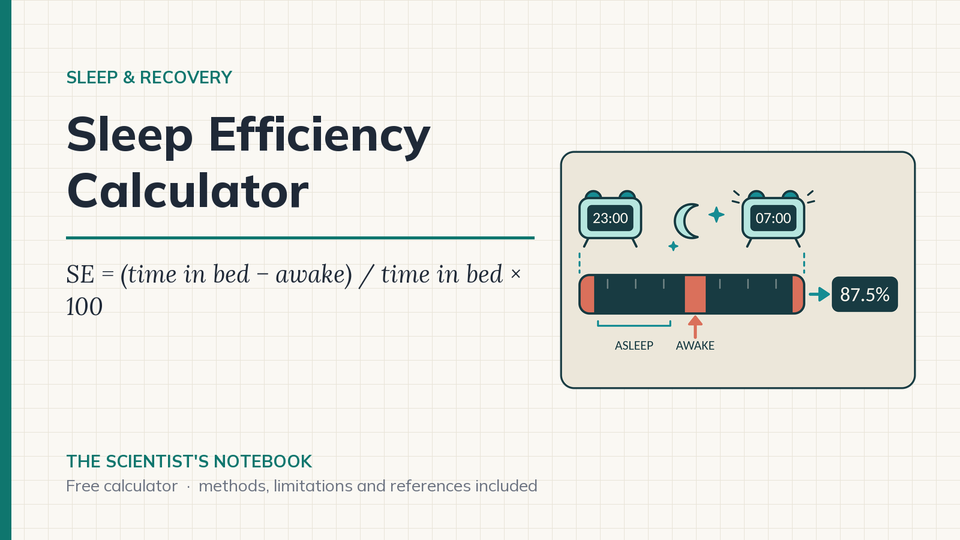
Sleep efficiency is the share of your time in bed that you actually spend asleep. Enter last night from your sleep diary and this calculator works out total sleep time and efficiency, then sets the result beside the National Sleep Foundation consensus values.
In short: Sleep efficiency is the share of your time in bed spent asleep: total sleep time divided by time in bed, times 100. With 480 minutes in bed and 60 minutes awake, you slept 420 minutes and your efficiency is 87.5%. The calculator sets the result beside the 85% value quoted from the National Sleep Foundation consensus.
How is sleep efficiency calculated?
TIB = get-up time − lights-out time
Awake = SOL + WASO + EMA
TST = TIB − Awake
SE (%) = TST / TIB × 100
- TIB is time in bed in minutes, from lights out to the final get-up.
- SOL is the minutes you took to fall asleep.
- WASO is the minutes you were awake after first falling asleep, added up over the night.
- EMA is the minutes you lay awake after your final awakening before getting up.
- TST is total sleep time in minutes.
You must enter all three awake figures. Type 0 where there was none. The tool does not fill in a typical value for you. Time in bed must be 1 to 18 hours (60 to 1080 min), and outside 3 to 12 hours you get a check-the-times warning. Each awake figure must lie between 0 and the time in bed, and together they cannot exceed it.
Reference values. The National Sleep Foundation consensus panel (Ohayon 2017) agreed that sleep efficiency is an appropriate indicator of good sleep quality across the life span. Later papers quote the cut-offs as 85% or more for the appropriate range and 74% or less for the range the panel did not rate as appropriate. I use three bands, read from the value shown at one decimal: 85.0% and above, 75.0 to 84.9%, and below 75.0%. For wake after sleep onset, the value citing papers quote for adults from the same consensus is 20 minutes or less, and the tool flags anything above that.
Optional second figure. Reed and Sacco (2016) pointed out that dividing by all time in bed counts reading or scrolling in bed as failed sleep. They proposed dividing by the duration of the sleep episode instead. If you enter the minutes you spent in bed awake but not trying to sleep, the tool also reports TST / (TIB − those minutes) × 100.
Worked example
Lights out at 23:00, final get-up at 07:00, so TIB = 480 min (8 h). It took 20 min to fall asleep, you were awake for 30 min in the night and 10 min before getting up.
- Awake = 20 + 30 + 10 = 60 min.
- TST = 480 − 60 = 420 min, which is 7 h.
- SE = 420 / 480 × 100 = 87.5%, above the 85% reference. WASO of 30 min is above the 20 min value quoted for adults, so that line is flagged.
A harder night: 23:30 to 06:30 is 420 min in bed. Awake 45 + 60 + 30 = 135 min. TST = 285 min and SE = 285 / 420 × 100 = 67.9%, below 75%.
How should I use the result?
- Check a tracker against your diary. Seven consumer trackers tested against laboratory polysomnography caught sleep well (sensitivity 0.93 or more), but their specificity for wake was only low to medium (0.18 to 0.54), and they did worse on disrupted nights (Chinoy 2021). If your watch says 95% and your diary says 82%, the diary is not necessarily the wrong one.
- Track a pattern, not a night. Use the same diary format for two weeks. A single poor night after a late dinner, a hard evening session or a hotel bed is a sample of one. Put the weekly totals into the sleep debt calculator.
- Look at where the minutes go. If most of the awake time is falling asleep, check bedtime and caffeine with the caffeine half-life calculator and the bedtime grid in the sleep cycle calculator. If it is waking in the night, note what came before it: alcohol, a late meal, heat, a long evening session. Bring the diary to a clinician if poor nights persist.
What are the limits of this calculator?
- The awake minutes are estimates. In the Sleep Heart Health Study (2,113 adults aged 40 and over), habitual sleep time reported on a questionnaire was about 61 minutes above polysomnography, and the next-morning estimate about 18 minutes above (Silva 2007). Self-report usually overstates sleep, and that raises the efficiency you calculate.
- Trackers miss part of the wake time, as above, so they tend to count it as sleep. Their efficiency figure and yours measure different things.
- The 85% and 74% cut-offs are as quoted in papers that cite the consensus. I could read the consensus abstract but not the full table, so check the table before you quote the bands. Papers citing the consensus do not all quote the same cut-offs, especially for older adults.
- The consensus describes healthy sleep quality in a population. It does not tell you whether your own sleep is a problem, and a result below a band is not an assessment of any condition.
- Efficiency rises when time in bed is short, so a high value can sit beside too little sleep. Read it next to total sleep time and your own need.
- Sleep apnoea, restless legs, pain, shift work and some medicines can lower efficiency. This calculator cannot see any of them.
⚠️ HEALTH & TRAINING GUIDANCE
Sleep problems have many causes. If poor sleep or daytime sleepiness persists, talk to a doctor or sleep clinician instead of relying on these estimates.
ℹ️ IMPORTANT DISCLAIMER
This calculator is for educational purposes only and does NOT constitute medical advice. Consult qualified professionals before making changes. Individual physiology varies. You assume all risk. Must be 18+.
Frequently asked questions
How do I calculate sleep efficiency?
Add the minutes it took to fall asleep, the minutes awake in the night and the minutes awake before getting up. Subtract that from your time in bed to get total sleep time, then divide by time in bed and multiply by 100. For 8 h in bed with 20, 30 and 10 minutes awake, that gives 87.5%.
What is a good sleep efficiency?
The National Sleep Foundation panel agreed that sleep efficiency is an appropriate indicator of good sleep quality (Ohayon 2017). Papers citing it quote 85% or more as appropriate and 74% or less as not appropriate. The calculator shows three bands: 85.0% and above, 75.0 to 84.9%, and below 75.0%.
Why does my sleep tracker show a higher efficiency than my diary?
Seven consumer trackers tested against polysomnography detected sleep with a sensitivity of 0.93 or more, but their specificity for wake was only 0.18 to 0.54 (Chinoy 2021). They miss part of the wake time and count it as sleep, so their efficiency can read higher than a diary.
Should reading in bed count against my sleep efficiency?
Reed and Sacco 2016 argued that it should not. They proposed dividing by the duration of the sleep episode instead of all time in bed. Enter the minutes you spent in bed not trying to sleep and the calculator reports that second figure as well.
Related calculators
- Caffeine Half-Life and Bedtime Cutoff Calculator
- HRV Baseline Calculator
- Sauna Heat-Adaptation Planner
- Sleep Cycle Calculator: Bedtime and Wake-Up Times
- All calculators on The Scientist's Notebook
References
- Ohayon M, Wickwire EM, Hirshkowitz M, et al. · 2017 · Sleep Health · PMID 28346153 · doi
- Reed DL, Sacco WP · 2016 · J Clin Sleep Med · PMID 26194727 · doi
- Silva GE, Goodwin JL, Sherrill DL, et al. · 2007 · J Clin Sleep Med · PMID 17993045
- Chinoy ED, Cuellar JA, Huwa KE, et al. · 2021 · Sleep · PMID 33378539 · doi