Sauna Heat-Adaptation Planner
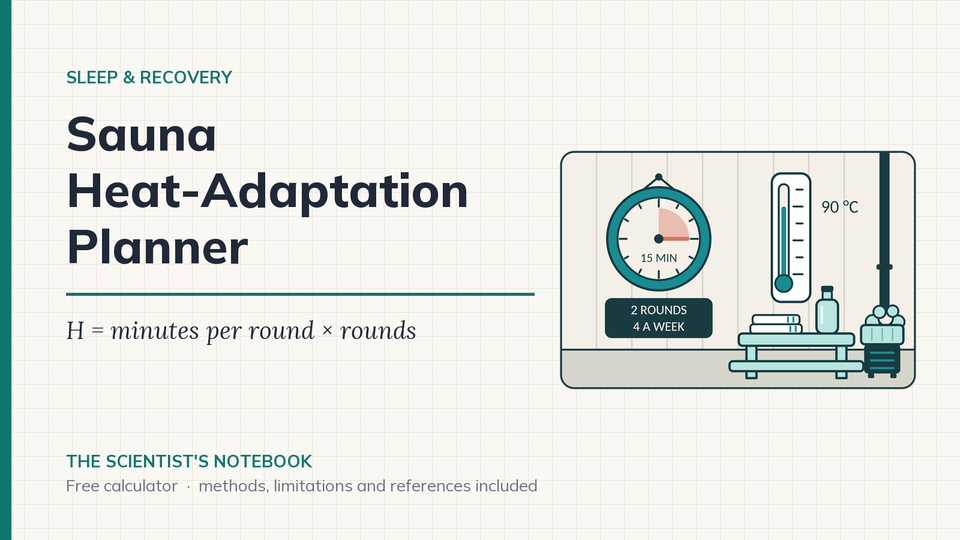
Sitting in a sauna after training is a heat-adaptation method that needs no heat chamber. This planner turns a temperature, a round length and a weekly frequency into a block of sessions inside hard limits, and sets the block beside the two published studies of post-exercise sauna in runners and cyclists.
Read this first. The planner is for adults 18 and over. Some answers stop it and show no plan: a condition or medicine on the question list, any doubt about it, alcohol, or no fluids ready. The full safety notice is below the limitations.
In short: The planner multiplies minutes per round by rounds to get your time in the heat per session, then totals the block over your sessions per week and weeks. It never prints a plan above 90°C or with more than 3 rounds, and it compares the block with Scoon 2007: 31 minutes on 12.7 occasions over 3 weeks.
How is the sauna block calculated?
The arithmetic is short:
H = minutes per round × rounds (time in the heat per session)
Session length = H + rest × (rounds − 1)
Block minutes = H × sessions per week × weeks
The block is then compared with Scoon 2007: 393.7 minutes in the heat, which is 31 minutes on 12.7 occasions, over 3 weeks.
The two studies behind the planner
- Scoon 2007. Six male distance runners did 3 weeks of sauna bathing straight after training and 3 weeks of control training, with a 3 week washout between them. The sauna was humid at 89.9 ± 2.0°C, for 31 ± 5 minutes on 12.7 ± 2.1 occasions. Against control, run time to exhaustion rose 32% (90% confidence limits 21 to 43%) in a run of about 15 minutes, which the authors equated to roughly 1.9% in a time trial. Plasma volume rose 7.1% (5.6 to 8.7%) and red-cell volume 3.5% (−0.8 to 8.1%).
- Stanley 2015. Seven well-trained male cyclists took 30 minutes at 87°C, 11% relative humidity, straight after normal training for 10 days. Plasma volume expansion peaked after four exposures at +17.8% (90% confidence limits 7.4 to 29.2%). The study had no performance outcome.
- Range in the review literature. Studies reviewed by Kukkonen-Harjula and Kauppinen used 80 to 90°C, with exposures of 5 to 20 minutes repeated one to three times.
The hard limits
The limits below are mine and they are not published thresholds. Every one of them sits inside the protocols above, so the planner never prints a plan hotter, longer or more repeated than the cited experiments.
- Temperature: the plan never goes above 90°C, the top of the 80 to 90°C in the reviewed experiments. Scoon used 89.9°C and Stanley 87°C.
- One round: 30 minutes, the length used by Scoon (31 minutes) and Stanley (30 minutes). 10 minutes for your first five sessions.
- Time in the heat per session: 45 minutes, 20 minutes for your first five sessions. If your rounds would add up to more, the number of rounds drops.
- At most 3 rounds, as in exposures repeated one to three times (2 for your first five sessions), and at least 5 minutes out of the heat between rounds.
- At most 7 sessions per week (3 while you are new to sauna).
Every change is listed in the results, with the reason, and the first safety notice above the result says what was reduced.
The form accepts 40 to 120°C, 1 to 90 minutes per round, 1 to 10 rounds, 0 to 60 minutes between rounds, 1 to 14 sessions per week, 1 to 12 weeks and ages 18 to 100. Anything outside those bounds is an input error, and a value read in °F gets the conversion °C = (°F − 32) / 1.8. Below 60°C, or for a block longer than 3 weeks, you still get a plan, with a warning that the studies did not test it.
Worked example
90°C, 2 rounds of 15 minutes, 10 minutes out between rounds, 4 sessions per week for 3 weeks, not new to sauna.
- H = 15 × 2 = 30 min. Session length = 30 + 10 × 1 = 40 min.
- Per week: 30 × 4 = 120 min. Block: 12 sessions and 360 min.
- Against Scoon: 360 / 393.7 = 0.9 × the minutes and 12 / 12.7 = 0.9 × the sessions.
A request of 105°C, 25 minutes × 5 rounds, 2 minutes rest and 9 sessions per week becomes 90°C, one round of 25 minutes (5 rounds drop to 3, and 45 minutes in the heat leave room for one round of 25), no rest because there is only one round, and 7 sessions per week.
Cohort data, as association only
In the Kuopio Ischaemic Heart Disease cohort (2,315 Finnish men, median follow-up 20.7 years), men who reported 4 to 7 sauna sessions per week had a hazard ratio for sudden cardiac death of 0.37 (95% CI 0.18 to 0.75) against once a week. For 2 to 3 sessions the ratio was 0.78 (0.57 to 1.07), and that interval includes 1. Sessions over 19 minutes had a ratio of 0.48 (0.31 to 0.75) against sessions under 11 minutes (Laukkanen 2015). For dementia the ratios were 0.78 (0.57 to 1.06) and 0.34 (0.16 to 0.71) (Laukkanen 2017).
These are associations in one group of men. The data come from habits reported at the start, so healthier men may simply have used saunas more often, and the numbers do not show what a sauna block would do for you. The planner prints them beside your plan for context. It does not recommend a frequency.
How should I use the result?
- Before a hot race. Both studies put sauna after normal training sessions. Neither compared sauna with training in the heat. Use the block as an addition you can discuss with your coach, and check race-day conditions in the heat adjustment calculator.
- Compare totals. The comparison line shows whether your block is 0.5 times or 1.5 times the Scoon minutes. Treat a block far above 1 with caution, because no study here tested one. In Stanley 2015 plasma volume peaked after four exposures in seven cyclists. That is a small sample, not a target.
- Handle fluids as part of the session. Weigh yourself before and after. In Shirreffs 1996, volumes equal to 50, 100, 150 and 200% of the body mass lost were compared, and a volume larger than the sweat loss had to be drunk to restore fluid balance. After a hard session you start from a deficit, so drink before you go in.
What are the limits of this planner?
- The samples are small and all male: 6 runners (Scoon 2007) and 7 cyclists (Stanley 2015). Scoon's performance test was a run of about 15 minutes to exhaustion, and red-cell volume changed by 3.5% with limits from −0.8 to 8.1%.
- Scoon used a humid sauna, Stanley a sauna at 11% humidity. The cohort data are mostly dry Finnish sauna. Infrared cabins are not covered by any of these studies.
- The cohort ratios are observational. They cannot rule out confounding or reverse causation, and the 2 to 3 sessions per week ratio for sudden cardiac death has an interval that includes 1.
- The hard limits are conservative planning caps set by The Scientist's Notebook. The condition question is deliberately broader than the three contraindications listed by Hannuksela and Ellahham 2001 (unstable angina, recent heart attack, severe aortic stenosis), so any reported condition stops the planner.
- Alcohol during sauna bathing is linked in that review with low blood pressure, irregular rhythm and sudden death. Antihypertensive medicine can make a person light-headed after bathing (Kukkonen-Harjula 2006).
- Sauna after training adds heat strain and fluid loss to a body that is already warm. No study here tested training in hot weather followed by sauna.
- The planner cannot see your health. It gives no verdict on whether sauna suits you.
🚨 CRITICAL SAFETY WARNING - Heat Stroke Risk
This calculator involves extreme heat conditions that can cause serious injury or life-threatening complications if misapplied.
EMERGENCY SYMPTOMS - Seek immediate medical attention if you experience:
- Confusion, disorientation, or altered mental status
- Hot, dry skin OR profuse sweating with cold, clammy skin
- A racing or irregular heartbeat, or chest pain
- Severe headache, dizziness, or loss of coordination
- Nausea, vomiting, fainting, or loss of consciousness
DO NOT use this calculator if you have:
- Heart disease, high blood pressure, or cardiovascular conditions
- Diabetes or metabolic disorders
- Kidney disease or electrolyte disorders
- History of heat illness (heat stroke, heat exhaustion)
- Are taking medications (diuretics, beta-blockers, ACE inhibitors, stimulants)
- Are pregnant or nursing
- Are under 18 years of age
- Plan to skip the build-up (the planner holds your first five sessions to 10 minute rounds at up to 90°C)
HARD LIMITS BUILT INTO THIS PLANNER:
- Temperature: the plan never goes above 90°C
- One round: 30 minutes, 10 minutes for your first five sessions
- Time in the heat per session: 45 minutes, 20 minutes for your first five sessions
- Rounds: at most 3, and 2 for your first five sessions
- Between rounds: at least 5 minutes out of the heat
- Sessions per week: at most 7, and 3 while you are new to sauna
- Alcohol: no plan is shown if you plan to drink before or during the sauna
- Fluids: no plan is shown unless you have fluids ready and are drinking before you go in
Ask a doctor first: These limits are planning caps set by The Scientist's Notebook, held inside the 80 to 90°C and the round lengths of the cited experiments. They are not published safety thresholds, and they do not tell you that sauna suits you. If anything on the list above applies to you, or you are not sure, ask your doctor before you use a sauna.
ℹ️ IMPORTANT DISCLAIMER
This calculator is for educational purposes only and does NOT constitute medical advice. Consult qualified professionals before making changes. Individual physiology varies. You assume all risk. Must be 18+.
Frequently asked questions
How long were the sauna sessions in the studies?
In Scoon 2007, six male runners sat in a humid sauna at 89.9°C for 31 minutes straight after training, on 12.7 occasions over 3 weeks. In Stanley 2015, seven cyclists took 30 minutes at 87°C after training over 10 days. The planner caps one round at 30 minutes and time in the heat at 45 minutes per session.
Why does the planner never go above 90°C?
90°C is the top of the 80 to 90°C used in the sauna experiments reviewed by Kukkonen-Harjula and Kauppinen, and Scoon used 89.9°C. A higher entry is reduced to 90°C, and the first safety notice above the result says so. The limits are planning caps set by The Scientist's Notebook, not published thresholds.
Why does the planner stop and show no plan?
It stops if you report a condition or medicine on the question list, are not sure about one, have alcohol before or during the sauna, or have no fluids ready. Hannuksela and Ellahham 2001 list unstable angina, recent heart attack and severe aortic stenosis as contraindications, and link alcohol during sauna bathing with low blood pressure, irregular rhythm and sudden death.
Does frequent sauna use lower the risk of sudden cardiac death?
In 2,315 Finnish men, those who reported 4 to 7 sessions per week had a hazard ratio for sudden cardiac death of 0.37 (95% CI 0.18 to 0.75) against once a week (Laukkanen 2015). That is an association in one group of men, and it does not show what a sauna block would do for you.
How much should I drink after a sauna session?
Weigh yourself before and after. In Shirreffs 1996, drinks equal to 50, 100, 150 and 200% of the body mass lost were compared, and a volume larger than the sweat loss had to be drunk to restore fluid balance. The planner shows no plan unless you have fluids ready.
Related calculators
- Caffeine Half-Life and Bedtime Cutoff Calculator
- HRV Baseline Calculator
- Sleep Cycle Calculator: Bedtime and Wake-Up Times
- Sleep Debt Calculator: Need vs Actual Sleep
- All calculators on The Scientist's Notebook
References
- Scoon GS, Hopkins WG, Mayhew S, Cotter JD · 2007 · J Sci Med Sport · PMID 16877041 · doi
- Stanley J, Halliday A, D'Auria S, Buchheit M, Leicht AS · 2015 · Eur J Appl Physiol · PMID 25432420 · doi
- Laukkanen T, Khan H, Zaccardi F, Laukkanen JA · 2015 · JAMA Intern Med · PMID 25705824 · doi
- Laukkanen T, Kunutsor S, Kauhanen J, Laukkanen JA · 2017 · Age Ageing · PMID 27932366 · doi
- Hannuksela ML, Ellahham S · 2001 · Am J Med · PMID 11165553 · doi
- Kukkonen-Harjula K, Kauppinen K · 2006 · Int J Circumpolar Health · PMID 16871826 · doi
- Shirreffs SM, Taylor AJ, Leiper JB, Maughan RJ · 1996 · Med Sci Sports Exerc · PMID 8897383 · doi