Sleep Cycle Calculator: Bedtime and Wake-Up Times
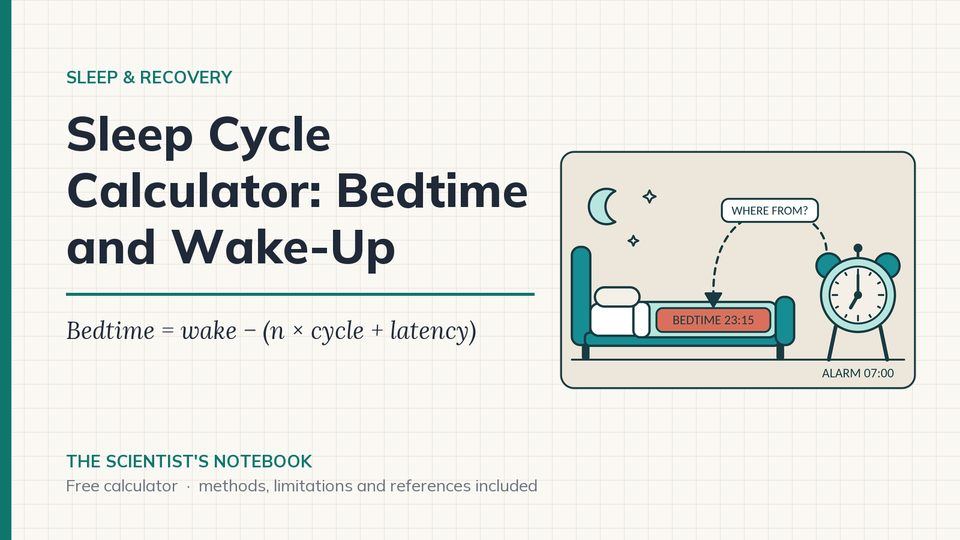
Sleep runs in repeating cycles, usually planned as blocks of about 90 minutes. Give this calculator a wake-up time or a bedtime and it lists the times that fit whole cycles, then checks the sleep time against the National Sleep Foundation range for your age group.
In short: The sleep cycle calculator lists bedtimes for a fixed wake-up time, or wake-up times for a fixed bedtime, in 3 to 6 whole sleep cycles. It adds the minutes you take to fall asleep, uses a 90 minute cycle you can change, and checks each option against the National Sleep Foundation range: 7 to 9 hours for ages 18 to 64 and 7 to 8 hours from 65.
How are the bedtimes and wake-up times calculated?
The arithmetic is plain addition and subtraction on the clock:
Bedtime = wake time − (n × c + L)
Wake time = bedtime + L + n × c
- n is the number of sleep cycles, from 3 to 6.
- c is the cycle length in minutes. It starts at 90, the textbook average, which I use as a planning convention because I could not verify a primary source for it. You can change it from 70 to 120.
- L is the time you take to fall asleep, in minutes, from 0 to 120. You enter it. I do not assume one.
Sleep time in hours is n × c / 60. That figure is compared with the range the National Sleep Foundation consensus panel gave for healthy people with normal sleep: 7 to 9 hours for young adults and adults (18 to 64) and 7 to 8 hours for older adults (65 and over) (Hirshkowitz 2015). The suggested row is the one inside your range and closest to its midpoint (8 h, or 7.5 h from 65).
Worked example
You must be up at 07:00. You are 34 and usually take 15 minutes to fall asleep, with 90-minute cycles.
- 5 cycles: 5 × 90 = 450 min of sleep, plus 15 min to fall asleep = 465 min, which is 7 h 45 min. 07:00 minus 7 h 45 min = 23:15. Sleep time 7.5 h, inside the 7 to 9 h range.
- 6 cycles: 540 + 15 = 555 min. Bedtime 21:45. Sleep time 9.0 h, at the top of the range.
- 4 cycles: 360 + 15 = 375 min. Bedtime 00:45. Sleep time 6.0 h, below the range.
The tool marks 5 cycles as the suggestion because 7.5 h sits closer to 8 h than 9.0 h does.
What the cycle idea does and does not show
Tassi and Muzet reviewed sleep inertia, the groggy stretch after waking. Waking out of slow wave sleep produced more of it than waking from stage 1 or 2, and without major sleep loss it rarely lasted beyond 30 minutes. That fits the idea of ending sleep at the edge of a cycle. It is indirect support. I know of no trial in the review showing that cycle-timed alarms improve how you feel or perform, so treat the times as a grid to test.
How should I use the result?
- Early training blocks. If the alarm is fixed at 05:30 for a pool or a long ride, enter it and read the bedtimes. With 15 minutes to fall asleep, 5 cycles puts you in bed at 21:45. Compare that with the bedtime you really keep and see the gap in hours.
- Race eve. Wake at 05:00 and fall asleep slowly because of nerves: enter 30 minutes. Five 90-minute cycles plus 30 minutes is 480 min, so lights out at 21:00. Put the real latency in. The number you hope for is the wrong input.
- Test, then adjust. Use one grid time for a week. Change the cycle length to 80 or 100 and see if you wake easier. Log the nights in the sleep efficiency calculator and check the week in the sleep debt calculator. If caffeine sits late in your day, run it through the caffeine half-life calculator.
What are the limits of this calculator?
- Cycle length varies between people and across the night. The 90-minute figure is an average used for planning, not a measured value for you.
- The time to fall asleep changes from night to night. A longer or shorter latency moves every time in the table by the same number of minutes.
- The NSF panel wrote its ranges for healthy people with normal sleep. It also noted that sleep needs differ from person to person (Hirshkowitz 2015). The calculator accepts ages 18 to 100.
- Sleep inertia depends on the stage you wake from, how much sleep you have lost and your body clock phase (Tassi 2000). Whole-cycle timing is one factor among several.
- The calculator does not know your actual sleep stages. A wearable that estimates stages is still an estimate.
- Naps, shift work and travel across time zones do not follow this single-night grid.
ℹ️ IMPORTANT DISCLAIMER
This calculator is provided for educational and informational purposes only.
NOT MEDICAL ADVICE: The outputs from this calculator do NOT constitute medical advice, diagnosis, treatment, or professional guidance. These are mathematical estimates based on scientific models and population averages.
CONSULT A PROFESSIONAL: Before making significant changes to your training based on these estimates, consult with a qualified sports medicine physician, certified coach, or exercise physiologist. Individual physiology, fitness level, and training response vary significantly.
ASSUMPTION OF RISK: By using this calculator, you acknowledge and accept all risks associated with training and physical activity. You agree that the calculator creator assumes NO liability for any injury, illness, or adverse outcome resulting from use of this tool.
NO WARRANTIES: This calculator is provided "as is" without any warranty of accuracy, completeness, or fitness for any particular purpose. Results should be considered estimates only.
FOR PRECISE TESTING: Laboratory testing with qualified professionals provides more accurate results than population-based estimates.
AGE RESTRICTION: You must be 18 years or older to use this calculator. If you are under 18, please consult with a parent/guardian and healthcare provider before use.
Frequently asked questions
How does the sleep cycle calculator work out a bedtime?
It subtracts whole cycles plus your time to fall asleep from the wake-up time: bedtime = wake time minus (n × c + L). With a 07:00 alarm, 15 minutes to fall asleep and 90 minute cycles, 5 cycles gives a 23:15 bedtime and 7.5 hours of sleep.
Is a sleep cycle always 90 minutes?
No. 90 minutes is a textbook average that the calculator uses as a planning convention, and cycle length varies between people and across the night. You can set any length from 70 to 120 minutes and test the times for a week.
Which sleep duration range does the calculator use?
It uses the National Sleep Foundation consensus range for healthy people with normal sleep: 7 to 9 hours for young adults and adults aged 18 to 64, and 7 to 8 hours for older adults from 65 (Hirshkowitz 2015). The suggested row is the option inside your range that sits closest to its midpoint.
Does waking at the end of a cycle make me less groggy?
The support is indirect. A review of sleep inertia found that waking from slow wave sleep produced more grogginess than waking from stage 1 or 2, and that without major sleep loss it rarely lasted beyond 30 minutes (Tassi 2000). It cites no trial of cycle-timed alarms, so treat the times as a grid to test.
Related calculators
- Caffeine Half-Life and Bedtime Cutoff Calculator
- HRV Baseline Calculator
- Sauna Heat-Adaptation Planner
- Sleep Debt Calculator: Need vs Actual Sleep
- All calculators on The Scientist's Notebook