Snippet #019: Durability Requires a Distinct Physiological Stimulus from Threshold Power
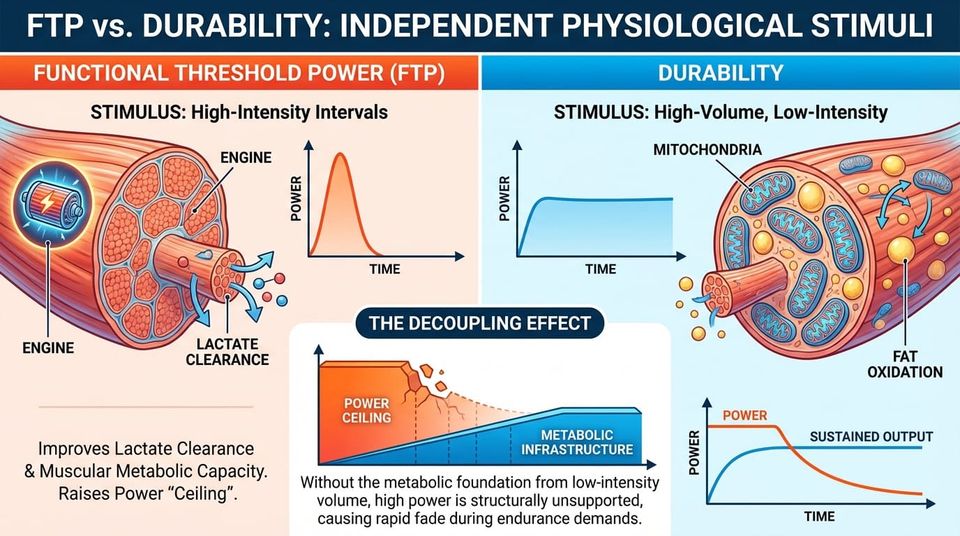
Recent physiological analysis suggests that Functional Threshold Power (FTP) and durability are independent performance dimensions requiring different training stimuli to develop. While high-intensity interval training effectively improves lactate clearance and muscular metabolic capacity to raise your threshold, it does not adequately build fatigue resistance. Instead, high-volume, low-intensity training triggers specific cellular adaptations—primarily increased mitochondrial density and improved fat oxidation rates—that are essential for sustaining power output over extended durations.
This distinction clarifies why athletes often experience a decoupling of performance, where they possess high power numbers for short tests but fade rapidly during longer events. Prioritizing low-intensity volume ensures the metabolic infrastructure is built to support the high-intensity engine, preventing the decline in power output that typically occurs after prolonged exertion. Without this foundation, an athlete may develop a high "ceiling" of power that is structurally unsupported during endurance demands.
Much of this data is derived from elite cyclists and skiers with high training availability; the magnitude of these specific durability adaptations may differ for amateurs unable to accumulate professional-level annual volume.
Reference:
Hunter B, Maunder E, Jones AM, Gallo G, Muniz-Pumares D. Durability as an index of endurance exercise performance: Methodological considerations. Exp Physiol. 2025 Nov;110(11):1612-1624. doi: 10.1113/EP092120. Epub 2025 Mar 27. PMID: 40150840; PMCID: PMC12576026.
Found this useful?
Get articles like this and free training calculators in your inbox every week.
Recommended reads
If this was useful, these are the other research-driven newsletters I actually read.


Member discussion