Snippet #016: Explosive Training Accelerates Neural Drive for Faster Force Production
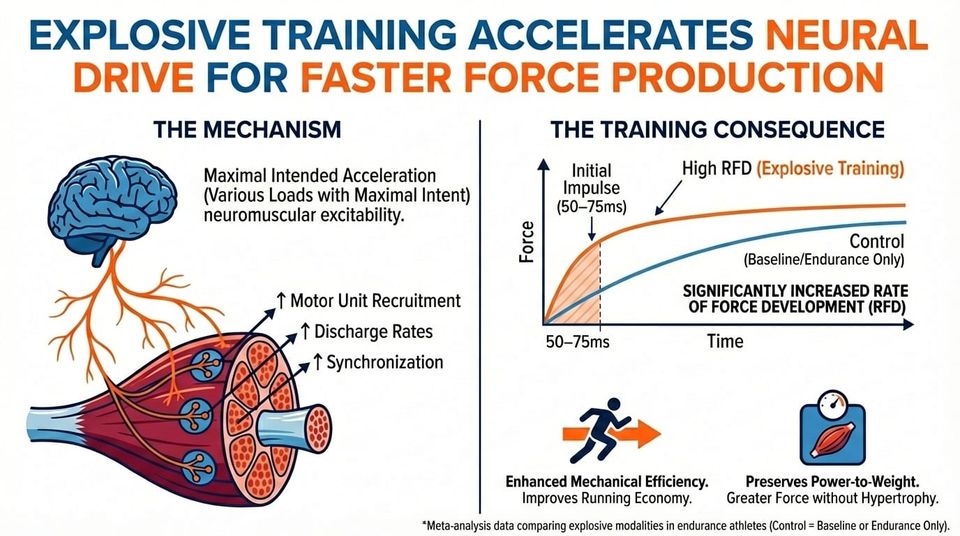
The Mechanism
Explosive-strength training involves moving moderate loads (40–79% of 1RM) with maximal intended acceleration. This specific stimulus primarily targets neuromuscular excitability and discharge characteristics rather than muscle fiber cross-sectional area.
High-velocity intent necessitates that the central nervous system maximize motor unit recruitment, discharge rates (rate coding), and synchronization. These neural adaptations primarily manifest as increased force impulse during the initial 50 to 75 milliseconds of muscle contraction.
The physiological outcome is a significantly increased Rate of Force Development (RFD). High RFD enables the muscle to generate a higher percentage of maximal force within the brief ground-contact times characteristic of running.
The Training Consequence
Improving RFD alters the metabolic cost of movement at submaximal intensities by enhancing the mechanical efficiency of force delivery per stride.
- Plyometric interventions have been shown to improve running economy specifically at aerobic paces (e.g., 12 km/h) distinct from maximal sprint mechanics.
- Enhanced neural drive allows for greater force application without necessitating significant hypertrophy, preserving the power-to-weight ratios critical for endurance performance.
Boundary
Insights reflect meta-analysis data comparing explosive modalities, including plyometrics, against maximal strength training and control groups in endurance athletes.
Reference:
Aagaard P, Simonsen EB, Andersen JL, Magnusson P, Dyhre-Poulsen P. Increased rate of force development and neural drive of human skeletal muscle following resistance training. J Appl Physiol (1985). 2002 Oct;93(4):1318-26. doi: 10.1152/japplphysiol.00283.2002. PMID: 12235031.
PS: If you have 60 seconds, I’d value your anonymous feedback here: https://forms.gle/9BJy78gBpszUnoY76
Disclaimer
The information provided in this newsletter is for educational purposes only and does not constitute medical advice. Exercise physiology is highly individual; what works for elite populations may not apply to everyone. Always consult with a physician before making significant changes to your training, nutrition, or supplementation protocols. The Scientist's Notebook and ESQ Coaching accept no liability for injuries or health issues arising from the application of these concepts.
Found this useful?
Get articles like this and free training calculators in your inbox every week.
Recommended reads
If this was useful, these are the other research-driven newsletters I actually read.



Member discussion