Snippet #017: Polygenic Scoring Identifies General Endurance Predisposition
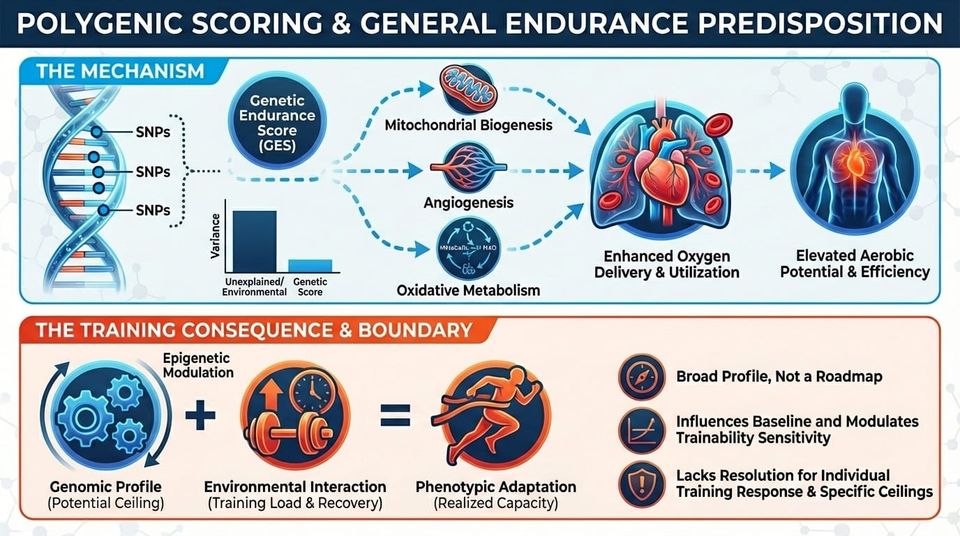
The Mechanism
Genetic Endurance Prediction Scores (GES) aggregate the weighted influence of multiple single nucleotide polymorphisms (SNPs) to estimate athletic potential. These scores quantify the cumulative burden of alleles associated with oxidative metabolism, angiogenesis (vascular remodeling), and mitochondrial biogenesis.
When an individual possesses a high load of associated alleles, the probability of systemic efficiency increases. This genetic architecture supports mechanisms for enhanced oxygen delivery and cellular substrate utilization. Consequently, the athlete exhibits a higher baseline aerobic capacity and a phenotypic bias toward endurance efficiency rather than explosive power generation.
Gradescale: Your physiology, decoded. Join the waitlist now.
 Thomas Mortelmans
The Training Consequence
Current genetic testing establishes a broad physiological profile rather than a prescriptive roadmap for adaptation.
- Genomic profiles influence baseline aerobic machinery but do not reliably predict the magnitude of trainability or responsiveness to specific exercise stimuli.
- Polygenic scoring identifies a predisposition for endurance versus power phenotypes rather than defining specific absolute physiological ceilings (e.g., VO2max limits).
- Phenotypic adaptation remains contingent upon training load and recovery; genetic potential requires environmental interaction to manifest as performance.
Boundary
Single genetic variants typically explain a negligible fraction (<1%) of phenotypic variance. Current polygenic models, often derived from specific elite cohorts (e.g., competitive cyclists), lack the resolution to accurately forecast individual training response magnitudes in the general population.
PS: If you have 60 seconds, I’d value your anonymous feedback here: https://forms.gle/9BJy78gBpszUnoY76
Disclaimer
The information provided in this newsletter is for educational purposes only and does not constitute medical advice. Exercise physiology is highly individual; what works for elite populations may not apply to everyone. Always consult with a physician before making significant changes to your training, nutrition, or supplementation protocols. The Scientist's Notebook and ESQ Coaching accept no liability for injuries or health issues arising from the application of these concepts.
Found this useful?
Get articles like this and free training calculators in your inbox every week.
Recommended reads
If this was useful, these are the other research-driven newsletters I actually read.


Member discussion