Snippet #014: Autonomic Competition at the Sinoatrial Node Drives HRV
The Mechanism
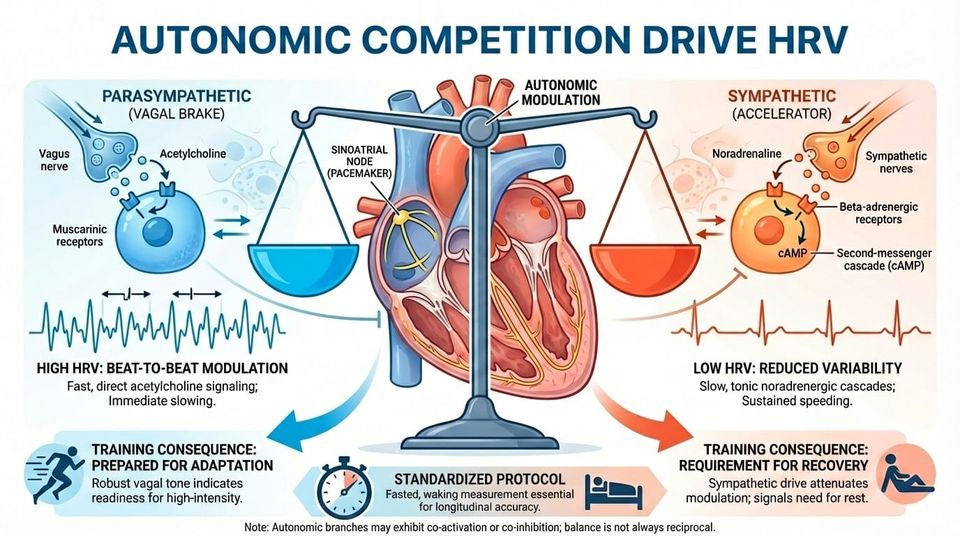
Heart rate variability (HRV) emerges from the dynamic interplay between sympathetic and parasympathetic signaling at the sinoatrial node, the heart’s intrinsic pacemaker.
The parasympathetic system, acting via the vagus nerve, releases acetylcholine. This neurotransmitter hyperpolarizes pacemaker cells to slow the heart rate. Because acetylcholine hydrolysis is rapid, this pathway facilitates immediate, beat-to-beat modulation of the cardiac cycle (respiratory sinus arrhythmia).
Simultaneously, the sympathetic system utilizes noradrenergic pathways to accelerate heart rate. Unlike the direct gating mechanism of the vagus nerve, sympathetic stimulation relies on slower second-messenger cascades (cAMP). This kinetic delay results in a low-frequency, tonic influence that cannot modulate heart rate on a beat-to-beat basis, effectively smoothing the rhythm.
Consequently, physiological stress results in a regular heart rhythm (low HRV) characterized by vagal withdrawal or sympathetic dominance. High HRV confirms that the parasympathetic system is effectively modulating cardiac timing without excessive sympathetic constraint.
The Training Consequence
- Suppressed HRV indicates that sympathetic drive is attenuating parasympathetic modulation, suggesting a physiological requirement for rest or low-intensity recovery.
- High HRV signals that the autonomic nervous system retains robust vagal tone, indicating a homeostatic state prepared for high-intensity adaptation.
- Because digestion, caffeine, and physical activity acutely alter autonomic balance, accurate longitudinal data requires fasted measurement immediately upon waking.
Boundary
This mechanism describes autonomic function in healthy athletic populations. Reliability depends on consistent positioning (seated or standing) to account for saturation effects and the use of RMSSD metrics derived from ECG chest straps or validated PPG devices.
PS: If you have 60 seconds, I’d value your anonymous feedback here: https://forms.gle/9BJy78gBpszUnoY76
Reference:
Altini M, Amft O. HRV4Training: Large-scale longitudinal training load analysis in unconstrained free-living settings using a smartphone application. Annu Int Conf IEEE Eng Med Biol Soc. 2016 Aug;2016:2610-2613. doi: 10.1109/EMBC.2016.7591265. PMID: 28268857.
If you want to see what I read to keep my own work sharp outside this newsletter, this is the list.
 Thomas Mortelmans
Disclaimer
The information provided in this newsletter is for educational purposes only and does not constitute medical advice. Exercise physiology is highly individual; what works for elite populations may not apply to everyone. Always consult with a physician before making significant changes to your training, nutrition, or supplementation protocols. The Scientist's Notebook and ESQ Coaching accept no liability for injuries or health issues arising from the application of these concepts.
Found this useful?
Get articles like this and free training calculators in your inbox every week.
Recommended reads
If this was useful, these are the other research-driven newsletters I actually read.

Member discussion