Snippet #010: Inorganic Phosphate Accumulation Directly Impairs Muscle Contractile Force
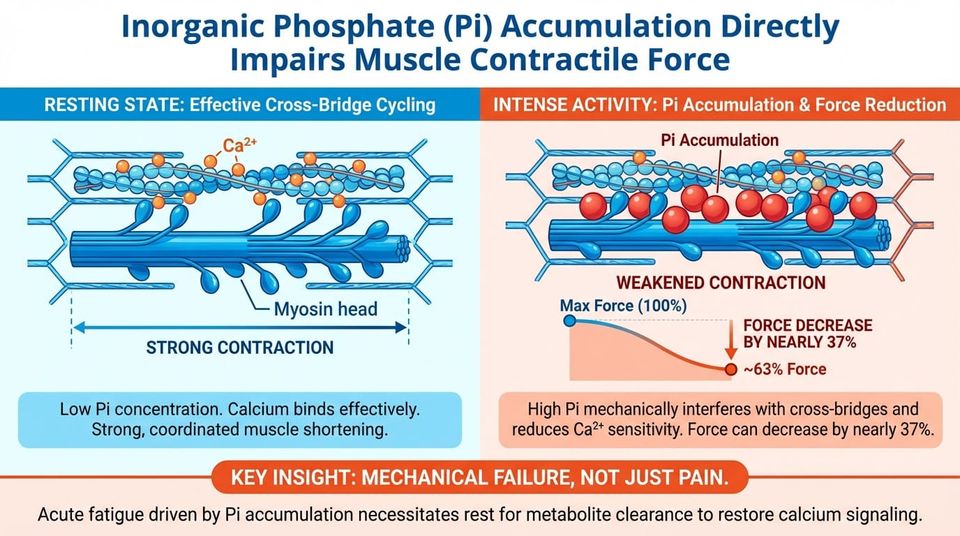
Core Insight: While lactate often receives the blame for fatigue, contemporary physiology identifies the accumulation of inorganic phosphate as a more potent disruptor of muscle function. As intense exercise rapidly breaks down ATP for energy, inorganic phosphate builds up within the cell and mechanically interferes with cross-bridge cycling—the microscopic grabbing and pulling action that shortens muscle fibers.
Simultaneously, this accumulation reduces the muscle’s sensitivity to calcium, which serves as the primary chemical signal for contraction. Research indicates that a significant rise in intracellular phosphate can reduce the maximum force a muscle fiber can generate by nearly 37 percent.
Why It Matters: This mechanism explains why "pushing through" becomes physiologically impossible during maximal efforts; the failure is mechanical, not just a sensation of pain. It highlights the biological necessity of rest intervals during high-intensity interval training, as time is required to clear these metabolites and restore the chemical environment needed for calcium to trigger a strong contraction again. Pacing strategies effectively manage the rate of phosphate accumulation to delay this cellular failure point.
Boundary Statement: These acute metabolic disturbances are primary drivers of fatigue during high-intensity, anaerobic activity. During prolonged, sub-maximal endurance events, fatigue is more commonly associated with glycogen depletion and central nervous system regulation.
PS: I’m always looking to improve.Send me an anonymous tip here. It takes seconds and helps me immensely.
 Thomas Mortelmans
Disclaimer
The information provided in this newsletter is for educational purposes only and does not constitute medical advice. Exercise physiology is highly individual; what works for elite populations may not apply to everyone. Always consult with a physician before making significant changes to your training, nutrition, or supplementation protocols. The Scientist's Notebook and ESQ Coaching accept no liability for injuries or health issues arising from the application of these concepts.
Allen, D. G., Lamb, G. D., & Westerblad, H. (2008).
Skeletal muscle fatigue: cellular mechanisms.
Physiological Reviews, 88(1), 287–332.
Debold, E. P., Dave, H., & Fitts, R. H. (2004).
Fiber type and temperature dependence of inorganic phosphate effects on force and unloaded shortening velocity in skeletal muscle.
American Journal of Physiology – Cell Physiology, 287(2), C517–C525.
Found this useful?
Get articles like this and free training calculators in your inbox every week.
Recommended reads
If this was useful, these are the other research-driven newsletters I actually read.



Member discussion