Entry #013: Exercising in a fasted state vs using isotonic drinks: effects on perceived effort
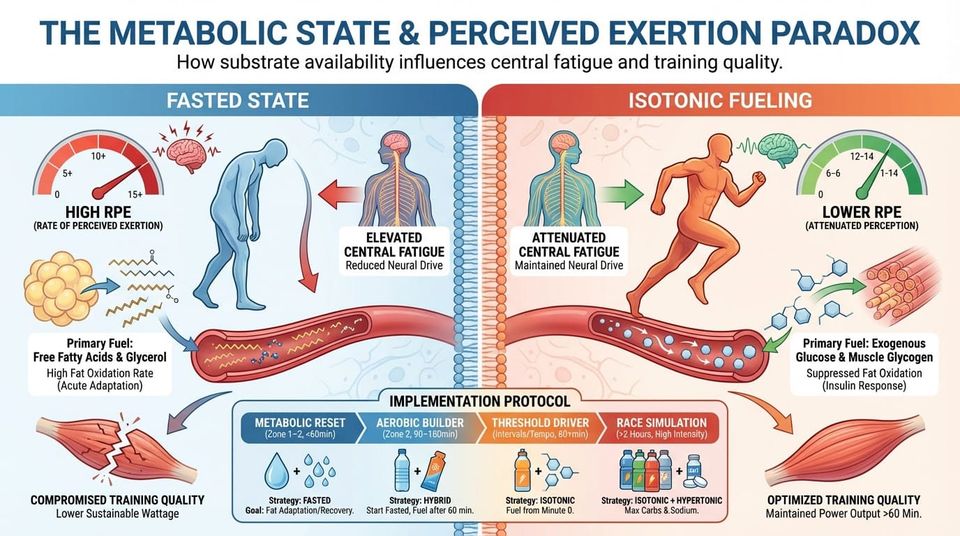
We often view training through the binary lens of "stimulus" and "recovery," obsessing over power numbers and heart rate zones. However, there is a third variable that often dictates the actual quality of that stimulus: your subjective perception of effort.
Now that we have talked about the mechanics of Zone 2, we need to address how your metabolic state—specifically whether you are fasted or fueled with isotonic solutions—fundamentally alters the "cost" of that training session.
Executive Summary
- The Trade-off: Fasted training increases fat oxidation rates but significantly elevates Rate of Perceived Exertion (RPE) for the same mechanical output.
- The Isotonic Advantage: Consuming isotonic beverages (6–8% carbohydrate) attenuates central fatigue and maintains performance quality during sessions >60 minutes.
- Performance Reality: There is currently no evidence that chronic fasted training improves race-day endurance performance, despite acute metabolic changes.
- The Mechanism: Carbohydrate availability directly influences the central nervous system's "governor," reducing the neural drive required to sustain high-intensity muscle contractions.
The Science at a Glance
The following table summarizes the physiological trade-offs between exercising in a fasted state versus using isotonic carbohydrate-electrolyte solutions.
| Variable | Fasted State | Isotonic Drink (Fed) |
|---|---|---|
| Primary Fuel Source | Free Fatty Acids (FFA) & Glycerol | Exogenous Glucose & Muscle Glycogen |
| Perceived Exertion (RPE) | Significantly Higher | Lower (Attenuated) |
| Fat Oxidation Rate | Elevated (acute adaptation) | Suppressed (insulin response) |
| Training Quality | Compromised at high intensities | Maintained/Optimized |
| Central Fatigue | Increased (Serotonin/Dopamine shift) | Delayed (Glucose signaling) |
| Hydration Efficiency | Poor (Water only) | Moderate (Fluid + Energy balance) |
Foundational Principles
1. The Central Governor and Glucose Signaling
We often assume fatigue is purely peripheral—muscles running out of fuel. However, elite physiology suggests a "Central Governor" model where the brain subconsciously downregulates motor recruitment to protect homeostasis. Research indicates that low carbohydrate availability (fasting) triggers this governor early, increasing the sense of effort required to produce the same wattage. Conversely, the presence of glucose in the blood (provided by isotonic drinks) signals safety to the brain, allowing for higher neural drive with lower perceived stress.
Scientist`s insight: "Exercise-induced hypoglycemia attenuates central nervous system activation... whereas central activation appears to be unaffected by three hours of moderately intense exercise... when euglycemia is maintained by carbohydrate ingestion."
2. The Dissociation of Metabolic Adaptation and Performance
It is crucial to distinguish between metabolic markers and performance outcomes. While fasted training acutely increases markers of lipolysis (glycerol levels rising from ~5.5 to 8.5 mmol/kg/min), this does not automatically translate to a faster athlete. Systematic reviews consistently show that while "fat burning" increases during the session, this adaptation rarely leads to improved time-trial performance in competitive scenarios where athletes are properly fueled.
3. Osmolality and the Isotonic Sweet Spot
An "isotonic" drink mimics the osmolality of human blood (275–300 mmol/kg). This is the physiological "sweet spot" for high-intensity training. It allows for the co-transport of glucose and sodium across the intestinal wall, delivering energy and fluid simultaneously. While hypotonic drinks (lower concentration) are superior for pure rehydration, they lack the energy density required to mitigate the rise in RPE during hard interval sessions.
The Decision Matrix
Use this diagnostic framework to categorize your upcoming session and select the appropriate fueling protocol.
| Category | Session Profile | Primary Goal | Fueling Strategy |
|---|---|---|---|
| The Metabolic Reset | Zone 1–2, < 60 min | Fat adaptation / Recovery | Fasted (Water/Electrolytes only) |
| The Aerobic Builder | Zone 2, 90–180 min | Mitochondrial density | Hybrid (Start fasted, introduce fuel after 60 min) |
| The Threshold Driver | Intervals / Tempo, 60+ min | Performance / Power Output | Isotonic (Fuel from minute 0) |
| The Race Simulation | High Intensity, > 2 hours | Gut training / Max output | Isotonic + Hypertonic (Max carbs/sodium) |
The Protocol
To implement this science into your training week, follow these technical steps:
- Determine Osmolality Requirements:
- For sessions involving Zone 3 (Threshold) or higher, target a 6–8% carbohydrate solution.
- Formula: Mix 30g to 40g of carbohydrates (maltodextrin/fructose mix) per 500ml of water.
- Timing the Dose:
- Pre-Load: Ingest 500ml of isotonic solution 15–20 minutes before high-intensity sessions to blunt the initial rise in cortisol and perceived exertion.
- Intra-Workout: Sip 150–200ml every 15 minutes. Do not wait for thirst.
- Sodium Calibration:
- Ensure your solution contains 400–800mg of sodium per liter. Sodium is critical for the glucose-sodium cotransporter mechanism in the gut; without it, carbohydrate absorption slows, and bloating may occur.
- The Fasted "Cap":
- If utilizing fasted training for body composition or metabolic signaling, cap the session at 90 minutes. Beyond this duration, the rise in cortisol and immune system suppression outweighs the potential metabolic benefits.
If you want to see what I read to keep my own work sharp outside this newsletter, this is the list.
 Thomas Mortelmans
Case Study: The "Stalled" Climber
Hypothetical Scenario illustrating non-linear adaptation.
Athlete Profile: "Mark," 38-year-old cyclist. FTP: 280w.
Context: Mark plateaued for 8 months. He adopted a "train low" (fasted) philosophy for all morning rides to improve power-to-weight ratio.
The Problem: While he lost 2kg, his interval quality suffered. He reported an RPE of 8/10 for efforts that used to feel like a 6/10. His "hard" days became "medium" days due to perceived fatigue, resulting in a loss of training stimulus.
The Intervention:
- Mon/Wed (Recovery/Endurance): Remained fasted (water only).
- Tue/Thu (Intervals): Mandatory intake of 60g carbs/hour via isotonic drink.
The Outcome:
Initially, Mark gained 0.5kg (water weight/glycogen). However, within 3 weeks, he hit personal bests in his 5-minute power duration. The isotonic fueling lowered his RPE during intervals, allowing him to dig deeper and actually achieve the necessary physiological overload. The "noise" of daily weight fluctuation was ignored in favor of the performance signal.
Best regards,
Dr. Thomas Mortelmans
PS: I love hearing from you! Click here to leave an anonymous noteabout today’s edition—it won't even take a minute.
Disclaimer
The information provided in this newsletter is for educational purposes only and does not constitute medical advice. Exercise physiology is highly individual; what works for elite populations may not apply to everyone. Always consult with a physician before making significant changes to your training, nutrition, or supplementation protocols. The Scientist's Notebook and ESQ Coaching accept no liability for injuries or health issues arising from the application of these concepts.
Annotated References
- Exercise Training and Fasting: Current InsightsThis paper details how fasted exercise elevates free fatty acid mobilization but highlights the lack of evidence for long-term endurance performance benefits.
- Different Types of Sports Drink and When to Use ThemA practical guide defining isotonic (275–300mOsm/kg) versus hypotonic and hypertonic solutions and their specific use cases for hydration vs. energy delivery.
- Carbohydrates and Endurance Exercise: A Narrative ReviewA review confirming that carbohydrate intake during exercise maintains blood glucose and high oxidation rates, which is critical for sustaining intensity.
- Rate of Perceived Exertion (RPE) ScaleAn overview of the Borg RPE scale, establishing the definitions of "moderate" (12-14) vs. "hard" (15+) intensity used in research protocols.
- The Hydrating Effects of Hypertonic, Isotonic and Hypotonic Sports DrinksA meta-analysis showing that while hypotonic drinks maximize plasma volume retention, isotonic drinks offer a balance of hydration and carbohydrate delivery.
- Evaluating the Impact of Fasted Training on PerformanceA critical analysis of literature concluding that while fasted training increases fat oxidation, it often fails to translate into measurable race performance improvements.
- Effect of Different Sports Drink Compositions on EnduranceThis study investigates how varying carbohydrate concentrations in sports beverages influence substrate oxidation and performance outcomes in trained athletes.
- Central Fatigue and Prolonged ExerciseResearch exploring the "serotonin-fatigue hypothesis," suggesting carbohydrate intake may mitigate central fatigue by altering the tryptophan-to-BCAA ratio.
- Effects of Fasted vs Fed State on Aerobic TrainingA systematic review of 27 studies confirming fasted exercise increases fat oxidation but highlighting the methodological limitations in long-term performance claims.
- Drive in Sports: How Mental Fatigue Affects EnduranceThis article discusses how mental fatigue and perceived exertion are linked, influencing the brain's inhibition centers and reducing physical drive.
- Carbohydrate Supplementation and Perceived ExertionA seminal study demonstrating that carbohydrate ingestion significantly attenuates the rise in RPE during the later stages of prolonged running.
- Effects of Six Weeks of Fasted Aerobic ExerciseResearch indicating that fasted morning exercise can effectively decrease 24-hour energy intake and improve insulin sensitivity for body composition goals.
- Carbohydrate Mouth Rinse and Central FatigueA study challenging the "mouth rinse" theory, finding that sensory signaling alone (without ingestion) may not be sufficient to reduce central fatigue in all contexts.
- Exercise with Fasting or Isotonic Drink?A randomized controlled trial showing that isotonic drink consumption significantly lowers RPE compared to fasting, even during short-duration high-intensity efforts.
- Muscle Fatigue: General Understanding and TreatmentA comprehensive look at peripheral fatigue mechanisms, including how glycogen depletion impairs excitation-contraction coupling beyond simple energy loss.
Disclaimer: The content provided in this newsletter is for informational purposes only and does not constitute medical advice, diagnosis, or treatment. Always seek the advice of your physician or other qualified health provider with any questions you may have regarding a medical condition or training intervention. The authors and publishers of this newsletter are not liable for any injury or damage resulting from the application of the information presented.
Found this useful?
Get articles like this and free training calculators in your inbox every week.
Recommended reads
If this was useful, these are the other research-driven newsletters I actually read.


Member discussion