Entry #007: Comparative Architecture of Endurance Training Models: Polarized vs. Threshold vs. HIIT
Executive Summary: The Brief
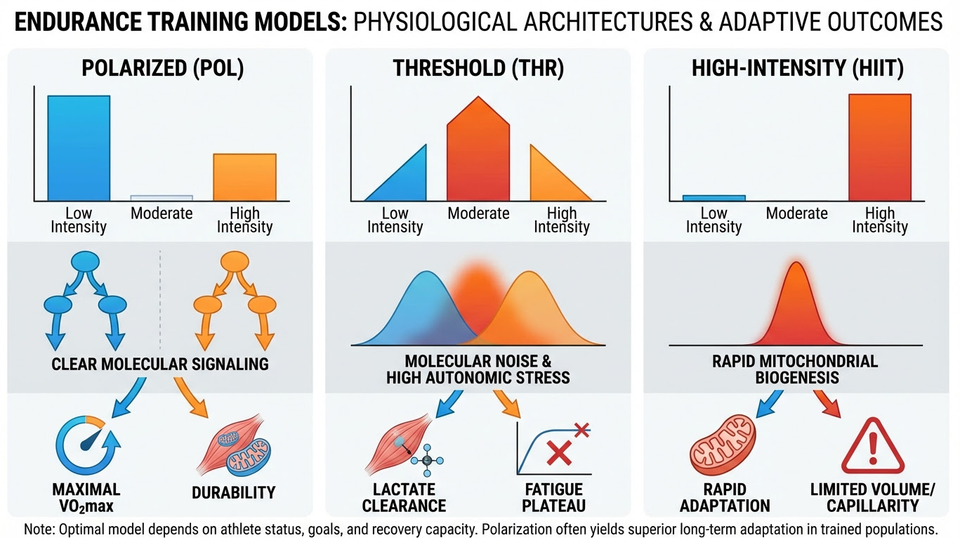
- The Signal-to-Noise Problem: Threshold training (moderate intensity) often creates a "physiological black hole" for well-trained athletes, generating high autonomic fatigue with diminishing returns on aerobic adaptation.
- Polarized Superiority: Current literature demonstrates that Polarized Training (POL)—characterized by ~80% low intensity and ~20% high intensity—consistently yields superior improvements in VO2max, Peak Power Output, and Time to Exhaustion compared to threshold-centric models in trained populations.
- The Efficiency Paradox: High-Intensity Interval Training (HIIT) offers the most potent stimulus for mitochondrial biogenesis per unit of time but fails to build durability and capillary density when used in isolation without sufficient low-intensity volume.
- Contextual Application: While POL is optimal for maximizing genetic potential, Threshold (THR) models remain effective for time-constrained athletes (<6 hours/week) or novices where "training monotony" has not yet blunted adaptation.
The Science at a Glance
The following comparison illustrates the physiological trade-offs between the three primary training intensity distributions (TID).
This post is for subscribers only
Found this useful?
Get articles like this and free training calculators in your inbox every week.
Recommended reads
If this was useful, these are the other research-driven newsletters I actually read.