Entry #009: Why functional threshold power may not fully capture durability in cycling
Before we get started, we were made aware that there might have been some regional restrictions with the coupon codes for our 50% of promotion. These are resolved so you should be able to use the code BETA for 50% of all our training plans without any restrictions:
 Thomas Mortelmans
Or view the plans directly on TrainingPeaks: here.
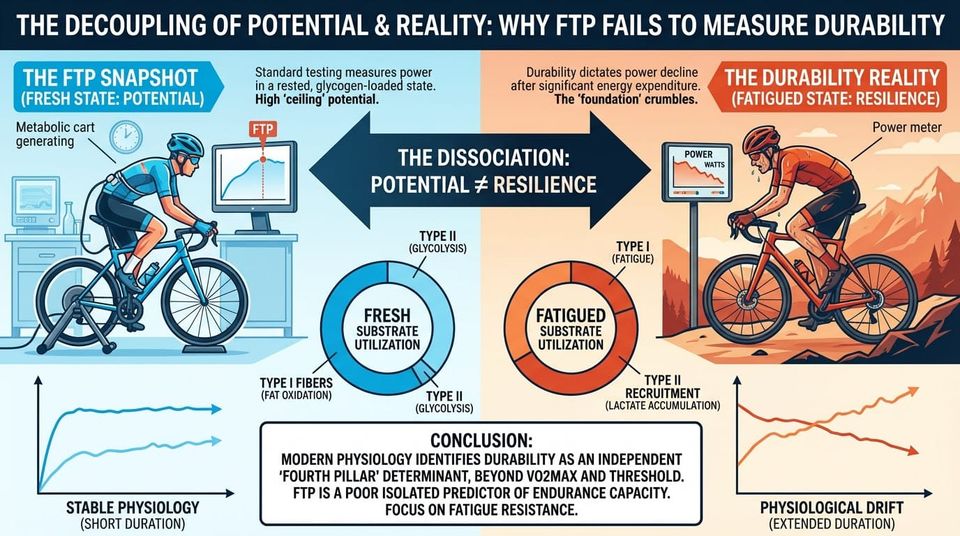
It is well established that Functional Threshold Power (FTP) can function as a pedagogical construct for intensity domains. Now, we need to address the metabolic elephant in the room: the decay of performance over time. For decades, the endurance community has operated under the reductionist assumption that a 20-minute field test scales linearly to performance in the fourth, fifth, or sixth hour of competition. This assumption is physiologically flawed.
We often conflate "potential" (what you can do when fresh) with "resilience" (what you can do when homeostatic perturbations accumulate). Emerging data suggests that two athletes with identical FTP values can have vastly different physiological responses after 2000 kilojoules of work.
If your training architecture focuses solely on raising the ceiling (FTP) without reinforcing the foundation (Durability), you are building a "glass cannon"—impressive on the dyno, but fragile in the field. This briefing dissects the dissociation between threshold power and fatigue resistance.
Executive Summary
- FTP is a Snapshot, Not a Movie: Standard FTP testing measures power in a rested, glycogen-loaded state. It fails to account for the "durability" parameter, which dictates how much that power declines after significant energy expenditure.
- The TTE Variable: Time to Exhaustion (TTE) at FTP is not a fixed 60 minutes. It varies wildly (from 35 to 70+ minutes) based on training history and muscle fiber typology, meaning FTP is a poor predictor of endurance capacity in isolation.
- The Fourth Pillar: Modern physiology now identifies Durability (or fatigue resistance) as an independent determinant of performance, alongside VO2max, Threshold, and Economy.
- Decoupling of Internal Load: In athletes with poor durability, internal stress (heart rate, lactate accumulation) rises significantly relative to external output (watts) as duration increases, creating a "drift" that standard zones do not capture.
The Science at a Glance
The following table contrasts the physiological profile of a "High FTP" phenotype against a "High Durability" phenotype. Note that in shorter events, the former wins; in extended events, the latter dominates.
| Physiological Parameter | High FTP / Low Durability (The Sprinter/Crit Racer) | High Durability / Moderate FTP (The Grand Tour Engine) | Performance Implication |
|---|---|---|---|
| Fresh Threshold (0 kJ) | 300 Watts (4.0 W/kg) | 280 Watts (3.7 W/kg) | High FTP phenotype leads early in the race. |
| Fatigued Threshold (2000 kJ) | 240 Watts (-20% decline) | 270 Watts (-3.5% decline) | Durability phenotype dominates late-race dynamics. |
| Cardiac Drift | Significant (>10% increase in HR at steady power). | Minimal (<3% increase in HR at steady power). | Low durability indicates aerobic decoupling/inefficiency. |
| Substrate Utilization | High reliance on glycolysis (CHO); poor fat oxidation. | High metabolic flexibility; spares glycogen. | High FTP athlete risks "bonking" significantly earlier. |
| Lactate Clearance | Rapidly compromised as Type II fibers are recruited. | Maintained via Type I fiber fatigue resistance. | Durable athletes maintain "steady state" longer. |
Foundational Principles
1. The Independence of Durability
For years, the "Three Pillar" model (VO2max, Lactate Threshold, Economy) reigned supreme. However, recent investigations led by researchers like Maunder and Seiler have proposed Durability as the critical "Fourth Pillar."
Crucially, this metric is not strongly correlated with VO2max or fresh FTP. An athlete can possess a world-class oxygen uptake but suffer from a "fragile" threshold that degrades rapidly under thermal strain, glycogen depletion, or central fatigue. Durability is the preservation of physiological characteristics (like Critical Power) over time.
"Durability is quantified not by the power you produce when the gun goes off, but by the magnitude of the deterioration in your physiological thresholds as work accumulates. It is the ability to resist the inevitable slide toward entropy."
Scientist’s Insight
2. The Fallacy of the 60-Minute Assumption
The industry standard suggests FTP is the power sustainable for approximately one hour. Data from Sitko et al. (2022) challenges this universality. In a cohort of cyclists, TTE at FTP ranged from roughly 35 to 60+ minutes depending on training status and phenotype.
Professional cyclists often sustain threshold intensities far longer than amateurs, not just because their FTP is higher, but because their fractional utilization and time to exhaustion are superior.
Using a fixed percentage of a 20-minute test to set training zones for a 4-hour ride introduces massive error for athletes with low TTE.
3. Metabolic Flexibility and Fiber Recruitment
Durability is inextricably linked to substrate use. As slow-twitch (Type I) muscle fibers fatigue, the body is forced to recruit less efficient fast-twitch (Type II) fibers to maintain power. These Type II fibers are more glycolytic, producing more lactate and requiring more oxygen for the same mechanical output. This creates a "Vicious Cycle of Efficiency Loss."
A durable athlete has conditioned their Type I fibers to be incredibly resilient, delaying the recruitment of Type II fibers and preserving glycogen stores for the critical moments of a race.
The Decision Matrix
Use this diagnostic matrix to determine if your training needs to shift focus from "Raising the Ceiling" (FTP) to "Hardening the Foundation" (Durability).
| Category | Symptoms & Indicators | Diagnosis |
|---|---|---|
| The Glass Cannon | • High results in Ramp Tests or 20-min tests. • Explodes/cramps after 3 hours. • HR rises 10+ bpm during steady Z2 rides. • Needs 90g+ carbs/hr just to survive moderate intensity. | High FTP / Low Durability. Focus: Extension & Metabolic Control. |
| The Diesel Engine | • Underperforms in short tests (20 min). • Can ride 5 hours at steady pace with no drift. • Strong finisher in long events, but lacks "punch." • Recovers quickly day-to-day. | High Durability / Moderate FTP. Focus: Intensive Threshold & VO2max. |
| The Balanced Rouleur | • TTE at FTP is 45–60 mins. • Minimal decoupling (<5%). • Power profile is relatively flat. • Consistent performance regardless of duration. | Balanced Profile. Focus: Periodized progression of both pillars. |
The Protocol
To capture durability, we must test and train in a fatigued state. The following protocol outlines how to integrate durability architecture into your training week.
1. Diagnostic: The Fatigue-State Profiling
Do not rely solely on fresh testing. Every 12 weeks, perform a "Durability Test."
- Step A: Ride 2000 kJ (approx. 2.5 to 3 hours for a moderate male cyclist) at Zone 2 (65-70% Max HR).
- Step B: Immediately perform a 20-minute maximal effort.
- Analysis: Calculate the percentage drop compared to your "Fresh" 20-minute power.
- <5% Drop: Excellent Durability.
- 5–10% Drop: Moderate Durability.
- >10% Drop: Poor Durability.
2. Implementation: Progressive Fatigue Resistance
If you fall into the "Glass Cannon" category, implement Fatigue-Dependent Intervals once per week.
- Pre-Load: Accumulate 1500–2000 kJ of Zone 2 work.
- The Stimulus: Execute your intensity blocks (e.g., 3 x 10 min at Sweet Spot or Threshold) after the pre-load.
- The Goal: Maintain target watts without allowing Heart Rate to spike significantly higher than fresh values.
3. Volume Architecture: The Long Low Ride
Durability is volume-dependent. You must target Type I fiber fatigue resistance.
- Frequency: Minimum one session per week.
- Duration: Must exceed your target event duration by 10-20% (if training for events <5 hours) or cap at 5-6 hours.
- Intensity: Strict Zone 2. Power is secondary; metabolic steady-state is primary. If cardiac drift occurs, reduce power to maintain HR cap.
4. Nutritional Training
Durability is also gut durability.
- Train with high carbohydrate intake (80–100g/hr) on hard days to upregulate transport proteins (SGLT1/GLUT5).
- Occasionally perform "low" carbohydrate availability rides (Zone 2 only) to stimulate mitochondrial biogenesis and fat oxidation, but use caution to avoid hormonal disruption.
The plans you find here are built on a simple truth: Adaptation only happens when you apply the right stress, at the right time, in the right dose.
 Thomas Mortelmans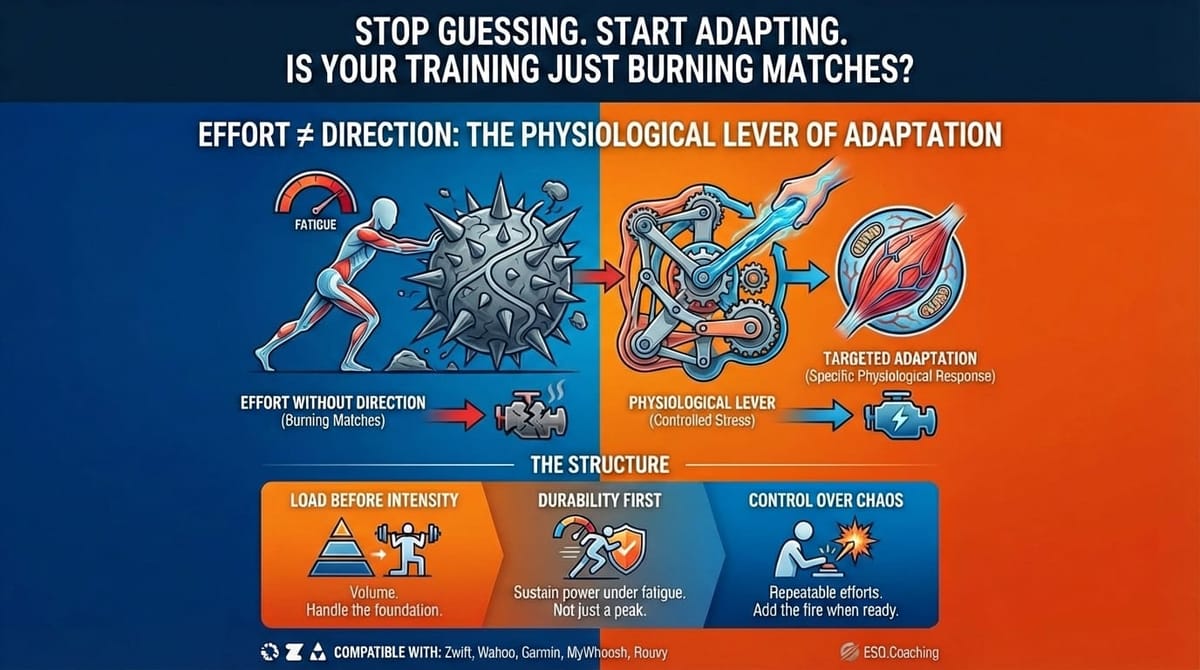
Case Study: The Non-Linear Progress of "Athlete A"
Consider "Athlete A," a Masters cyclist preparing for a mountainous gran fondo.
- Baseline: FTP 280W. TTE 35 minutes. Durability Test drop: -12%.
- The Problem: Athlete A focused exclusively on 2x20 minute intervals and Ramp Tests. In races, they were dropped on the final climb despite the power requirement being "sub-threshold."
- The Intervention:
- Replaced one intensity session with a 4-hour ride ending with 30 minutes at "Tempo" (76-88% FTP).
- Extended Tuesday intervals to focus on TTE (e.g., 1 x 40 min) rather than raw power.
- The "Noise": After 8 weeks, Athlete A’s Ramp Test FTP remained exactly 280W. They felt frustrated, believing they had plateaued.
- The Reality: Their TTE at FTP extended to 50 minutes. Their Durability Test drop improved to -4%.
- The Outcome: On race day, Athlete A set a personal best on the final climb. While their "ceiling" (FTP) hadn't moved, their ability to access that power after 4 hours had drastically improved. This is the hidden metric of success.
Best regards,
Dr. Thomas Mortelmans
PS: Real feedback helps me stay on track.Share your anonymous view here—it’s fast and I read everything you send.
If you want to see what I read to keep my own work sharp outside this newsletter, this is the list.
 Thomas Mortelmans
Disclaimer
The information provided in this newsletter is for educational purposes only and does not constitute medical advice. Exercise physiology is highly individual; what works for elite populations may not apply to everyone. Always consult with a physician before making significant changes to your training, nutrition, or supplementation protocols. The Scientist's Notebook and ESQ Coaching accept no liability for injuries or health issues arising from the application of these concepts.
Annotated References
- Sitko et al. (2022) - Time to Exhaustion at FTP
This study reveals that Time to Exhaustion at estimated FTP varies significantly widely among cyclists (35 to 60+ minutes) based on training status, debunking the one-hour standard. - Maunder et al. (2021) - Durability as the Fourth Pillar
This pivotal paper establishes durability as an independent physiological trait, distinct from VO2max and lactate threshold, that determines performance in long-duration events. - Mackey & Horner (2021) - FTP Physiological Validity
A systematic review demonstrating that while FTP is a reliable field test, its validity as a precise physiological marker is limited compared to laboratory gold standards. - TrainerRoad - Understanding Time to Exhaustion
This article explains the practical distinction between FTP as a number and the duration it can be sustained, emphasizing the importance of TTE in training analysis. - High North - Critical Power vs. FTP
A technical breakdown of how the Critical Power model (CP and W') offers a more robust physiological profile than the single-point FTP estimation. - Seiler (2010) - Polarized Training
Provides the evidentiary basis for polarized training, showing that high-volume low-intensity work is the primary driver for developing long-term fatigue resistance. - Fast Talk Labs - Durability: The Fourth Pillar
A deep dive into the definition of durability and why traditional metrics fail to capture the decline in performance markers over time. - TrainingPeaks - Exercise Metabolism
Discusses the metabolic underpinnings of endurance, specifically how substrate utilization efficiency impacts the ability to sustain power. - TrainingPeaks - Power Duration Model
Explores the Power Duration Curve as a superior alternative to FTP for mapping an athlete's complete physiological capabilities across all time domains. - INSCYD - FTP Limitations
Highlights how FTP fails to account for the energetic contribution of the anaerobic system (VLaMax), leading to potential errors in training prescription. - Mateo-March et al. - Durability in Professionals
Research indicating that professional cyclists are distinguished not just by high power, but by their ability to resist fatigue and maintain values close to fresh profiles after hours of work. - Spragg - Determining Fatigue Resistance
Practical discussion and methods for athletes to assess their own fatigue resistance using power data and cardiac decoupling. - Gore Wear - Increasing FTP
Provides context on traditional methods of increasing FTP and how they must be balanced with volume to ensure the power is functional for endurance. - Athletica - From VO2max to Durability
A discussion on the paradigm shift in endurance training science, moving away from pure VO2max focus toward resilience and durability. - Cycling Inform - The World's Fittest Cyclists
Argues that elite cyclists rely on more granular metrics than FTP, using metabolic testing to pinpoint specific physiological limiters.
Found this useful?
Get articles like this and free training calculators in your inbox every week.
Recommended reads
If this was useful, these are the other research-driven newsletters I actually read.



Member discussion