Entry #010: Beta-alanine supplementation to extend time to exhaustion in endurance tasks
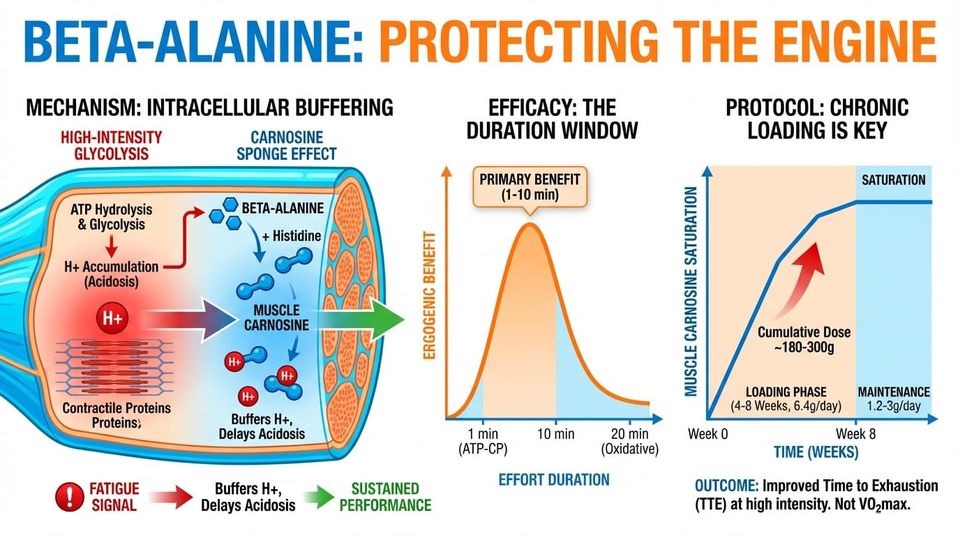
Now that we have established the hierarchy of aerobic development in previous editions, we need to address the specific biochemical limitations that occur when you push beyond the lactate threshold. We often discuss "fueling the engine" (glycogen) or "building the engine" (mitochondrial density), but we rarely discuss "protecting the engine" from the metabolic byproducts of high-intensity work.
If you have ever felt your muscles "seize up" or burn during a hill repeat or the final kilometer of a 5K, you have experienced the accumulation of hydrogen ions (H+) outpacing your body's buffering capacity. This is not merely discomfort; it is a mechanical failure signal. The research surrounding Beta-Alanine is extensive, yet often misunderstood. It is not a stimulant, nor is it a fuel source. It is an intracellular buffer modification.
Today, we strip away the marketing hype and look strictly at the kinetics of carnosine loading to determine if this protocol belongs in your training architecture.
Executive Summary
- Mechanism of Action: Beta-alanine is the rate-limiting precursor to carnosine. Supplementation increases intramuscular carnosine, which acts as a "sponge" for hydrogen ions ($H^+$) during high-intensity glycolysis.
- The "Goldilocks" Zone: The ergogenic benefit is highly specific to duration. It is most effective for efforts lasting 1 to 10 minutes. Efforts under 60 seconds (pure ATP-CP) or over 25 minutes (oxidative) show significantly diminished returns.
- Chronic, Not Acute: Unlike caffeine, beta-alanine has no acute effect. It requires a loading phase of 4 to 6 grams daily for at least 4 weeks to saturate muscle tissue.
- The Responder Effect: Nearly everyone responds, but the magnitude varies. Vegetarians often see the largest relative increase in buffering capacity due to lower baseline carnosine levels.
- Side Effects: The only verified side effect is paresthesia (tingling of the skin), which is harmless and dose-dependent.
The Science at a Glance
We must view supplementation through a cost-benefit lens. Beta-alanine does not improve oxygen delivery (VO2max); it improves the muscle's ability to operate in an acidic environment.
| Variable | Short Duration (<60s) | Middle Duration (1-10 min) | Long Duration (>20 min) |
|---|---|---|---|
| Primary Energy System | Phosphocreatine / Anaerobic | Fast Glycolysis / Oxidative | Oxidative Phosphorylation |
| Fatigue Driver | PCr Depletion | H^2 Accumulation (Acidosis) | Glycogen Depletion / CNS |
| Beta-Alanine Efficacy | Negligible | High (Primary Benefit) | Low / Contextual |
| Performance Impact | < 0.5% | 2.85% - 15% improvement | Potential benefit for surges only |
| Physiological Cost | None | High Acidosis | Structural Damage |
Foundational Principles
1. The Rate-Limiting Precursor
Muscle carnosine is a dipeptide composed of histidine and beta-alanine. While histidine is abundant in muscle tissue, beta-alanine is not. Therefore, the synthesis of carnosine is strictly limited by the availability of beta-alanine. By supplementing with beta-alanine, we remove this bottleneck, driving intramuscular carnosine concentrations up by 30 to 80 percent. This is a saturation game, not a timing game.
Scientist’s Insight: "The efficiency of beta-alanine incorporation is low (approx. 3-6%). This explains why we cannot 'pulse' this supplement. It requires massive cumulative doses (approx. 300g total) to reach significant saturation levels."
2. The Intracellular Buffering Defense
During high-intensity exercise, ATP hydrolysis and glycolysis release protons (H+). This drops intracellular pH from a resting ~7.1 to as low as 6.5. At this acidity, glycolytic enzymes (like phosphofructokinase) stop functioning, and the calcium sensitivity of the contractile machinery is impaired.
Carnosine has a pKa of 6.83, making it chemically perfect to buffer protons within this specific physiological range.
3. The Washout Kinetics
Biological adaptations usually revert quickly. Beta-alanine is an anomaly. Once muscle carnosine levels are elevated, they are remarkably stable. The washout period (return to baseline) is extremely slow, with a half-life of roughly 5 to 6 weeks.
This allows for strategic periodization: an athlete can load for 8 weeks, stop supplementation, and still retain enhanced buffering capacity for a month-long competitive season.
 Thomas Mortelmans
The Decision Matrix
Do not waste financial resources on supplements that do not match your physiological demands. Use this matrix to determine if beta-alanine fits your profile.
Category A: The "Miler" / Pursuit Cyclist
- Event Duration: 2 to 8 minutes.
- Limiter: Burning sensation, "heavy" legs, inability to hold cadence at end of effort.
- Verdict: Essential. This is the exact window where buffering capacity correlates with Time to Exhaustion (TTE).
Category B: The Crit Racer / Interval Specialist
- Event Duration: 45 to 60 minutes (stochastic).
- Limiter: Repeated high-power surges (closing gaps, attacks).
- Verdict: High Value. While the total event is long, the selection moments are high-intensity bouts where acidosis accumulates.
Category C: The Ultra-Endurance Athlete
- Event Duration: 4+ hours (Ironman, Ultra-marathon).
- Limiter: Glycogen depletion, dehydration, central fatigue.
- Verdict: Low Value. Acidosis is rarely the limiter at steady-state aerobic intensity. Money is better spent on carbohydrate availability.
VO₂ Max Development (8 Weeks):
Your aerobic ceiling is limiting everything downstream.
This 8-week VO₂max block is for riders who already train consistently but feel capped in hard efforts above threshold. The goal is not “suffering better,” but increasing the amount of oxygen you can actually turn into power.
If long intervals feel fine but short, repeatable efforts keep breaking you, this is the block you’re missing. View plan here
The Protocol
If you fall into Category A or B, execution is critical. Randomly taking beta-alanine will result in expensive urine and itchy skin, not performance.
Phase 1: The Loading Architecture (Weeks 1-8)
The goal is to reach a cumulative dose of ~180 to 300 grams.
- Daily Target: 6.4 grams per day.
- Dose Fractionation: Divide into 4 doses of 1.6 grams.
- Why? Large boluses saturate the transporters (TauT) and cause paresthesia. Smaller doses increase retention.
- Timing: Take with meals. Insulin aids in muscle uptake.
- Duration: Maintain this for minimum 4 weeks, ideally 8 weeks for maximum saturation (80% increase).
Phase 2: The Maintenance Architecture (Weeks 9+)
- Daily Target: 1.2 grams to 3 grams per day.
- Timing: Any time of day, preferably with a meal.
Phase 3: The Washout (Strategic)
- Stop supplementation completely.
- Expect elevated levels to persist for ~9-15 weeks.
- Re-start loading 8 weeks prior to your next "A" race.
Case Study: The Non-Linear Responder
Hypothetical scenario based on physiological data.
Subject: Elias, 34, 1500m runner and criterium cyclist.
Baseline: Well-trained, plateaued 5-minute power (380 Watts).
Intervention: 6.4g Beta-Alanine daily for 6 weeks.
The "Noise" in the Data:
Week 1-2: Elias experienced significant paresthesia (tingling) in his hands and face. He found it distracting and skipped 30% of his evening doses. This is a common behavioral failure point. We adjusted his protocol to a sustained-release formula and strictly with meals, improving compliance.
The Adaptation:
By Week 5, Elias reported no change in "feeling" during easy rides (expected). However, during VO2max interval sets (4 minutes ON, 3 minutes OFF), he noted he could maintain the target wattage for the final 30 seconds of the last rep, where he usually faded.
The Outcome:
After 8 weeks, his 5-minute power test increased to 392 Watts (+3.1%).
Note: This is not a 20% miracle jump. However, in a 1500m race or a hilltop finish, a 3% improvement in time to exhaustion at maximal capacity translates to a winning margin of several seconds.
The physiology did not make him faster; it allowed him to express his speed for longer before acidosis forced deceleration.
Best regards,
Dr. Thomas Mortelmans
PS: I personally check every response to make this better for you.Drop your anonymous feedback herein just a few clicks!
Disclaimer
The information provided in this newsletter is for educational purposes only and does not constitute medical advice. Exercise physiology is highly individual; what works for elite populations may not apply to everyone. Always consult with a physician before making significant changes to your training, nutrition, or supplementation protocols. The Scientist's Notebook and ESQ Coaching accept no liability for injuries or health issues arising from the application of these concepts.
Annotated References
- Role of beta-alanine supplementation on growth and healthThis review highlights that while beta-alanine is critical for carnosine synthesis, its impact extends beyond buffering to include potential antioxidant roles in muscle tissue.
- International Society of Sports Nutrition position stand: Beta-AlanineThe definitive consensus statement confirming that 4-6g daily doses significantly increase muscle carnosine and improve exercise performance in the 1-10 minute range.
- Effect of beta-alanine supplementation on muscle carnosine and exercise performanceA seminal meta-analysis demonstrating that beta-alanine improves exercise capacity with a median effect size of roughly 2.85%, specifically in high-intensity protocols.
- Beta-alanine dosage for bodybuilding and hypertrophy contextsOutlines that while typically used for endurance, beta-alanine supports volume tolerance in resistance training by delaying failure in the 8-15 rep range.
- Kinetics of muscle carnosine decay after cessation of supplementationThis study provides the data for the "washout" phase, showing that muscle carnosine has a very long half-life, taking up to 15 weeks to return to baseline levels.
- Influence of beta-alanine on VO2max and TTE in endurance athletesResearch indicating that while VO2max itself (aerobic power) does not change, the Time to Exhaustion at VO2max intensities increases significantly.
- Beta-alanine and the female athlete: Sex-based differencesEvidence suggests females may have lower baseline carnosine and thus might experience a larger relative percentage increase from supplementation than males.
- The absorption kinetics of beta-alanine and paresthesiaExplains the mechanism of the "tingling" side effect, attributing it to the saturation of MrgD receptors when plasma concentrations spike too rapidly.
- Individual variability in response to beta-alanineDiscusses why some athletes are "high responders" (often those with low initial carnosine, like vegetarians) compared to "low responders."
- Effects of beta-alanine on 10km running time trialDemonstrates that even in longer events like a 10k, supplementation can improve performance, likely by aiding the high-intensity surges or final sprint.
- Combining Beta-Alanine and Sodium BicarbonateInvestigates the synergy between intracellular (beta-alanine) and extracellular (bicarbonate) buffers, suggesting a potential additive effect for racing.
- Safety of long-term beta-alanine supplementationProvides toxicological data confirming that chronic supplementation at recommended dosages presents no adverse effects on blood markers or organ function.
- Muscle fiber type specific responses to beta-alanineDetails how Type II (fast-twitch) fibers hold more carnosine naturally and may have a higher capacity for accumulation during loading phases.
- Beta-alanine vs. Placebo in repeated sprint abilityShows that while a single sprint isn't affected, the ability to maintain power output over repeated bouts is significantly preserved with supplementation.
- Vegetarian vs. Omnivore muscle carnosine contentHighlights that vegetarians have significantly lower baseline muscle carnosine, making beta-alanine supplementation potentially more impactful for this demographic.
Found this useful?
Get articles like this and free training calculators in your inbox every week.
Recommended reads
If this was useful, these are the other research-driven newsletters I actually read.
Member discussion