Snippet #004: Aerobic Metabolism Recharges High-Intensity Anaerobic Power
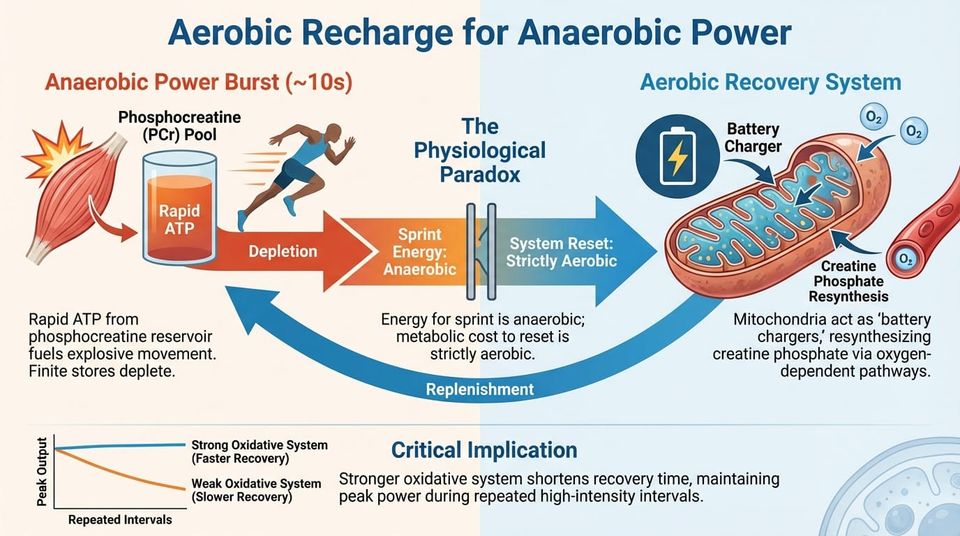
The phosphocreatine system acts as the body's immediate energy reservoir, rapidly regenerating ATP molecules to fuel explosive movement for approximately ten seconds. Once these finite stores are depleted, however, the muscle relies entirely on oxygen-dependent pathways to refill them. This creates a physiological paradox where the energy used for a maximal sprint is anaerobic, but the metabolic cost to reset the system for a subsequent effort is strictly aerobic. The mitochondria must work in the background to resynthesize creatine phosphate, effectively acting as the battery charger for your explosive power.
If you want to see what I read to keep my own work sharp outside this newsletter, this is the list.
 Thomas Mortelmans
This mechanism underscores why aerobic capacity is critical even for power-based athletes performing repeated high-intensity efforts. A stronger oxidative system does not just support long-duration activity; it shortens the recovery time required to restore peak power output between intervals. Consequently, an athlete’s ability to maintain speed or force during the later stages of a workout is often dictated by their underlying aerobic fitness rather than raw muscular strength.
These recovery kinetics are generalized, as the rate of replenishment correlates strongly with an individual's specific mitochondrial density and local blood flow dynamics.
This Margin Snippet is drawn from Entry #002 of The Scientist’s Notebook. The interaction between aerobic and anaerobic energy systems during endurance efforts
PS: Help me make the next one even better.Leave your anonymous feedback here—it’s quick and I value every note.
Invite one friend who joins the newsletter and unlock a free 12-week Gran Fondo training plan, plus three endurance playbooks.
 Thomas Mortelmans
Reference:
• Drake JC et al., Molecular Basis of Exercise-Induced Skeletal Muscle Adaptations, 2016 — discusses mitochondrial biogenesis and regulation in response to exercise, underscoring links between energy demand and cellular adaptation.
While this review does not focus exclusively on PCr recovery, it provides the molecular context that high-rate ATP turnover from anaerobic systems and subsequent recovery depend on oxidative pathways and mitochondrial adaptation.
Foundational paper (classic energy system physiology):
• W. McArdle et al., Exercise Physiology: Energy, Nutrition, and Human Performance (standard text, not open access but widely accepted). (Not linked but foundational)
Found this useful?
Get articles like this and free training calculators in your inbox every week.
Recommended reads
If this was useful, these are the other research-driven newsletters I actually read.


Member discussion