Entry #005: Comparing whey protein and carbohydrate-based recovery strategies after endurance exercise
Hi Endurance Enthusiast,
For decades, the post-exercise mantra has been simple: "Refuel." We have been conditioned to view recovery almost exclusively through the lens of glycogen replenishment—shoveling pasta or sugary drinks to refill the tank. While glycogen is non-negotiable, this carb-centric dogma often ignores the structural reality of endurance physiology.
Training does not just empty your fuel stores; it damages the chassis.
Now that we have established the importance of fueling during the work, we need to address the architectural repair required after it. Consensus statements and recent reviews emphasize that recovery is multi-component: carbohydrate for glycogen, protein for remodeling, and context determines urgency.
It is no longer just about carbohydrates; it is about the synergistic effect of protein-specifically whey—in signaling adaptation. We are moving from a model of "refueling" to a model of "remodeling."
Executive Summary
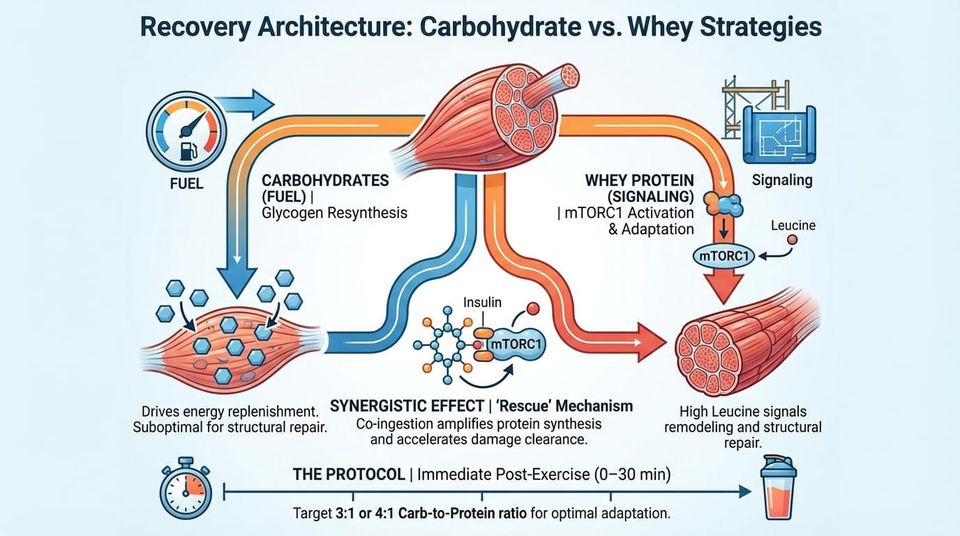
- Carbohydrates are for Fuel, Protein is for Signaling: While carbohydrates drive glycogen resynthesis (energy), whey protein drives mTORC1 signaling (adaptation and repair). You need both.
- The "Window" is Context-Dependent: The urgency of the 30-minute anabolic window is critical for glycogen only if you are training twice in one day. For protein, however, intake soon after training is a convenient way to hit your daily target and can support acute MPS; especially when you’ll have long gaps between protein-containing meals
- Whey is Superior: Due to its high Leucine content and rapid absorption, whey protein is a very practical first choice and evidence shows it outperforms soy, casein, and beef in stimulating myofibrillar protein synthesis after endurance efforts.
- The "Rescue" Effect: When CHO intake is below the level that maximizes glycogen resynthesis (<1.2 g/kg), adding protein can help maintain high resynthesis rates; when CHO is already sufficient, extra protein typically doesn’t further increase glycogen storage
The Science at a Glance
A physiological comparison of recovery modalities based on the latest meta-analytic data.
| Strategy | Glycogen Resynthesis Rate | Muscle Protein Synthesis (MPS) | Muscle Damage Markers (CK/Myoglobin) | Best Application |
|---|---|---|---|---|
| Carbohydrate Only (1.2 g/kg) | Optimal (High) | Low / Baseline | High (Slow clearance) | Single daily sessions with >24h recovery. |
| Carbohydrate + Whey (Isocaloric) | High | High (Significant elevation) | May reduce muscle soreness/damage markers in some settings (Faster clearance) | Compressed recovery (<8h) or high-damage sessions (running/intervals). |
| Carbohydrate + Whey (Hypercaloric) | Optimal + | Maximal | Reduced | Heavy training blocks, stage races, or Masters athletes. |
| Low Carb + High Protein | Suboptimal | Moderate | Moderate | Weight management phases (risk of incomplete recovery). |
Foundational Principles
1. The "Fuel vs. Build" Dichotomy
Endurance exercise triggers two distinct deficits: glycogen depletion (fuel) and myofibrillar disruption (structure). Carbohydrates address the fuel deficit via insulin-mediated glucose uptake (GLUT-4). However, carbohydrates alone do not signal the repair of contractile proteins. Whey protein provides the essential amino acids—specifically Leucine—required to activate mTORC1, the master switch for cell growth. Without protein, you are refueled but structurally vulnerable.
Scientist's Insight: "Think of carbohydrates as the bricklayers and protein as the foreman. You can have all the bricks (glycogen) you want, but without the foreman (mTORC1 signal from protein), the wall doesn't get built efficiently. The latest data shows endurance exercise can substantially elevate mitochondrial protein remodeling. Your body needs structural suppport, not only sugar"
2. The "Rescue Mechanism" of Insulin
When you cannot stomach massive amounts of carbohydrates (e.g., >1.2 g/kg) immediately after a hard session, protein becomes a metabolic lever. Protein ingestion stimulates insulin secretion independently of blood glucose. This means adding whey to a smaller dose of carbohydrates can drive glycogen storage rates similar to a high-carb dose, effectively "rescuing" your refueling process while simultaneously starting muscle repair.
3. The Leucine Threshold
Not all proteins are created equal. To trigger maximal muscle protein synthesis, a specific threshold of intracellular Leucine (~2-3g) must be met. Whey protein hits this threshold faster and with a smaller total dose than soy or casein. For the endurance athlete, this efficiency is key: it minimizes GI bulk while maximizing the adaptive signal.
The Decision Matrix
Identify your current training status to select the optimal protocol.
Category A: The "Weekend Warrior"
- Profile: Single daily session, >24 hours between hard efforts.
- Physiological State: Glycogen depletion is moderate; repair time is ample.
- Recommendation: Focus on total daily intake. Immediate timing is less critical.
- Target: High quality meal within 2 hours.
Category B: The "Stage Racer" / High Volume
- Profile: Double days, <8 hours between sessions, or >15 hours/week volume.
- Physiological State: Chronic glycogen debt, suppressed immune markers, elevated CK.
- Recommendation: Aggressive immediate dual-fueling.
- Target: Liquid CHO + Whey within 30 mins.
Category C: The "Masters Athlete" (Age 50+)
- Profile: Any volume, but aged 50+.
- Physiological State: "Anabolic Resistance." You are less sensitive to protein signals and require higher doses to achieve the same repair effect as a 20-year-old.
- Recommendation: Higher protein ratios are non-negotiable.
- Target: 0.4–0.5 g/kg protein per meal (vs. 0.3 g/kg for younger athletes).
The Protocol
1. Immediate Post-Exercise (0–30 Minutes)
- The "Golden Ratio": Target a 3:1 or 4:1 ratio of Carbohydrate to Protein.
- The Mix:
- Carbohydrate: 0.8 – 1.0 g/kg bodyweight (Maltodextrin/Glucose mix or ripe banana/rice cakes).
- Protein: 0.3 – 0.4 g/kg bodyweight (High-quality Whey Isolate).
- Example for 70kg Athlete: ~60g Carbs + ~25g Whey Protein.
- Note: If you are a Masters athlete (50+), bump the protein to 0.5 g/kg.
2. The Follow-Up (2–4 Hours Post)
Shift to whole foods. The "window" is open for 4-6 hours, but the urgency drops.
Target a solid meal containing complex carbs and a slower-digesting protein source (chicken, eggs, yogurt) to sustain amino acid availability.
3. Hydration Integration
Ensure the post-exercise shake includes Sodium (500–700mg) if sweat losses were high. Sodium aids in glucose absorption and fluid retention.
Case Study: The "Stalling" Cyclist
Hypothetical
The Athlete: Mark, 45, avid gravel cyclist training 10 hours/week.
The Problem: Mark was religiously eating pasta after rides but felt "heavy legs" and stagnant power numbers for three months. He was fueling the work but failing the adaptation. His bloodwork showed chronically elevated Creatine Kinase (CK) and low-normal Testosterone/Cortisol ratios.
The Intervention:
- Immediate: Introduced a liquid recovery mix (50g Maltodextrin + 25g Whey Hydrolysate) to be consumed before showering.
- Daily: increased daily protein intake from 1.2 g/kg to 1.8 g/kg.
The Result (Non-Linear):
Weeks 1-2 saw no power increase, but Mark reported "less soreness" on getting out of bed.
By Week 4, Mark hit a personal best on his benchmark 20-minute climb.
Observation: The progress wasn't linear. Life stress (work deadlines) in Week 3 caused a dip in HRV, but because his nutritional protein floor was higher, he didn't spiral into fatigue/illness as he usually would. The whey didn't make him faster; it allowed him to absorb the training that made him faster.
Best regards,
Dr. Thomas Mortelmans
PS: I love hearing from you!Click here to leave an anonymous noteabout today’s edition—it won't even take a minute.
Annotated References
- Marathon Recovery & Biomarkers: A study demonstrating that whey protein supplementation significantly lowers markers of liver stress and muscle damage (AST/ALT) compared to carbohydrates alone after marathon distances. (Link)
- Protein Synthesis Timing: Foundational research establishing that immediate post-exercise protein intake amplifies the skeletal muscle protein synthetic response compared to delayed feeding. (Link)
- Glycogen Rescue: A meta-analysis confirming that co-ingesting protein with suboptimal carbohydrate intakes enhances glycogen storage efficiency through insulin-mediated pathways. (Link)
- Glycogen Resynthesis Fundamentals: Seminal work defining the physiological upper limits of glycogen storage and the importance of carbohydrate timing post-exercise. (Link)
- Nutritional Timing Review: A 2025 systematic review analyzing how specific timing of nutritional interventions impacts fatigue recovery kinetics. (Link)
- Whey Efficacy in Specific Conditions: Research exploring the comparative efficacy of whey protein in mitigating performance decrements during intensified training blocks. (Link)
- Sports Nutrition Consensus: A broad consensus statement on optimal fueling strategies, reinforcing the role of protein in endurance adaptation. (Link)
- Physiological Basis of Recovery: An in-depth physiological review of how muscle tissue remodels following the mechanical and metabolic stress of endurance exercise. (Link)
- Protein Quality Assessment: An evaluation of different protein sources, highlighting the superior amino acid profile of whey for athletic recovery. (Link)
- Soy vs. Whey: A comparative analysis detailing why whey protein's Leucine content makes it superior to soy for muscle protein synthesis. (Link)
- Masters Athlete Requirements: Critical data from the Gatorade Sports Science Institute indicating that older athletes require significantly higher protein doses to overcome anabolic resistance. (Link)
- Mitochondrial Biogenesis: Research showing that exercise modality combined with nutrient availability dictates the rate of mitochondrial vs. myofibrillar protein synthesis. (Link)
- Nutrient Timing Position Stand: The official position stand on nutrient timing, emphasizing the context-dependent nature of the "anabolic window." (Link)
- Female Athlete Needs: Sex-specific analysis suggesting female athletes may have distinct protein oxidation rates and recovery requirements compared to males. (Link)
- Carbohydrate-Electrolyte Effects: Classic study on how fluid and carbohydrate provision influences endurance capacity during intermittent high-intensity running. (Link)
Disclaimer: The content provided in The Scientist’s Notebook is for informational and educational purposes only and does not constitute medical advice, diagnosis, or treatment. Always seek the advice of a physician or other qualified health provider regarding any medical condition or before implementing significant changes to your diet or training program. ESQ Coaching is not liable for any risks or issues associated with the use of the information provided.
Found this useful?
Get articles like this and free training calculators in your inbox every week.
Recommended reads
If this was useful, these are the other research-driven newsletters I actually read.



Member discussion