Entry #008: Periodized nutrition plans aligned with training phases for better recovery
Now that we’ve talked so much about training structure—base work, intensity blocks, recovery weeks—we need to address the other “periodization” that often decides whether those phases actually work: nutrition.
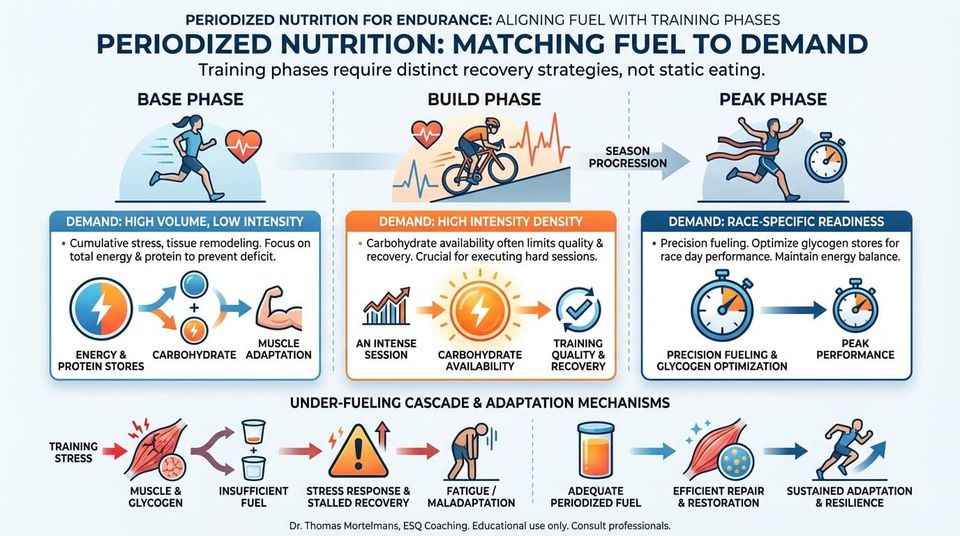
The central problem is simple: many athletes eat roughly the same way year-round, even though the physiological demands (and recovery costs) of training phases change markedly across a season.
Today I want to answer three questions:
- What does “periodized nutrition” actually mean in endurance training, beyond just “eat more when training more”?
- Which nutrition variables matter most across base, build, and peak phases for recovery and adaptation?
- How do you apply this without turning your life into a spreadsheet—or panicking when appetite, weight, or performance fluctuates?
Too long didn’t read:
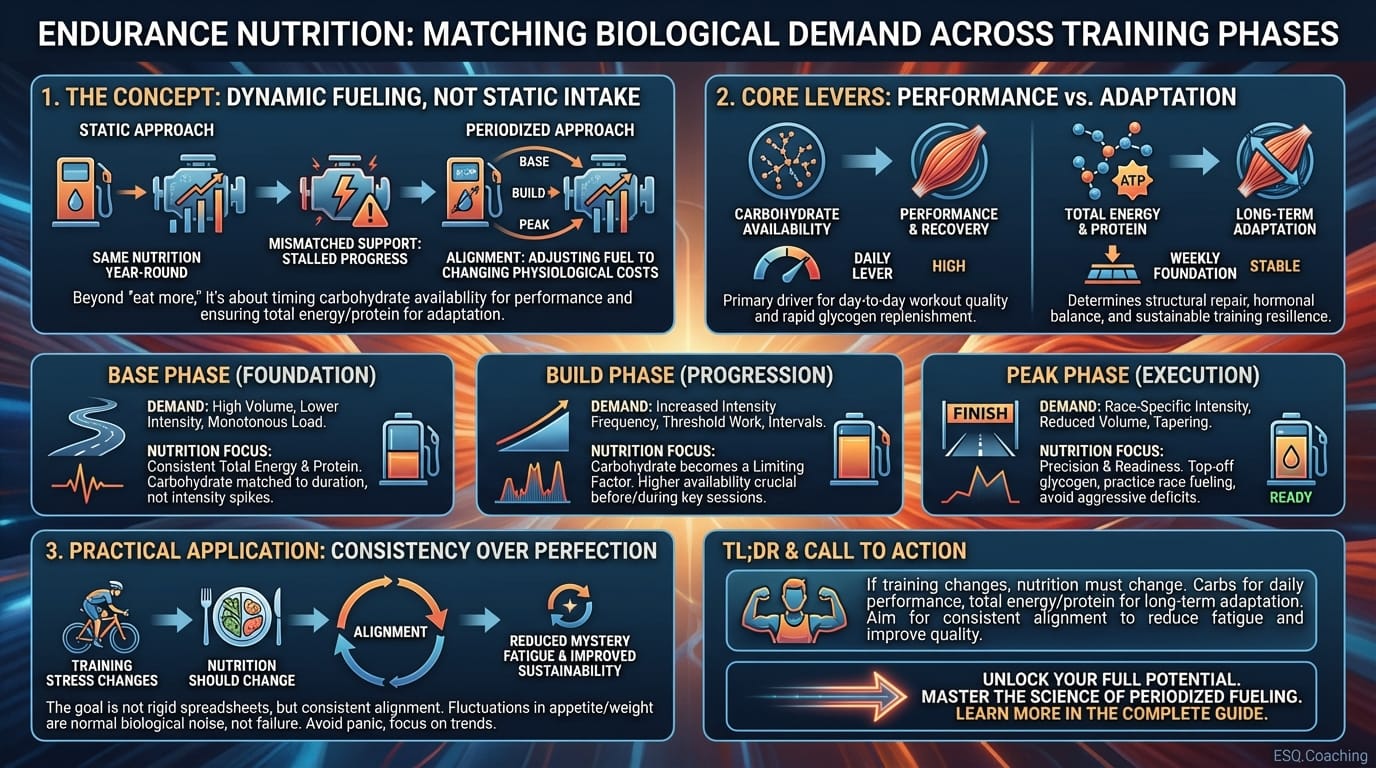
If training stress changes across phases, nutrition should change too. Carbohydrate availability is usually the biggest lever for day-to-day performance and recovery, while total energy and protein determine how well you actually adapt across weeks.
The goal is not perfect fueling—it’s consistent alignment between training demand and nutrition support. Done well, this reduces “mystery fatigue,” improves workout quality, and makes hard phases more sustainable.
1. Core Concepts
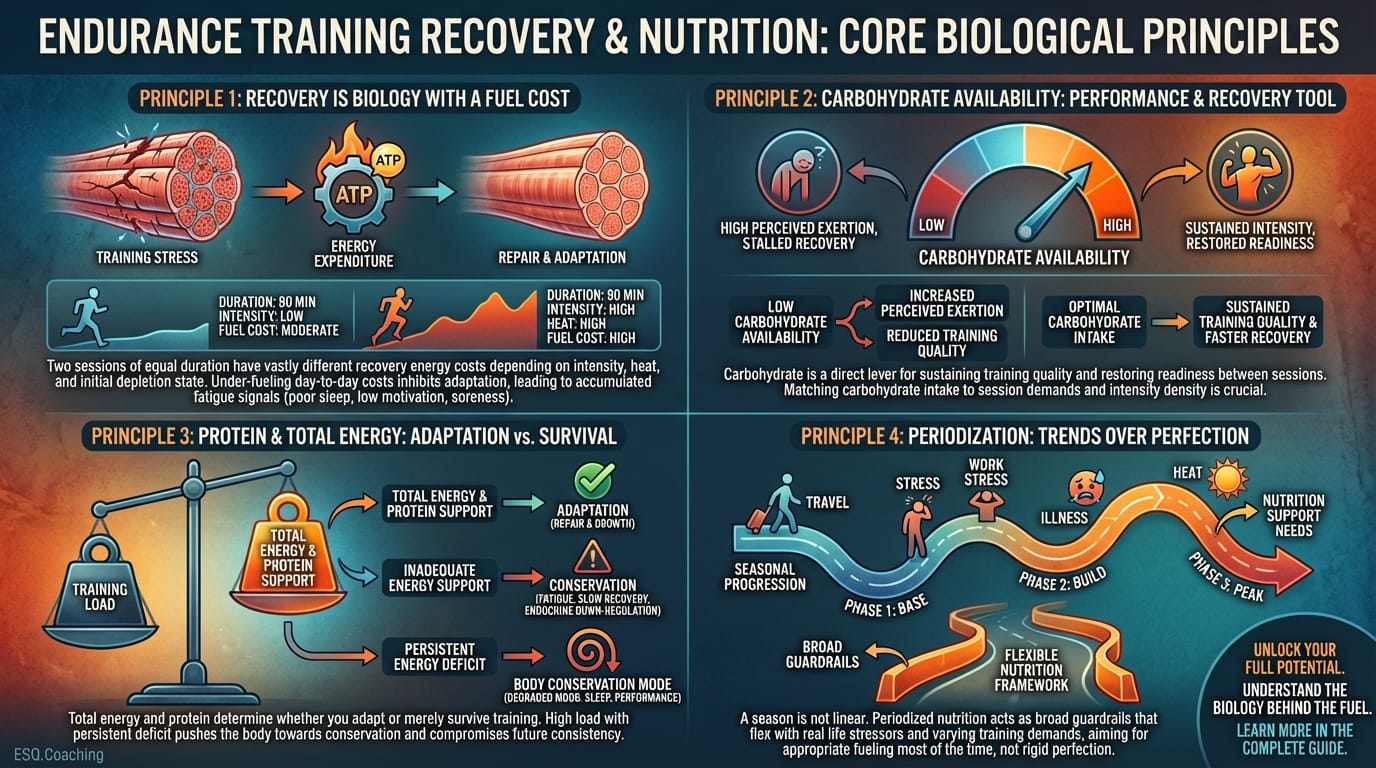
Principle 1: Recovery is not a feeling—it's biology with a fuel cost
Training adaptation requires repairing muscle damage, restoring glycogen (stored carbohydrate), rebuilding proteins, and downshifting stress hormones and nervous system load. All of that costs energy.
A key practical implication: two sessions can have the same duration and still have very different recovery costs depending on intensity, heat, terrain, and how depleted you were going in. That’s why “I trained 10 hours this week” is not enough to decide how to eat. The intensity distribution and session type matter.
If you under-fuel the day-to-day costs of training, the body does not simply “adapt harder.” More often, it adapts less, while accumulating fatigue signals that look like poor sleep, low motivation, stubborn soreness, and gradually declining workout quality.
Principle 2: Carbohydrate availability is a performance tool—and a recovery tool
In endurance sports, carbohydrate is not only about racing. It is the most direct lever for sustaining training quality (especially at moderate-high intensity) and for restoring readiness for the next session.
When carbohydrate availability is low, perceived exertion rises, intensity becomes harder to hit, and recovery between demanding sessions can stall.
This is where periodized nutrition becomes concrete: the goal is not “high carbohydrate forever,” and not “low carbohydrate because fat adaptation.” It is matching carbohydrate intake to the sessions that require it, and to the phases where intensity density is higher.
Principle 3: Protein and total energy determine whether your training is “supported” or “survived”
Carbohydrate largely dictates whether you can execute training. Total energy and protein strongly influence whether you adapt to it.
In phases with high training load, many athletes accidentally create a persistent energy deficit (not necessarily intentional dieting—just appetite, schedule, and fatigue).
Over time, this pushes the body toward conservation: recovery slows, mood and sleep can degrade, and the endocrine system may down-regulate. You may still complete sessions for a while—but you are often borrowing from future training consistency.
Principle 4: Periodization is about trends, not perfection
A season is not linear. Travel, illness, work stress, heat, and poor sleep all change how much nutrition support you need. Even within the same training phase, a “simple endurance week” and a “threshold-heavy week” are different animals.
So periodized nutrition is best understood as broad guardrails that flex with real life, not rigid rules. The target is a higher probability of being fueled appropriately, most of the time.
2. The Science
Carbohydrate timing: important, but not magic
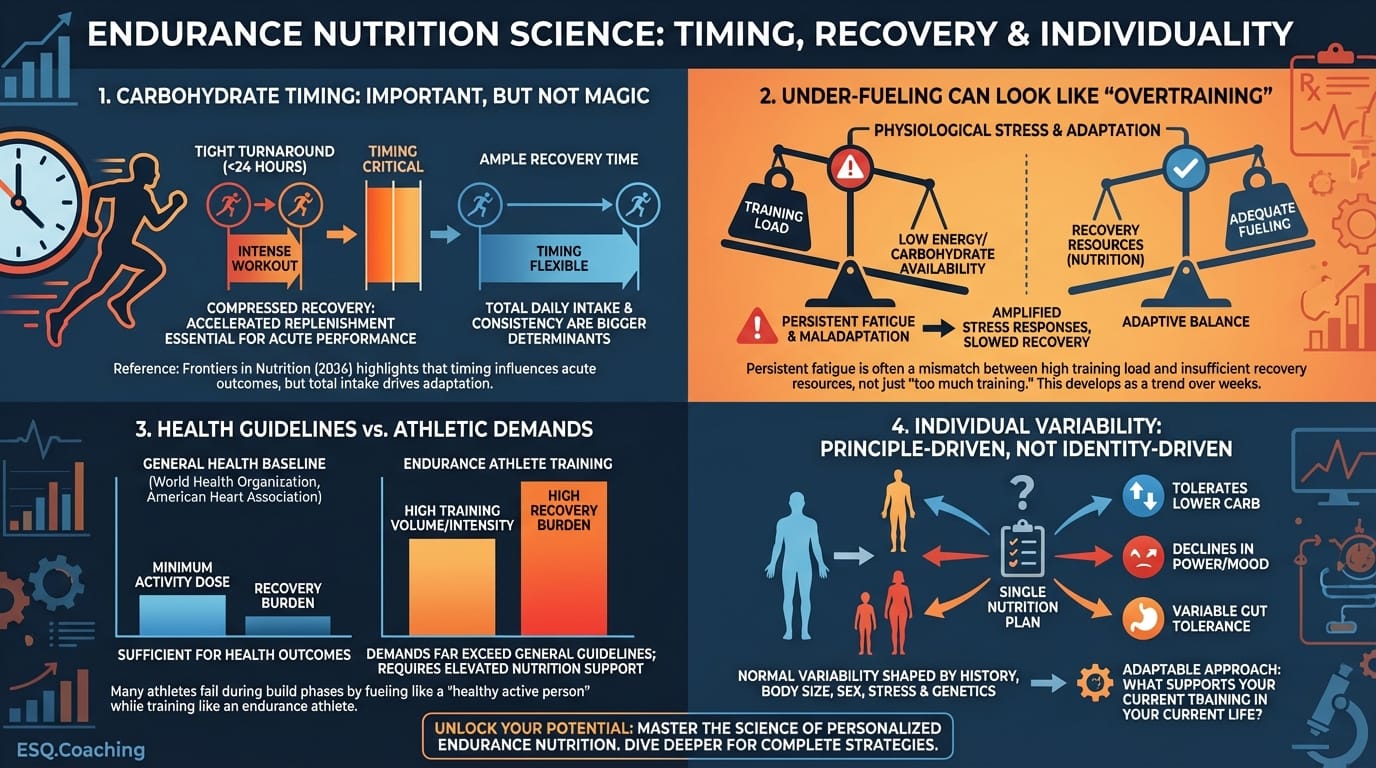
A recurring theme in sports nutrition research is that timing can matter, but rarely in a way that overrides total daily intake. A recent Frontiers in Nutrition paper (2024) discussing different timing strategies highlights this modern interpretation: timing can influence acute outcomes (like how you feel in the next session), but the bigger determinants of adaptation remain overall intake and consistency.
The practical nuance:
- If you have two demanding sessions within ~24 hours, carbohydrate timing becomes more important because you are compressing recovery.
- If you have ample time between key workouts, you often have more flexibility—without needing to obsess over a narrow “window.”
Training stress and maladaptation: under-fueling can look like “overtraining”
Endurance athletes often attribute persistent fatigue to “too much training,” when the real issue is a mismatch between training load and recovery resources—nutrition being one of the largest.
The classic practical guide on overtraining syndrome emphasizes that unexplained underperformance and prolonged fatigue are multi-factorial and require careful interpretation. Nutrition is part of that interpretation because low energy availability and insufficient carbohydrate can amplify stress responses and slow recovery. Importantly, this is rarely a single-week issue; it’s typically a trend developing across weeks of accumulating mismatch.
Health guidelines as context: more training demands more recovery support
Public health organizations (World Health Organization and American Heart Association) provide baseline recommendations for physical activity aimed at general health.
Those baselines are helpful context: endurance athletes often train far above the minimum doses associated with health outcomes, meaning the recovery burden is also far above what general guidelines assume.
This matters because many athletes try to fuel like a “healthy active person” while training like an endurance athlete.
That mismatch tends to show up first during build phases—exactly when we need consistent recovery to keep intensity progressing.
Individual variability: the same plan can work great—or poorly
Some athletes tolerate lower carbohydrate availability during certain sessions without obvious issues; others see immediate declines in power/pace sustainability, mood, or sleep. This variability is normal and is shaped by training history, body size, sex, stress load, gut tolerance, and genetic factors.
The consequence: periodized nutrition should be principle-driven, not identity-driven (“I’m a low-carb athlete” or “I always eat high-carb”). The right question is: what supports the training you are doing right now, in the life you are living right now?
3. Practical Interpretation
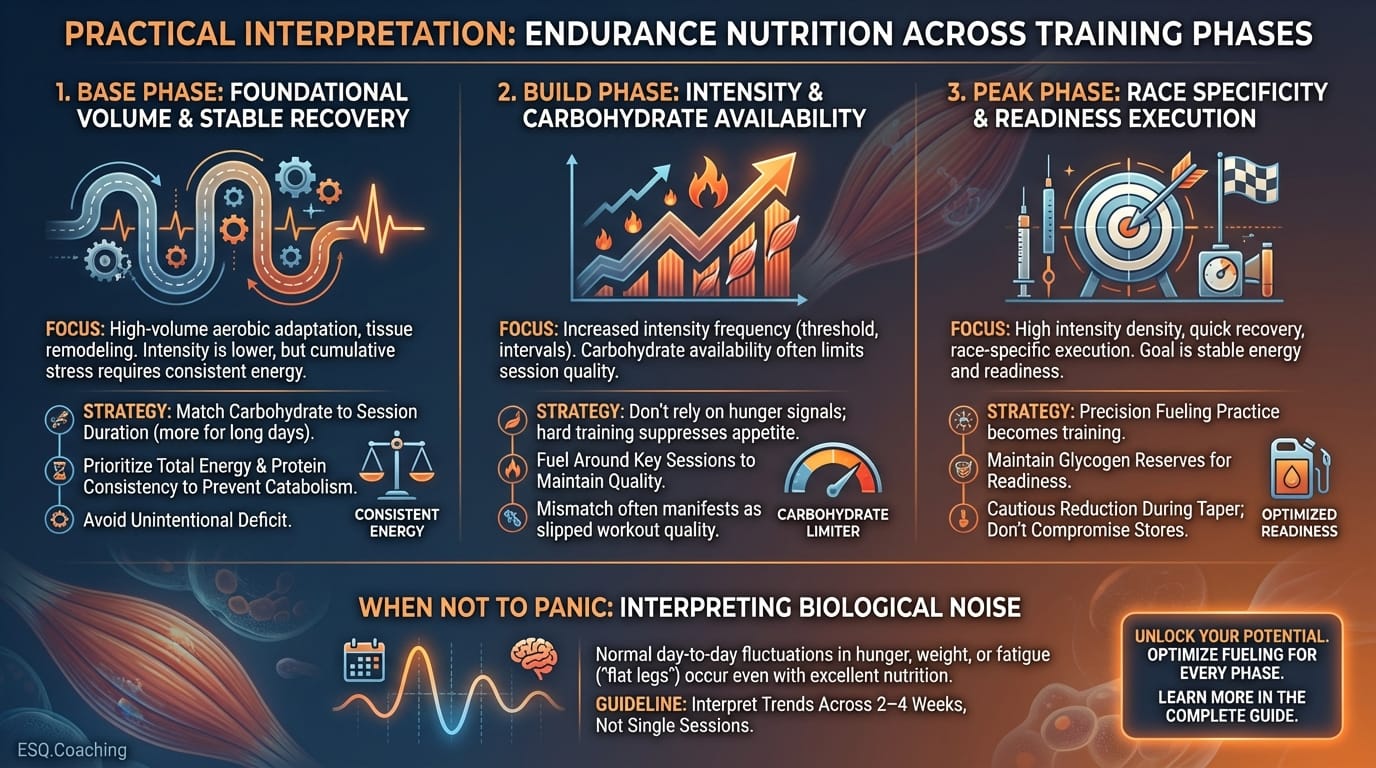
Base phase: build the engine, keep recovery quietly consistent
In base training, intensity is often lower, but volume can be high and monotonous. Many athletes under-eat here because sessions “feel easy.” But long aerobic work still consumes glycogen and carries cumulative stress.
Practical interpretation:
- You may not need aggressive carbohydrate loading for every easy day, but you do need enough total energy to prevent slow drift into deficit.
- Protein consistency matters because base phases are where you want stable tissue remodeling and resilience.
- A useful strategy is carbohydrate matched to session length (more for long endurance days, less for short easy days), while keeping total daily intake steady enough that body weight and mood are not trending downward unintentionally.
Build phase: carbohydrate becomes the limiting factor more often than you think
When intensity frequency increases—threshold, longer intervals, harder group rides—carbohydrate availability commonly becomes the primary limiter of session quality.
Practical interpretation:
- Don’t judge fueling needs by hunger alone; hard training can suppress appetite while increasing carbohydrate requirement.
- If workout quality is slipping, or you’re “failing” intervals that used to be manageable, nutrition mismatch is a reasonable first hypothesis before assuming fitness is declining.
- Carbohydrate intake around key sessions and between back-to-back hard days can reduce the feeling that you are always “catching up.”
Peak and race-specific: fewer “hero workouts,” more precision and readiness
Closer to key events, training may become more race-specific, sometimes with reduced volume but higher intensity density. The goal shifts toward being able to execute very specific sessions, recover quickly, and arrive at race day with stable energy and confidence.
Practical interpretation:
- Carbohydrate practice becomes part of training, not an afterthought.
- If you reduce volume (taper) but keep intensity sharp, many athletes can reduce total calories slightly—but should be careful not to reduce carbohydrate too aggressively, since readiness depends heavily on glycogen.
When not to panic
Day-to-day fluctuations in hunger, body weight, or “flat legs” happen even with excellent nutrition. Periodized fueling reduces probability of issues; it doesn’t eliminate biological noise.
A good rule: interpret trends across 2–4 weeks, not one session.
4. Case Study
One of our coached athletes (age-group cyclist, full-time job, two kids) had a consistent pattern: base phase felt fine, but every build phase turned into a slow slide—sleep got lighter, legs felt heavy, and threshold intervals became a negotiation.
Training analysis showed the build phase wasn’t dramatically “more hours,” but it was more dense: two threshold sessions plus a hard group ride most weeks. Nutrition logs showed a stable eating pattern year-round: similar breakfast, similar lunch, light dinner, minimal carbohydrate during training unless the ride exceeded 2 hours.
We didn’t change the training plan initially. We changed the nutrition alignment:
- Carbohydrate during all quality sessions (not just long rides)
- A deliberate post-session meal on interval days even when appetite was low
- Slightly higher carbohydrate on the day before the hardest session of the week
Within two weeks, subjective recovery improved first (better sleep, less heaviness), then workout completion improved, and only later did performance markers rise. The key lesson wasn’t that fueling “unlocked” instant fitness. It was that aligning nutrition with the build phase made the training sustainable enough for fitness to accumulate across the block—nonlinear progress, but real progress.
If your FTP hasn’t moved in months, more intensity is not the answer.
This 8-week threshold plan is built to stabilize power just below the red line and extend how long you can sit there without bleeding fatigue. It replaces guesswork with controlled stress and clear recovery.
Use this when your training feels busy, but your race-relevant power stays flat. View Plan here

5. Summary
- Periodized nutrition means adjusting nutrition to the phase and session demands, not eating the same way year-round.
- Carbohydrate availability is often the biggest lever for training quality and short-term recovery, especially in build and peak phases.
- Total energy and protein intake strongly influence long-term adaptation and resilience, particularly during high load weeks.
- Under-fueling can mimic “overtraining” signs; interpretation should be trend-based and context-aware.
- Real progress is nonlinear—nutrition alignment reduces preventable fatigue, but it cannot remove normal variability from training.
Context determines interpretation. The “right” plan is the one that supports your training and your real life consistently enough to let adaptation stack over months.
If you take one thing from today’s newsletter, let it be this: training phases are different problems, and they deserve different recovery strategies. When nutrition is aligned with the phase, you don’t just feel better—you give the training a fair chance to work.
Best regards,
Dr. Thomas Mortelmans
PS: Curious to know what you liked today.Tap here for a 45-second anonymous survey. I read every single note!
6.References
- https://www.frontiersin.org/journals/nutrition/articles/10.3389/fnut.2024.1397090/full — Discusses how different timing strategies of nutrition intake around training can affect performance and recovery-related outcomes, emphasizing practical application.
- https://pmc.ncbi.nlm.nih.gov/articles/PMC3435910/ — Practical scientific overview of overtraining syndrome, including warning signs, contributing factors, and interpretation in athletes.
- https://pmc.ncbi.nlm.nih.gov/articles/PMC1402378/ — Review of the health benefits of physical activity, providing context for baseline exercise doses versus athletic training loads.
- https://www.who.int/news-room/fact-sheets/detail/physical-activity — World Health Organization physical activity recommendations and health rationale.
- https://www.heart.org/en/healthy-living/fitness/fitness-basics/aha-recs-for-physical-activity-in-adults — American Heart Association recommendations for adult physical activity, useful for framing health versus performance training loads.
- https://pmc.ncbi.nlm.nih.gov/articles/PMC12044783/ — Systematic review and meta-analysis on high-intensity interval training effects in university students, offering context on intensity demands and fitness changes.
This newsletter is for educational purposes only and is not medical advice. Always consult a qualified medical professional before implementing changes to training, diet, or supplementation. ESQ Coaching does not assume any responsibility or liability for any consequences arising from the use or misuse of the information provided here.
Found this useful?
Get articles like this and free training calculators in your inbox every week.
Recommended reads
If this was useful, these are the other research-driven newsletters I actually read.




Member discussion