Entry #003: How to prepare for a cycling race, pre-race fueling timeline, 24 hours to the start
Hi Endurance Enthusiast,
Now that we have talked about the long-term aerobic development required to build your engine, we need to address the structural integrity of the chassis before you take it to the redline. Too often, I see athletes invest months in meticulous Zone 2 volume and threshold/Vo2 Max intervals, only to dismantle that physiological architecture in the final 24 hours through hydration errors, nutritional mismanagement, or psychological drift.
The reality is that your fitness is "banked" seven to ten days before the start gun. Nothing you do in the final 24 hours can increase your VO2max or functional threshold power. However, everything you do during this window determines whether you can access 100% of that fitness or if you will be capped at 85% by glycogen depletion and neuromuscular fatigue. We will strip away the "pasta party" mythology and replace it with a precise physiological protocol.
Executive Summary: The Brief
- Tapering is not Cessation: The goal is to shed fatigue while maintaining plasma volume and neuromuscular snap. Complete rest often leads to "staleness."
- Precision Glycogen Loading: For events >90 minutes, a target of 10-12g carbohydrate per kg of bodyweight in the 24-36 hours prior is required to saturate muscle glycogen.
- The Sodium Preload: Drinking water without electrolytes in the final hours risks hyponatremia. A hypertonic sodium solution (1,500mg/L) is superior for plasma volume expansion.
- Sleep Banking: One night of poor sleep before a race has negligible impact on physiological capacity if you have "banked" sleep in the preceding 72 hours.
- The "Opener" Session: A specific priming workout 24 hours pre-race upregulates metabolic enzymes without inducing structural damage.
The Science at a Glance
We often rely on intuition during race week, which typically leads to over-resting and under-fueling. Here is the physiological reality of the trade-offs:
| Component | Intuitive Approach (The Mistake) | Physiological Optimization (The Goal) | Metabolic Impact |
|---|---|---|---|
| Taper | Complete rest 2 days before. | "Openers" with short high-intensity bursts. | Maintains blood plasma volume and neuromuscular firing rates. |
| Fueling | A large pasta dinner the night before. | 10-12g CHO/kg over 24-36 hours. | Increases muscle glycogen storage by ~20% above baseline. |
| Hydration | Drinking clear water until urine is clear. | Sodium loading (1500mg/L) 2-3h prior. | Expands plasma volume; prevents hyponatremia and excessive urination. |
| Fiber | Eating "healthy" whole grains. | Low-residue (white rice/bread). | Reduces gastrointestinal bulk and risk of mid-race distress. |
Foundational Principles
1. The Fitness-Fatigue Impulse
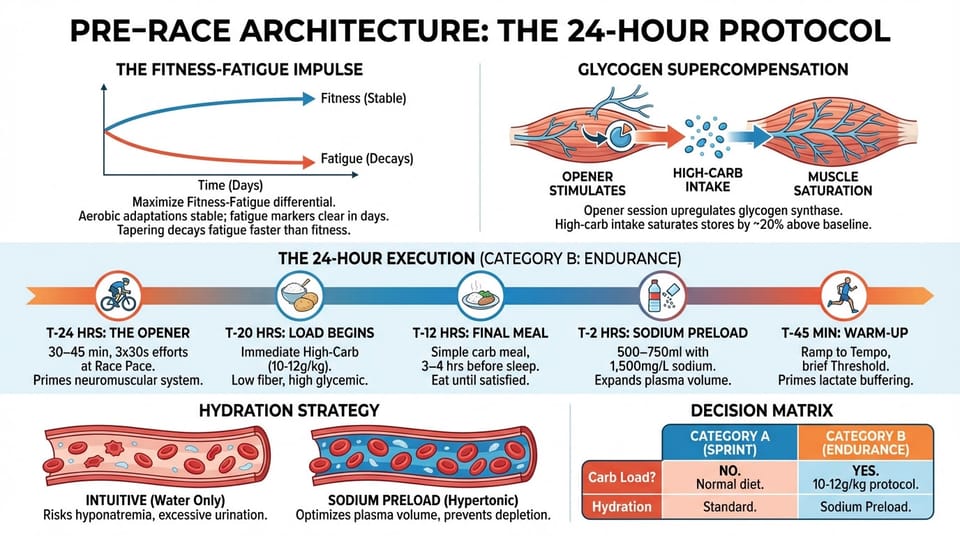
Performance is not simply a measure of fitness; it is the net result of Fitness minus Fatigue. In the final week, our primary objective is to decay fatigue at a faster rate than we decay fitness. Biological data suggests that while aerobic adaptations (mitochondrial density) are stable for weeks, fatigue markers (creatine kinase, hormonal stress) clear in days. The "Taper" is a mathematical equation, not a vacation.
2. Glycogen Supercompensation
The human body has a finite storage capacity for glycogen. To maximize this, we utilize a depletion-repletion model. A short, high-intensity bout (the "opener") performed ~24 hours prior stimulates the enzyme glycogen synthase. When followed immediately by high-carbohydrate intake, the muscles act like a dry sponge, soaking up fuel far beyond their normal resting capacity.
"The body does not know you are racing. It only understands stress and homeostasis. If you starve it of intensity for three days, it downregulates critical metabolic pathways. You must keep the engine idling high, even when the volume drops."
Scientist's Insight
The Decision Matrix
Identify your event profile below to determine if a full physiological load is required.
| If you are racing... | Category A: The Crit / TT / Sprint (<90 Minutes) | Category B: The Endurance Event (>2.5 Hours) |
|---|---|---|
| Limiting Factor | Lactate clearance, Neuromuscular power. | Glycogen depletion, Dehydration, Cardiac Drift. |
| Carb Load? | NO. Normal diet is sufficient. | YES. 10-12g/kg CHO loading protocol required. |
| Hydration | Standard hydration. | Sodium Preload (Hypertonic). |
| Warm-up | Extensive, high intensity (20-40 min). | Minimal, energy conservation focus. |
The Protocol: 24-Hour Execution
This timeline assumes a Category B (Endurance) event. Adjust logically for shorter durations.
This framework is already used by competitive age-group athletes and coaches to prevent race-week performance loss.
T-Minus 24 Hours: The Opener
- Duration: 30–45 minutes.
- Content: 15 mins Zone 1/2. 3 x 30-second efforts at Race Pace (or slightly above) with 3-minute recovery. 5 mins spin down.
- Objective: Prime the neuromuscular system and stimulate glycogen synthase.
T-Minus 20 Hours: The Load Begins
- Nutrition: Immediately post-ride, begin high-carb intake.
- Target: Low fiber, high glycemic index (white rice, potatoes, fruit juice).
- Avoid: fats, excessive proteins, and fiber (salads, whole grains) which slow gastric emptying.
- Hydration: Sip electrolyte water constantly. Do not chug plain water.
T-Minus 12 Hours: The Final Meal
- Timing: 3–4 hours before sleep.
- Content: A simple, boring meal. E.g., White rice with lean chicken or a moderate portion of pasta.
- Volume: Eat until satisfied, not stuffed. You should have been grazing all day; this is not a "feast."
T-Minus 2 Hours: The Sodium Preload
- Protocol: Consume 500–750ml of fluid containing ~1,000–1,500mg of sodium.
- Why: This pulls fluid into the vascular space (plasma expansion), providing a reservoir for sweat loss.
- Caution: Stop drinking substantial volume 60 minutes before the start to allow the kidneys to clear excess fluid.
T-Minus 45 Minutes: The Warm-Up
- Structure:
- 10 min: Easy spin (Zone 1).
- 5 min: Ramp to Tempo (Zone 3).
- 3 min: Threshold (Zone 4) – Prime the lactate buffering system.
- 5 min: Easy spin.
- Finish: 10 minutes prior to start.
Case Study: Managing "Noise" in the Data
Consider "Mark," a 45-year-old Masters cyclist targeting a 100km Gran Fondo.
The Context: Mark’s work week was high-stress. He missed his T-2 day ride. He arrived at the event venue late and slept only 5 hours the night before the race due to nerves.
The Physiological Reality:
- Sleep: Mark panicked, believing his race was over. However, physiology dictates that acute sleep loss (one night) affects perception of effort more than actual contractile capability. Because Mark had "banked" 8 hours/night for the three days prior, his physiological readiness was intact.
- The Adjustment: Mark utilized a caffeine protocol (3mg/kg) 60 minutes pre-race to counteract the central fatigue and reduced his warm-up duration to conserve energy.
- The Result: Despite feeling "foggy" on the start line, Mark’s legs responded. He set a personal best.
The Lesson: Adherence to the long-term principles (sleep banking, hydration) provides a buffer against the inevitable chaos of race day. You do not need to feel perfect to perform perfectly.
Best regards,
Dr. Thomas Mortelmans
If you know someone racing soon:
Forward this and tell them to read only the Executive Summary + 24-Hour Protocol. That alone can save their race.
Annotated References
- Source-e.net: Finding the Perfect Openers
Scientific analysis of pre-race priming workouts, suggesting that short, high-intensity efforts 24 hours prior can optimize neuromuscular readiness without inducing fatigue. - Skratch Labs: Pre-Race Fueling
A practical guide emphasizing the importance of simple, easily digestible carbohydrates and adequate sodium intake in the hours leading up to competition. - Nduranz: Carb Loading Guide
Reviews modern carbohydrate loading protocols, recommending 10-12g/kg of body weight in the 24-36 hours prior to events lasting longer than 90 minutes. - PubMed: Effects of Tapering on Performance
A meta-analysis demonstrating that a structured reduction in training volume of 40-60% while maintaining intensity can significantly improve cycling time-trial performance. - Precision Hydration: 24 Hour Nutrition Record
Case study data from an elite ultra-endurance athlete, highlighting the specific caloric and hydration requirements for extreme duration events. - The Feed: Athlete's Guide to Carb Loading
Outlines the metabolic rationale for "topping off" glycogen stores and provides specific food examples to achieve high carbohydrate intake with low gastric distress. - High5: Final 24 Hours Before a Race
Practical checklist for endurance athletes covering hydration, equipment checks, and meal timing to minimize race-day friction. - O2 Endurance: TT Warmup Protocol
Detailed step-by-step warm-up structure specifically designed for time-trial efforts to optimize the aerobic system and lactate buffering capacity. - EF Pro Cycling: Sleep and Recovery Tips
Insights from professional cycling teams on sleep hygiene, temperature control, and banking sleep to mitigate the effects of travel and pre-race nerves. - TrainRight: Tapering Week Before Race
Discusses the balance between rest and activation, warning against the common mistake of complete cessation of training during the taper week. - TrainingPeaks: Hydration Before Race Day
Explains the risks of over-drinking water (hyponatremia) and the benefits of electrolyte-rich fluids for maintaining proper fluid balance. - Precision Hydration: Examples of Race Tapers
Comparative analysis of different tapering strategies, emphasizing individual variability and the need to test protocols before "A" races. - TrainingPeaks: Avoiding Mental Sabotage
Psychological strategies for reframing pre-race anxiety as performance-enhancing arousal rather than debilitating fear. - Precision Hydration: Sodium Preloading
Explains the physiological mechanism of sodium preloading (1,500mg/L) to expand plasma volume and improve cardiovascular stability in the heat. - Liv Cycling: Calming Nerves Before a Race
Practical mental exercises including visualization and breathing techniques to manage the sympathetic nervous system response on race morning. - TrainerRoad: Pre-Race Equipment Prep
A comprehensive mechanical checklist to ensure bicycle reliability, reducing cognitive load and mechanical risk on race day.
Disclaimer
The information provided in this newsletter is for educational purposes only and does not constitute medical advice. Exercise physiology is highly individual; what works for elite populations may not apply to everyone. Always consult with a physician before making significant changes to your training, nutrition, or supplementation protocols. The Scientist's Notebook and ESQ Coaching accept no liability for injuries or health issues arising from the application of these concepts.