Entry #010: Beta-alanine supplementation to extend time to exhaustion in endurance tasks
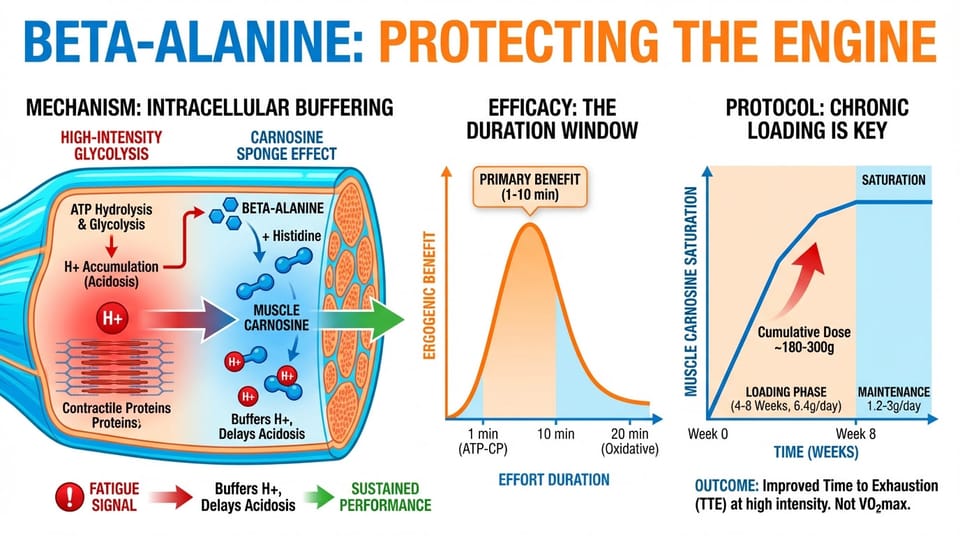
Now that we have established the hierarchy of aerobic development in previous editions, we need to address the specific biochemical limitations that occur when you push beyond the lactate threshold. We often discuss "fueling the engine" (glycogen) or "building the engine" (mitochondrial density), but we rarely discuss "protecting the engine" from the metabolic byproducts of high-intensity work.
If you have ever felt your muscles "seize up" or burn during a hill repeat or the final kilometer of a 5K, you have experienced the accumulation of hydrogen ions (H+) outpacing your body's buffering capacity. This is not merely discomfort; it is a mechanical failure signal. The research surrounding Beta-Alanine is extensive, yet often misunderstood. It is not a stimulant, nor is it a fuel source. It is an intracellular buffer modification.
Today, we strip away the marketing hype and look strictly at the kinetics of carnosine loading to determine if this protocol belongs in your training architecture.
Executive Summary
- Mechanism of Action: Beta-alanine is the rate-limiting precursor to carnosine. Supplementation increases intramuscular carnosine, which acts as a "sponge" for hydrogen ions ($H^+$) during high-intensity glycolysis.
- The "Goldilocks" Zone: The ergogenic benefit is highly specific to duration. It is most effective for efforts lasting 1 to 10 minutes. Efforts under 60 seconds (pure ATP-CP) or over 25 minutes (oxidative) show significantly diminished returns.
- Chronic, Not Acute: Unlike caffeine, beta-alanine has no acute effect. It requires a loading phase of 4 to 6 grams daily for at least 4 weeks to saturate muscle tissue.
- The Responder Effect: Nearly everyone responds, but the magnitude varies. Vegetarians often see the largest relative increase in buffering capacity due to lower baseline carnosine levels.
- Side Effects: The only verified side effect is paresthesia (tingling of the skin), which is harmless and dose-dependent.
The Science at a Glance
We must view supplementation through a cost-benefit lens. Beta-alanine does not improve oxygen delivery (VO2max); it improves the muscle's ability to operate in an acidic environment.
This post is for subscribers only
Found this useful?
Get articles like this and free training calculators in your inbox every week.
Recommended reads
If this was useful, these are the other research-driven newsletters I actually read.