Snippet #008: Buffering Acidity to Extend High-Intensity Anaerobic Output
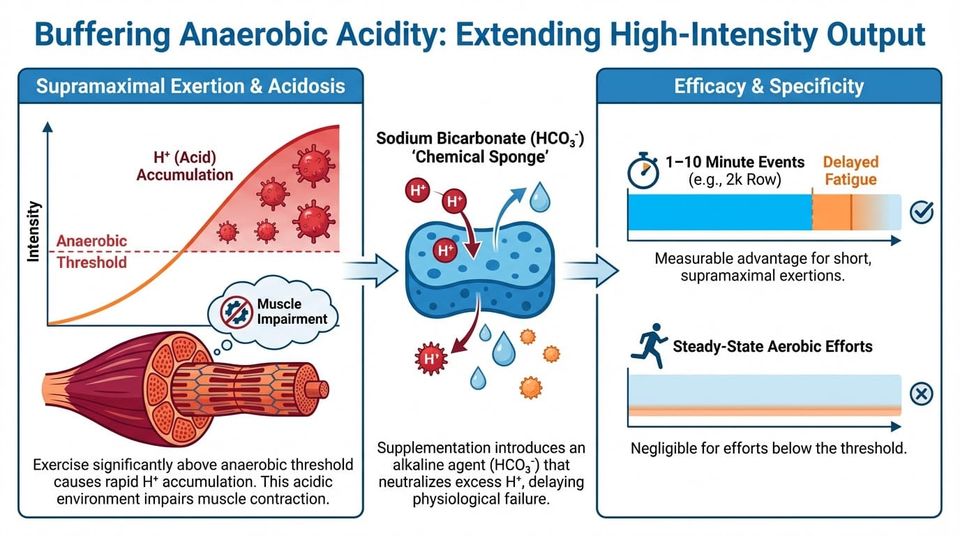
The efficacy of sodium bicarbonate relies heavily on the metabolic demands of the specific exercise intensity relative to an athlete's physiology. When an athlete sustains an effort significantly above their anaerobic threshold, the body rapidly accumulates hydrogen ions, creating a highly acidic environment that eventually impairs the muscles' ability to contract. Supplementation introduces an alkaline agent into the bloodstream that acts effectively as a chemical sponge, helping to neutralize this excess acid and delay the physiological failure point associated with intense metabolic fatigue.
This distinction clarifies why buffering agents provide measurable advantages in events lasting one to ten minutes, such as a 2,000-meter row or a middle-distance track event, but offer negligible returns for steady-state endurance efforts. The utility is strictly tied to overcoming the specific biochemical bottleneck of short, supramaximal exertions rather than mitigating general aerobic exhaustion.
These ergogenic effects are inconsistent in scenarios where exercise intensity dips below the anaerobic threshold, suggesting the mechanism is only activated during sustained, near-maximal acidosis.
If you want to see what I read to keep my own work sharp outside this newsletter, this is the list.
 Thomas Mortelmans
PS: To keep this valuable, I need your input.Give your anonymous feedback here(I read every single one!).
Hultman, E., & Sahlin, K. (1980).
Acid–base balance during exercise.
Exercise and Sport Sciences Reviews, 8, 41–128.
Disclaimer
The information provided in this newsletter is for educational purposes only and does not constitute medical advice. Exercise physiology is highly individual; what works for elite populations may not apply to everyone. Always consult with a physician before making significant changes to your training, nutrition, or supplementation protocols. The Scientist's Notebook and ESQ Coaching accept no liability for injuries or health issues arising from the application of these concepts.
Found this useful?
Get articles like this and free training calculators in your inbox every week.
Recommended reads
If this was useful, these are the other research-driven newsletters I actually read.

Member discussion