Entry #011: Genetic variability in VO2max responses and what it means for individualized training
Now that we have established the physiological underpinnings of aerobic capacity, we need to address the biological noise that often clouds training data: your DNA.
In the pursuit of peak performance, a common frustration arises when a standardized protocol yields divergent results among training partners. One athlete sees a 15% surge in VO2max, while another, adhering to the exact same workload, stagnates.
For decades, this was dismissed as a lack of discipline or "poor genetics." However, the current body of literature—specifically data from the landmark HERITAGE Family Study—suggests a more nuanced reality.
Genetics do not merely dictate your starting point; they dictate the specific style of stimulus required to force adaptation. We are moving away from the binary concept of "talent" toward a structural understanding of "trainability."
Executive Summary
- The Heritability of Trainability: While baseline VO2max is 43–72% heritable, your ability to improve that number (trainability) is approximately 47% heritable. This implies roughly half of your adaptation potential is distinct from your genetic starting point.
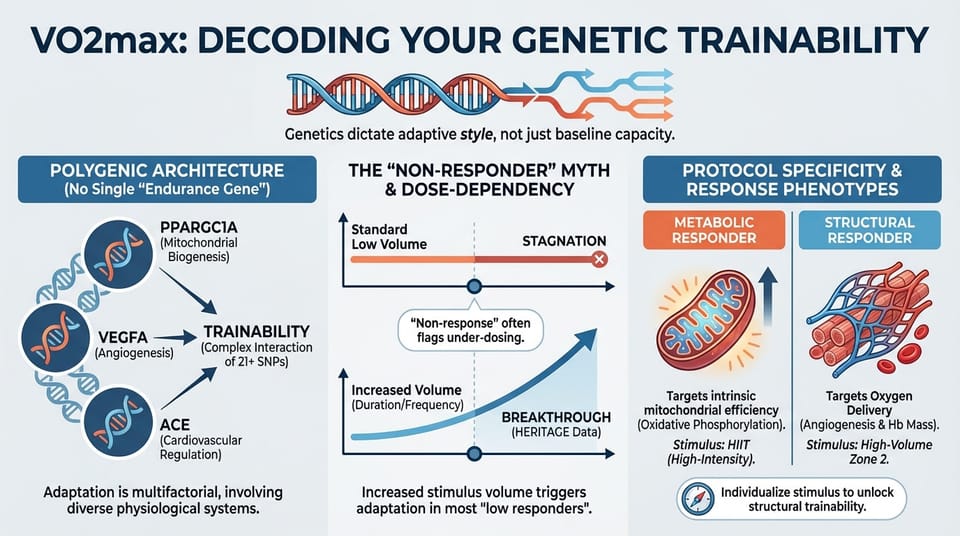
- The "Non-Responder" Myth: Recent rigorous investigations have effectively dismantled the concept of the "non-responder." Individuals who fail to adapt to standard moderate-volume training almost universally respond when the stimulus is increased in duration or frequency. "Non-response" is often a diagnostic marker for under-dosing.
- Polygenic Architecture: There is no single "endurance gene." Trainability is determined by a complex interaction of at least 21 single nucleotide polymorphisms (SNPs) involving mitochondrial biogenesis (PPARGC1A), angiogenesis (VEGFA), and cardiovascular regulation (ACE).
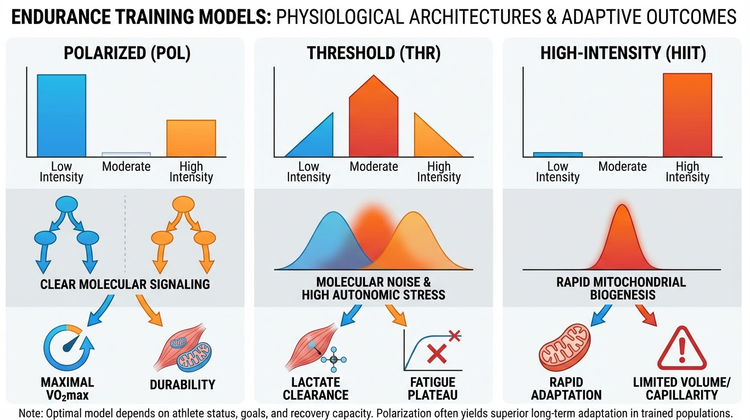
- Protocol Specificity: Adaptation heterogeneity suggests that "low responders" to intensity often require high-volume interventions, whereas others require high-intensity stimuli to trigger mitochondrial respiration improvements.
The Science at a Glance
The following table categorizes the physiological trade-offs observed between different genetic "response phenotypes." This data synthesizes findings regarding mitochondrial efficiency versus capillary density adaptations.
This post is for subscribers only
Found this useful?
Get articles like this and free training calculators in your inbox every week.
Recommended reads
If this was useful, these are the other research-driven newsletters I actually read.