Entry #016: The Science Of Training Periodization in Endurance Sports (Base, Build, Peak, Taper, Transition)

The fundamental challenge in endurance training architecture is managing the non-linear dose-response relationship between training stress and physiological adaptation. While the biological imperative for progressive overload is well-established, the optimal temporal organization of that load—periodization—remains a subject of evolving modeling.
Contemporary sports science has moved beyond rigid, calendar-based linear progressions toward more fluid, adaptive frameworks that account for individual recovery kinetics, bio-energetic systems, and the competing demands of peripheral versus central adaptations.
This briefing dissects the physiological mechanisms underlying the five canonical phases of training (Base, Build, Peak, Taper, Transition) and evaluates the evidence supporting Linear, Block, and Polarized models for maximizing performance outcomes.
Executive Summary – The Brief
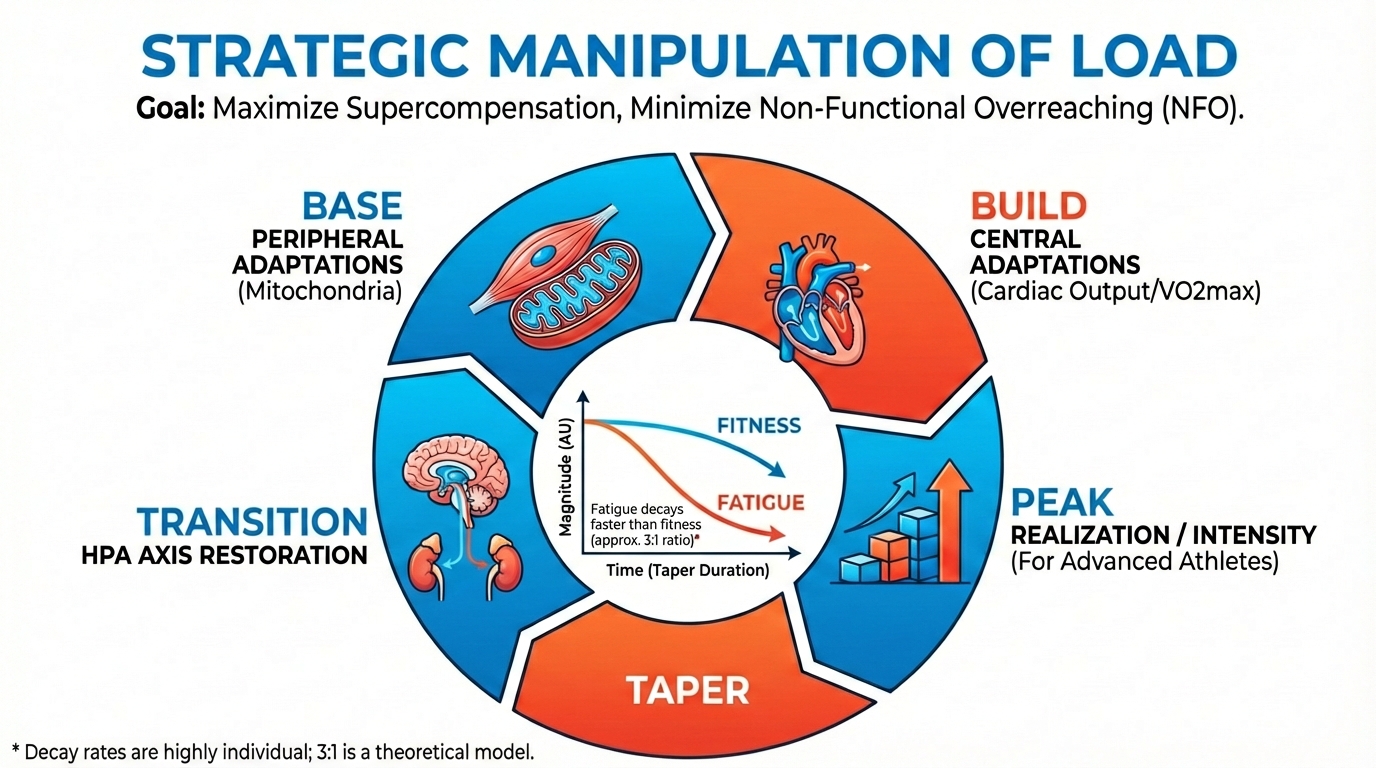
• Periodization is the strategic manipulation of volume, intensity, and frequency to maximize supercompensation while minimizing the risk of non-functional overreaching (NFO).
• The Base Phase prioritizes peripheral adaptations, specifically mitochondrial density and capillary-to-fiber ratios, utilizing high-volume, low-intensity stimuli to improve oxidative flux.
• The Build Phase shifts emphasis toward central cardiovascular adaptations (stroke volume) and metabolic efficiency at lactate threshold, often necessitating a polarized distribution to prevent autonomic monotony.
• Tapering is a mathematical optimization based on impulse-response modeling, where fatigue decays approximately three times faster than fitness, allowing performance to rebound.
• Block Periodization offers superior outcomes for advanced athletes by concentrating specific training stimuli to overcome the blunted signaling of homeostasis, whereas Linear models often suffice for developing athletes.
• The Transition Phase is physiologically mandatory to reset the hypothalamic-pituitary-adrenal (HPA) axis and repair connective tissue micro-trauma before the next macrocycle.
The Science at a Glance
Foundational Principles:
1. The Fitness-Fatigue Model (Banister’s Impulse-Response)
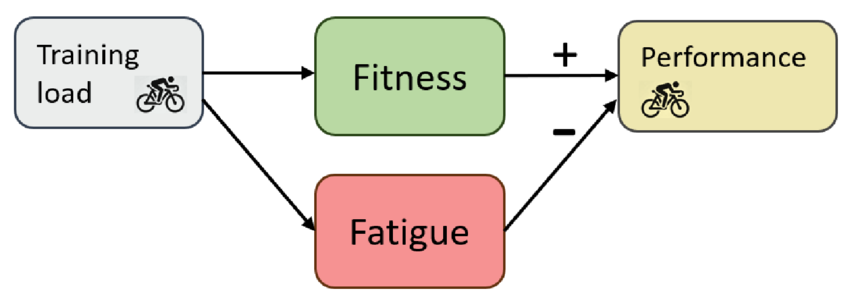
Performance is modeled as the difference between two competing variables: Fitness (positive adaptation) and Fatigue (negative stress). Fitness is chronic with a long time constant (decaying slowly); Fatigue is acute with a short time constant (decaying rapidly).
Effective periodization maximizes the delta between these curves. Training load must be sufficient to elevate the Fitness integral, while strategic recovery phases allow the Fatigue integral to dissipate precipitously.
2. Specificity vs. Interference Effects
Physiological systems adapt specifically to the imposed demand. However, concurrent training of conflicting systems (e.g., maximal glycolytic power vs. mitochondrial efficiency) can blunt adaptation pathways.
For example, high glycolytic flux can inhibit lipid oxidation rates, and concurrent strength training may create signaling conflicts (e.g., AMPK vs. mTOR pathways).
Periodization segregates these stimuli—either by phase (Linear) or by concentrated block (Block Periodization)—to minimize interference and maximize the signal-to-noise ratio of the training stimulus.
Scientist's Insight:
"The most common error in endurance architecture is the 'middle-ground' fallacy. Athletes often drift into a threshold-heavy distribution (Zone 3 in a 5-zone model) during Base and Build phases. While effective for some central adaptations (and the time-crunched cyclist), this intensity generates disproportionate autonomic fatigue relative to the signaling benefit.
Advanced periodization is increasingly defined by discipline in intensity distribution—adhering to the polarized principle where low-intensity volume maximizes mitochondrial signaling (PGC-1α) without compromising the high-intensity quality required for VO2max development."
The Decision Matrix
Use this framework to select the appropriate periodization model based on athlete profile and constraints.

DIAGNOSTIC CRITERIA
Training Age & Resilience
• Low (<2 years structured training): Linear Periodization. The physiology responds to novel stimuli without complex variation. Skeletal/connective tissue durability is the primary limiter.
• High (>5 years, plateaued): Block Periodization. Homeostasis is resistant to standard progressive overload; concentrated (shock) stimuli are required to force new adaptations.
Season Structure
• Single Peak (One 'A' Race): Linear or Pyramidal. Allows for a long, uninterrupted progression from aerobic base to event specificity.
• Multiple Peaks (Racing season): Block or Undulating. Allows for maintenance of base metrics while cycling through short, intense blocks of race-specific preparation and recovery.
Volume Capacity
• Low Volume (<6 hours/week): High-Intensity Interval Training (HIIT) focus with Undulating structure. Intensity compensates for insufficient duration to drive peripheral adaptations via volume alone.
• High Volume (>10 hours/week): Polarized Model. Strict adherence to Zone 1 (in a 3-zone model) is critical to prevent autonomic overtraining. High intensity is typically capped at ~15-20% of total sessions.
SELECTION LOGIC
The Protocol : The 5-Phase Periodization Architecture
Triathlon - From Capacity to Control (4 Weeks):

Fitness isn’t the problem. Durability is.
This 4-week triathlon block is built to improve how long you can hold quality across swim, bike, and run as fatigue accumulates. The goal is control, not maximal effort.
Use this when you feel fit, but execution falls apart late. View Plan here
Case Study: The Plateaued Marathoner
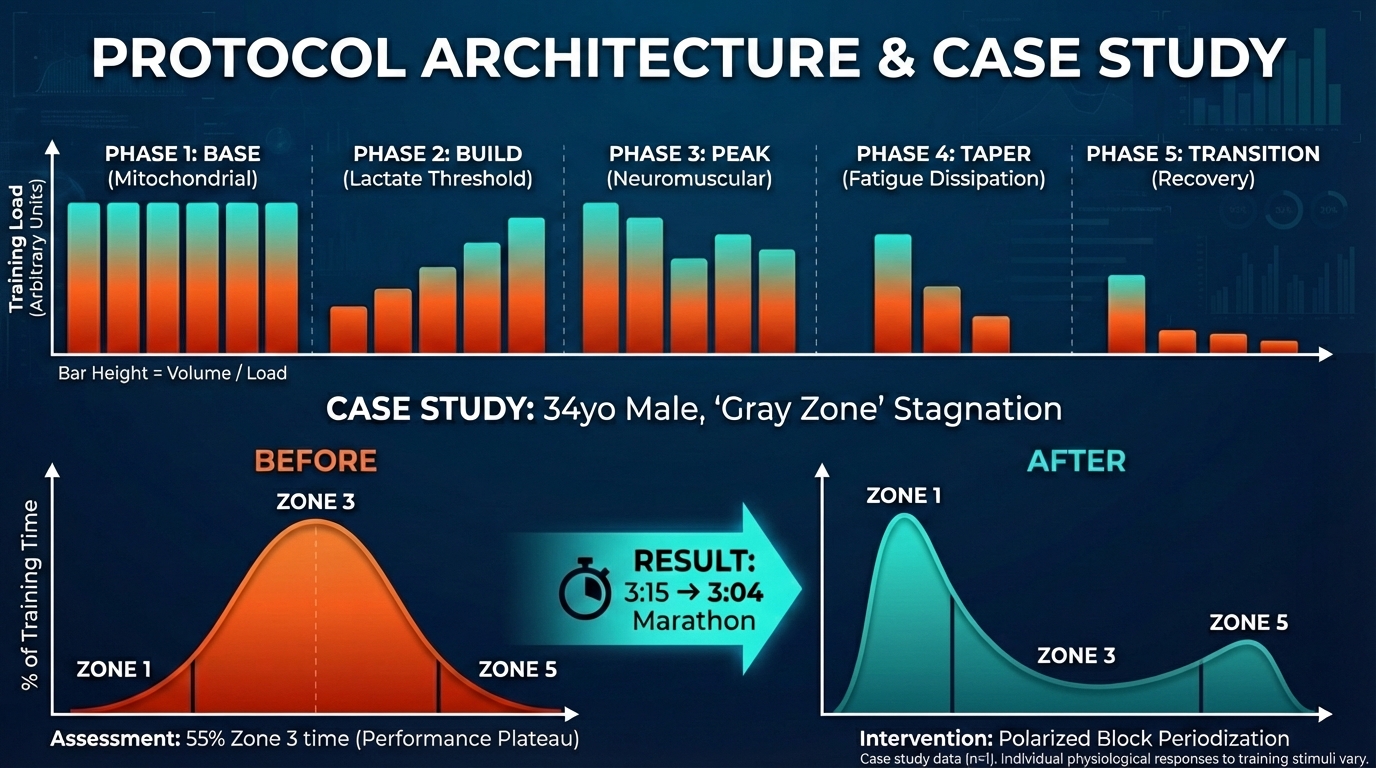
Subject: Male, 34, with 5 years of training history. He was stuck at a 3:15 marathon.
Diagnosis: "Gray Zone" stagnation. Analysis showed 55% of training time in Zone 3 (Moderately Hard), leading to chronic autonomic fatigue and blunted adaptation (disclaimer: he was running a high volume training plan, which he wasn`t able to complete due to fatigue).
Intervention: Switch to Polarized Periodization.
• Base: 10 weeks strict Zone 2 (HR < Aerobic Threshold). Volume increased by 15% due to lower fatigue cost.
• Build: 4-week VO2max block (3x/week HIIT). This was followed by a 4-week Threshold block, for a total of 8 weeks.
• Taper: 2-week fast-decay taper.
• Result: 3:04 marathon. Polarization allowed for higher mechanical output during key sessions, while the block structure broke the physiological plateau.
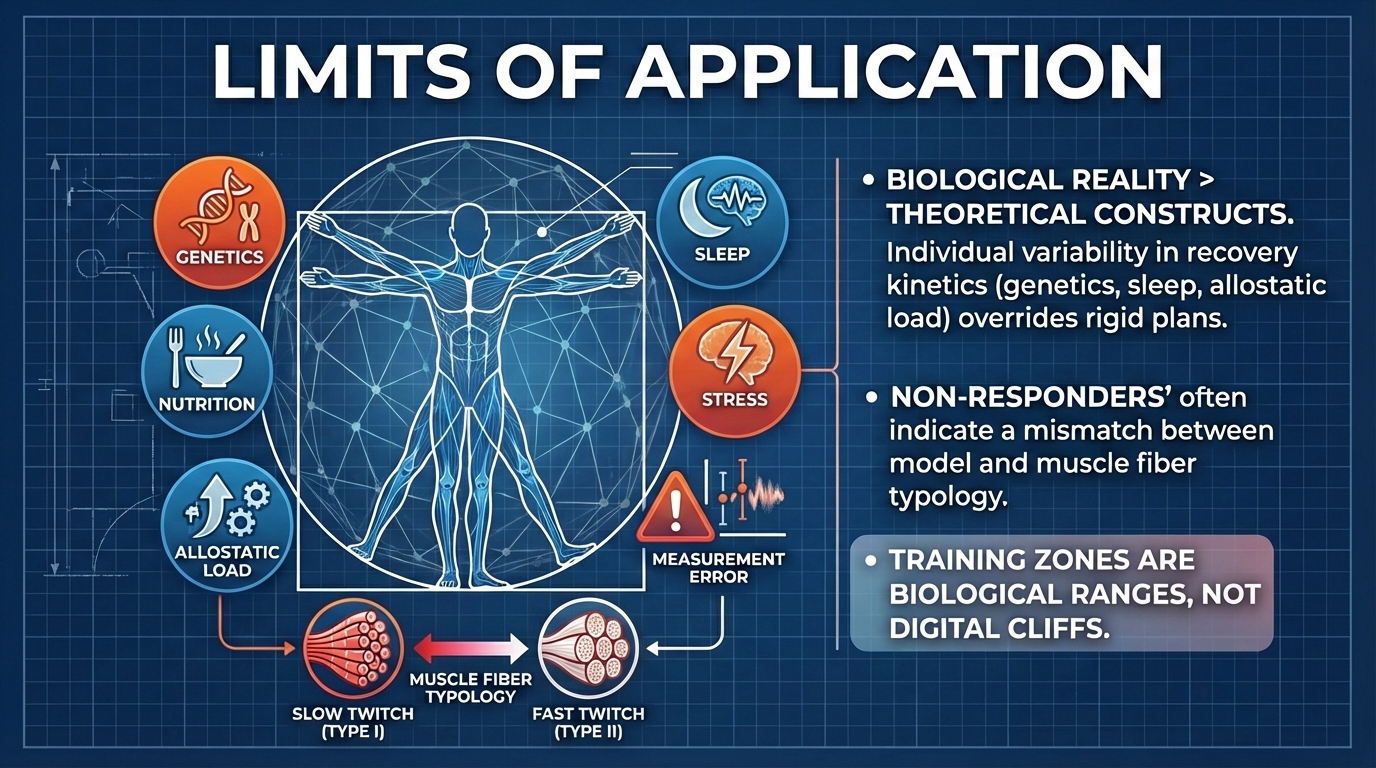
While periodization models provide necessary structure, they are theoretical constructs that must yield to biological reality. Individual variability in recovery kinetics—influenced by genetics, sleep quality, nutrition, and allostatic load—can render a rigid plan obsolete.
The non-responder phenomenon often indicates not a lack of effort, but a mismatch between the periodization model and the athlete's muscle fiber typology (e.g., a fast-twitch athlete struggling with high-volume linear plans).
Furthermore, field testing for thresholds and VO2max has inherent measurement error; training zones should be treated as biological ranges, not precise digital cliffs. Flexibility and autoregulation are the hallmarks of advanced application.
Best regards,
Dr. Thomas Mortelmans
If you want to see what I read to keep my own work sharp outside this newsletter, this is the list.
 Thomas Mortelmans
Disclaimer
The information provided in this newsletter is for educational purposes only and does not constitute medical advice. Exercise physiology is highly individual; what works for elite populations may not apply to everyone. Always consult with a physician before making significant changes to your training, nutrition, or supplementation protocols. The Scientist's Notebook and ESQ Coaching accept no liability for injuries or health issues arising from the application of these concepts.
References:
1. Training Phases | Summary: Overview of endurance training phases including base build peak taper and transition
2. What is Periodization Training? | Summary: Defines periodization with strategically fluctuating variables and macrocycles
3. Tapering and Peaking | Summary: Guidelines on tapering for optimal performance and peak race readiness
4. Training Periodization Macro-Meso-Microcycles | Summary: Explains macro, meso, and microcycles in training planning
5. Understanding the Timeline of Training Adaptations | Summary: Illustrates progressive physiological adaptations over training
6. Polarized Training | Summary: Describes the polarized intensity distribution approach
7. All About Intensity Balance | Summary: Reviews balance between high and low intensity in endurance programs
8. Tapering for Endurance Athletes | Summary: Outlines tapering strategies for endurance performance
9. Aerobic Endurance Training Strategies | Summary: Summarizes aerobic endurance training approaches and progression
10. Periodization Phases to Success | Summary: Describes practical periodization phases for athletic success
11. Periodisation Strategies: A Meta-Analysis Unravelling the Impact on Optimising Athletic Peak Performance | Summary: Meta-analysis examining periodisation strategies for peak performance
12. Deloading Week | Summary: Discusses deloading as a planned recovery week in training cycles
Disclaimer
The information provided in this newsletter is for educational purposes only and does not constitute medical advice. Exercise physiology is highly individual; what works for elite populations may not apply to everyone. Always consult with a physician before making significant changes to your training, nutrition, or supplementation protocols. The Scientist's Notebook and ESQ Coaching accept no liability for injuries or health issues arising from the application of these concepts.
Found this useful?
Get articles like this and free training calculators in your inbox every week.
Recommended reads
If this was useful, these are the other research-driven newsletters I actually read.





Member discussion