Sleep Debt Calculator: Need vs Actual Sleep
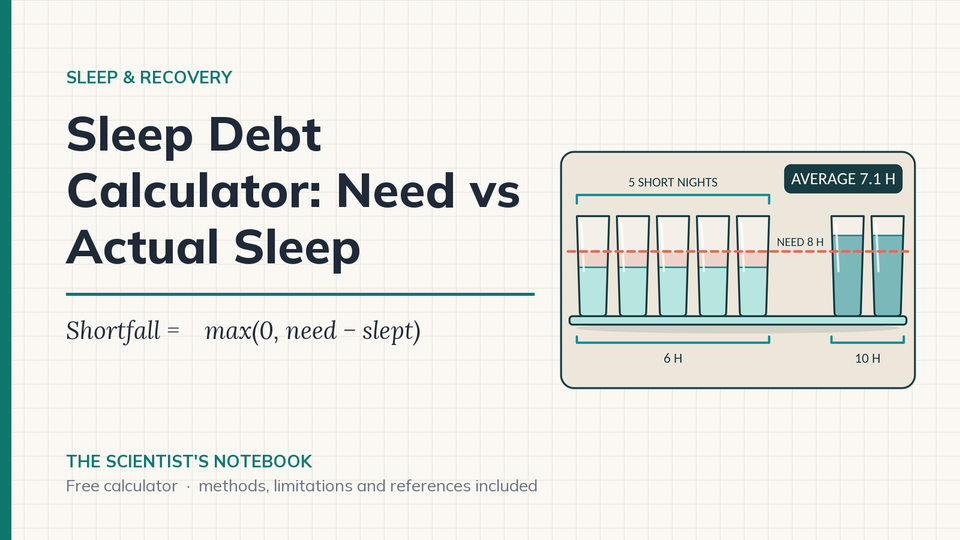
Sleep debt is the gap between the sleep you need and the sleep you actually got. This calculator adds up that gap over your last 7 to 14 nights and compares your pattern with the sleep-restriction arms of a controlled laboratory study.
In short: The sleep debt calculator adds up the gap between the sleep you need and the sleep you logged over 7 to 14 nights. The headline counts only the nights that fell short, a second figure lets long nights offset short ones, and a third sets your pattern beside the 8, 6 and 4 hour time-in-bed arms of Van Dongen 2003.
How is sleep debt calculated?
For every logged night the tool takes the gap between your stated need and your actual sleep:
gi = N − Si
- N is your sleep need in hours per night. You enter it. The NSF consensus range for healthy people is 7 to 9 hours for ages 18 to 64 and 7 to 8 hours from 65 (Hirshkowitz 2015).
- Si is the hours you slept on night i.
Three figures come out of that:
- Accumulated shortfall = the sum of the positive gaps only. This is the headline number. A long night does not erase a short one in this figure.
- Net balance = the sum of all gaps, so extra sleep offsets shortfalls. It is shown as a second number because recovery does not work hour for hour (see the limits below).
- Van Dongen exposure = the sum of max(0, (24 − Si) − 15.84). In Van Dongen 2003, lapses in attention rose near-linearly with waking time beyond 15.84 hours. The study counted waking time as 24 hours minus time in bed. The tool applies the same cut-off to 24 hours minus your hours asleep, which reads a little high, and sets the total beside the study's 8, 6 and 4 hour time-in-bed arms, scaled to the same number of nights.
Nights you leave blank are skipped. They are never counted as zero, and you need at least seven logged nights. Each night accepts 0 to 16 hours asleep, and a night above 12 hours gives a check-the-value warning. Your need accepts 4 to 12 hours, and your age 18 to 100 years.
Worked example
Need 8 h, age 34, seven nights: 8, 9, 7, 6, 10, 5, 8 hours. The gaps are 0, −1, +1, +2, −2, +3, 0.
- Accumulated shortfall: 1 + 2 + 3 = 6.0 h.
- Net balance: 0 − 1 + 1 + 2 − 2 + 3 + 0 = 3.0 h.
- Average: 53 / 7 = 7.6 h, inside the 7 to 9 h range. Three nights fell short, and the 7 and 6 hour nights were back to back.
Now seven nights of 6 hours with the same need. Shortfall = 7 × 2 = 14.0 h. Van Dongen exposure = 7 × (18 − 15.84) = 15.1 h, the same value as the 6 hour time-in-bed arm over 7 nights (7 × 2.16). The 8 hour arm gives 1.1 h and the 4 hour arm 29.1 h over the same span.
The repayment lines are plain division. A 14 hour shortfall divided by 1 extra hour per night is 14 nights, and by half an hour per night is 28 nights. They show scale. They do not predict recovery.
How should I use the result?
- Heavy training blocks. Log the last week of a block. If the shortfall is climbing while the average sits under your need, that is a descriptive signal to look at your schedule, not a verdict on your fitness.
- Before a key race or test. Count back 7 to 14 nights. Banks 2010 found that after five nights at 4 hours in bed, one recovery night of 10 hours in bed left attention lapses, sleepiness and fatigue ratings short of baseline. The authors suggested that complete recovery may need a longer sleep period in one night, more recovery nights, or both. If the pattern in your log looks like that, plan several longer nights rather than one.
- Find the cause. If the shortfall comes from late bedtimes, use the sleep cycle calculator to set a bedtime for your fixed alarm. If it comes from broken sleep, use the sleep efficiency calculator. If late caffeine is involved, check the caffeine half-life calculator.
What are the limits of this calculator?
- Self-reported sleep is imprecise. In the Sleep Heart Health Study (2,113 adults aged 40 and over), habitual sleep time reported on a questionnaire ran about 61 minutes above polysomnography, and the next-morning estimate about 18 minutes above (Silva 2007). Over seven nights, a gap like that can move the total by hours.
- Your stated need drives the answer. If every night falls short, moving it by 30 minutes shifts a seven-night shortfall by 3.5 hours. The tool does not measure your need.
- Van Dongen 2003 studied 48 healthy adults aged 21 to 38 in a laboratory. The restriction arms held time in bed at 4, 6 or 8 hours for 14 nights, and a separate experiment kept people awake for 3 nights. Time asleep in those arms was shorter than time in bed, so setting your hours asleep beside them is an approximation. Sleepiness ratings showed only small further increases after the first days, and participants were largely unaware of the growing deficits. Your life is not a laboratory.
- Banks 2010 studied 159 healthy adults aged 22 to 45. Of these, 142 spent five nights of 4 hours in bed and then one recovery night of 0 to 10 hours in bed; the rest stayed at 10 hours in bed as controls. Even the 10 hour recovery night did not restore every measure. That is why extra sleep is not netted off in the headline figure.
- The common rule of thumb that each lost hour needs four days to recover could not be traced to a verified source, so this tool does not use it.
- The calculator describes hours, not sleep quality, and does not assess any sleep condition. Persistent sleepiness or poor sleep deserves a conversation with a clinician.
⚠️ HEALTH & TRAINING GUIDANCE
Sleep needs and sleep problems differ between people. Talk to a doctor or a sleep clinician if you are often sleepy or sleep badly, rather than relying on these estimates.
ℹ️ IMPORTANT DISCLAIMER
This calculator is for educational purposes only and does NOT constitute medical advice. Consult qualified professionals before making changes. Individual physiology varies. You assume all risk. Must be 18+.
Frequently asked questions
How is sleep debt calculated?
For each night the tool takes your stated need minus the hours you slept. The accumulated shortfall adds up only the positive gaps. With a need of 8 hours and nights of 8, 9, 7, 6, 10, 5 and 8 hours, the shortfall is 6.0 hours and the net balance is 3.0 hours.
Can one long night pay back the sleep I missed?
Not fully. In Banks 2010, 142 healthy adults spent five nights of 4 hours in bed, then one recovery night of 0 to 10 hours in bed. Even 10 hours in bed left attention lapses, sleepiness and fatigue ratings short of baseline. That is why the headline figure does not net extra sleep against the shortfall.
What did Van Dongen 2003 find about 6 hours in bed?
In 48 healthy adults aged 21 to 38, time in bed held at 4 or 6 hours for 14 nights produced cumulative deficits on cognitive tasks. Sleepiness ratings rose only a little after the first days, and the volunteers were largely unaware of the growing deficits.
How accurate are my logged hours?
Self-reported sleep is an estimate. In the Sleep Heart Health Study of 2,113 adults, habitual sleep time from a questionnaire ran about 61 minutes above polysomnography (Silva 2007). Treat the shortfall as bookkeeping, not as a measure of how you feel or perform.
Related calculators
- Caffeine Half-Life and Bedtime Cutoff Calculator
- HRV Baseline Calculator
- Sauna Heat-Adaptation Planner
- Sleep Cycle Calculator: Bedtime and Wake-Up Times
- All calculators on The Scientist's Notebook
References
- Van Dongen HP, Maislin G, Mullington JM, Dinges DF · 2003 · Sleep · PMID 12683469 · doi
- Banks S, Van Dongen HP, Maislin G, Dinges DF · 2010 · Sleep · PMID 20815182 · doi
- Hirshkowitz M, Whiton K, Albert SM, et al. · 2015 · Sleep Health · PMID 29073412 · doi
- Silva GE, Goodwin JL, Sherrill DL, et al. · 2007 · J Clin Sleep Med · PMID 17993045