Caffeine Dose Calculator for Endurance
The research dose for caffeine is quoted in milligrams per kilogram, which for most adults lands above the EFSA single-dose reference amount. This calculator converts the range for your body mass and then holds it under the limits.
In short: The research range is 3 to 6 mg of caffeine per kg of body mass, taken about 60 minutes before the session, with a low-dose option of 2 to 3 mg/kg. The dose shown never exceeds 200 mg or what is left of 400 mg for the day (200 mg in pregnancy and breastfeeding), and it is rounded down to the nearest 5 mg.
How does the calculator work?
- Research range (mg) = body mass (kg) x 3 to 6 mg/kg. The low-dose option uses 2 to 3 mg/kg, because the position stand notes that the minimal effective dose may be as low as 2 mg/kg.
- Allowance today (mg) = 400 minus the caffeine you have already had, or 200 minus it if you are pregnant or breastfeeding.
- Dose shown = the smaller of the research range, 200 mg and the allowance today, rounded down to the nearest 5 mg.
- Timing is about 60 minutes before the session, the most commonly used window.
The calculator will not show a dose if you are under 18, if any question is left blank, if you report a heart or blood pressure condition, an anxiety or sleep disorder, regular medication or advice to limit caffeine, or if your allowance for the day is used up (less than 5 mg left).
The calculator accepts ages 18 to 100 and a body mass of 30 to 300 kg. Below 40 kg or above 200 kg it still works, with a warning that the value is outside the usual range, and the 200 mg and 400 mg caps hold at any body mass. You can enter up to 2000 mg of caffeine already had today and up to 24 hours until bed. Nothing is filled in for you.
Worked example. A 60 kg adult, no other caffeine today, standard range. Research range = 60 x 3 to 60 x 6 = 180 to 360 mg. The allowance today is 400 mg and the single-dose cap is 200 mg, so the dose shown is 180 to 200 mg. That is 3.0 to 3.3 mg/kg.
A second case. A 50 kg adult picks the low-dose option: 50 x 2 to 50 x 3 = 100 to 150 mg, which is under both limits, so 100 to 150 mg is shown. If that person has already had 300 mg today, the allowance is 100 mg and the dose shown is 100 mg.
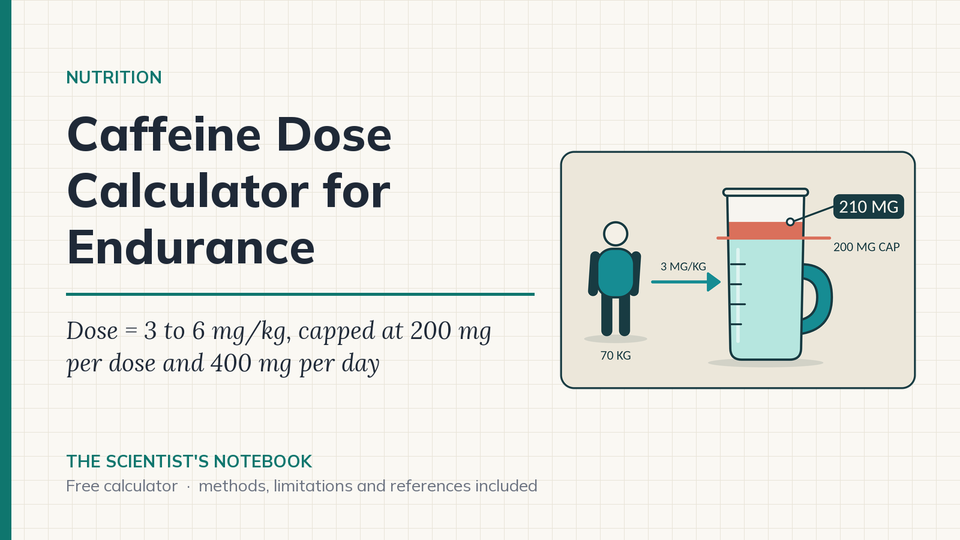
For a 70 kg adult both ends of the standard range (210 to 420 mg) are above 200 mg, so the dose shown is a flat 200 mg, about 2.9 mg/kg. Above roughly 67 kg the tool cannot reach 3 mg/kg.
How should you use the result?
- Rehearse in training. Pick a long session that mimics your event. Take the dose 60 minutes before, and note heart rate, stomach and nerves. If anything is off, drop to the low-dose option or skip it.
- Plan around sleep. In a placebo-controlled home study, 400 mg taken 6 hours before bedtime reduced sleep. For an evening race, or a morning session after a short night, the sleep cost can matter more than the performance gain. Enter the hours until bed and the tool will flag it.
- Add up the day. A race-morning coffee, a caffeinated gel and a cola on the drive home all count toward the 400 mg. Enter what you have had so the allowance is honest. For fuelling around the session see the daily carbohydrate calculator, and for fluid the water intake calculator.
What are the limitations?
- The 3 to 6 mg/kg range is from studies of performance. The ISSN position stand reports consistent improvement in that range, with the most consistent benefits in aerobic endurance, and a high incidence of side effects at doses around 9 mg/kg.
- Low doses (2 to 3 mg/kg) have shown benefit in studies, but a 2019 critical review points out that they have rarely been compared directly with 3 to 6 mg/kg. It is not clear how the two compare.
- Benefit and side effects both vary between people. The position stand lists genetics, physical and psychological response, and habitual caffeine intake as possible reasons.
- The EFSA reference amounts are 200 mg as a single dose, 400 mg per day for adults, and 200 mg per day in pregnancy and breastfeeding. They are population reference values, not a personal limit, and they apply to caffeine from all sources.
- For a heavier athlete the caps mean the dose shown is lower than the research range. That is by design.
- Caffeine content of coffee and supplements varies, so check the label. Avoid bulk caffeine powder, which is hard to measure accurately.
🚨 CRITICAL SAFETY WARNING - Caffeine Dose Limits
Caffeine is a drug. High doses can cause serious harm, including abnormal heart rhythm. This calculator gives population estimates from sport research. It cannot tell you how your own body will respond.
EMERGENCY SYMPTOMS - Stop and seek immediate medical attention if you experience:
- Chest pain or tightness
- A racing, pounding, or irregular heartbeat
- Fainting or near-fainting
- Severe agitation, confusion, or tremor you cannot control
- Repeated vomiting, or a seizure
Do NOT use this calculator, and speak to your doctor or pharmacist first, if you:
- Have a heart rhythm disorder, high blood pressure, or other cardiovascular condition
- Have an anxiety disorder, panic attacks, or difficulty sleeping
- Take regular medication, including some antidepressants, antibiotics, asthma medicines, or stimulants
- Have been told to limit caffeine for any reason
- Are under 18 years of age
PREGNANCY AND BREASTFEEDING: The EFSA reference amount is lower, 200 mg per day from all sources, and the tool applies it with a warning. Talk to your midwife or doctor before using caffeine as an exercise aid.
HARD LIMITS BUILT INTO THIS TOOL (EFSA 2015 reference amounts):
- Single dose: never more than 200 mg. The research range of 3 to 6 mg/kg is cut to this ceiling.
- Daily total: never more than 400 mg from all sources, or 200 mg if pregnant or breastfeeding.
- Doses around 9 mg/kg are linked to a high incidence of side effects and are never shown.
Count every source: Coffee, tea, cola, energy drinks, gels, tablets, pre-workout powders, and some cold or pain medicines all contain caffeine. Do not try a dose for the first time on race day.
ℹ️ IMPORTANT DISCLAIMER
This calculator is for educational purposes only and does NOT constitute medical advice. Consult qualified professionals before making changes. Individual physiology varies. You assume all risk. Must be 18+.
Frequently asked questions
How much caffeine should I take before a race?
The ISSN position stand reports consistent improvement at 3 to 6 mg per kg of body mass, taken about 60 minutes before. The calculator converts that range for your body mass and then holds it under 200 mg per dose. For a 60 kg adult with no other caffeine that day, the dose shown is 180 to 200 mg.
Why is the dose capped at 200 mg?
The EFSA reference amounts are 200 mg as a single dose, 400 mg per day for adults and 200 mg per day in pregnancy and breastfeeding, from all sources. They are population reference values, not a personal limit. For a 70 kg adult both ends of the 3 to 6 mg/kg range are above 200 mg, so the dose shown is a flat 200 mg, about 2.9 mg/kg.
Does a lower caffeine dose work?
The position stand notes that the minimal effective dose may be as low as 2 mg/kg, and the low-dose option uses 2 to 3 mg/kg. A 2019 critical review points out that low doses have rarely been compared directly with 3 to 6 mg/kg, so it is not clear how the two compare.
When does the calculator show no dose?
It shows no dose if you are under 18, if any question is left blank, if you report a heart or blood pressure condition, an anxiety or sleep disorder, regular medication or advice to limit caffeine, or if less than 5 mg of your allowance for the day is left.
Does caffeine before an evening race affect sleep?
It can. In a placebo-controlled home study, 400 mg taken 6 hours before bedtime reduced sleep. For an evening race the sleep cost can matter more than the performance gain. Enter the hours until bed and the tool will flag it.
Related calculators
- Daily Carbohydrate Intake Calculator
- Creatine Loading and Maintenance Calculator
- Fat Intake Calculator
- Fiber Intake Calculator
- All calculators on The Scientist's Notebook
References
- Guest NS et al. · 2021 · J Int Soc Sports Nutr · PMID 33388079 · doi
- EFSA Panel on Dietetic Products, Nutrition and Allergies · 2015 · EFSA Journal 13(5):4102, Scientific Opinion on the safety of caffeine · not indexed in PubMed · doi
- Pickering C, Kiely J · 2019 · Nutrition · PMID 31400738 · doi
- Drake C et al. · 2013 · J Clin Sleep Med · PMID 24235903 · doi
- Grgic J et al. · 2020 · Br J Sports Med · PMID 30926628 · doi
- Goldstein ER et al. · 2010 · J Int Soc Sports Nutr · PMID 20205813 · doi