Fat Intake Calculator
One way to plan fat is to set it last, as whatever energy is left after carbohydrate and protein. This calculator gives fat a number of its own: it turns your daily energy intake and a fat share into grams, and shows the reference range around it.
In short: The calculator multiplies your daily energy by a fat share and divides by 9 kcal per gram. At 3000 kcal and 30 % that is 100 g of fat a day. The reference range is 20 to 35 % of energy, the range the ACSM, AND and DC position stand uses for athletes, and the calculator never returns a target below 20 %.
How is my fat target calculated?
Fat (g/day) = daily energy (kcal) x fat share (%) / 100 / 9
- daily energy in kilocalories, for example from the calorie calculator
- fat share as a percentage of energy. Presets are 20, 30 and 35 %, plus 45 % flagged as outside the usual range. You can also type a custom share.
- 9 is kilocalories per gram of fat (the general Atwater factor)
The reference range is 20 to 35 % of energy, the range the ACSM, Academy of Nutrition and Dietetics and Dietitians of Canada position stand uses for athletes (Thomas 2016). It matches the adult Acceptable Macronutrient Distribution Range. The calculator never returns a target below 20 %: if you type a lower share it raises it to 20 % and says so.
Three reference values are shown next to the result:
- Saturated fat ceiling: less than 10 % of energy (Dietary Guidelines for Americans 2020 to 2025)
- Linoleic acid (n-6): 5 to 10 % of energy (Institute of Medicine 2005)
- Alpha-linolenic acid (n-3): 0.6 to 1.2 % of energy (Institute of Medicine 2005)
Worked example
3000 kcal per day at a 30 % fat share: 3000 x 0.30 = 900 kcal from fat; 900 / 9 = 100 g/day.
- 20 % of 3000 kcal = 600 kcal = 66.7 g, shown as 67 g. 35 % = 1050 kcal = 116.7 g, shown as 117 g. The reference range is 67 to 117 g.
- Saturated fat ceiling: 3000 x 0.10 / 9 = 33 g.
- Linoleic acid: 17 to 33 g. Alpha-linolenic acid: 2.0 to 4.0 g.
At 2000 kcal the same 20 to 35 % range gives 44 to 78 g.
How do I use the result?
- Fill the energy gap on heavy days. On long-ride days carbohydrate takes priority. Set carbohydrate with the daily carbohydrate calculator and protein with the protein intake calculator, then check that the remaining energy lands inside your fat range.
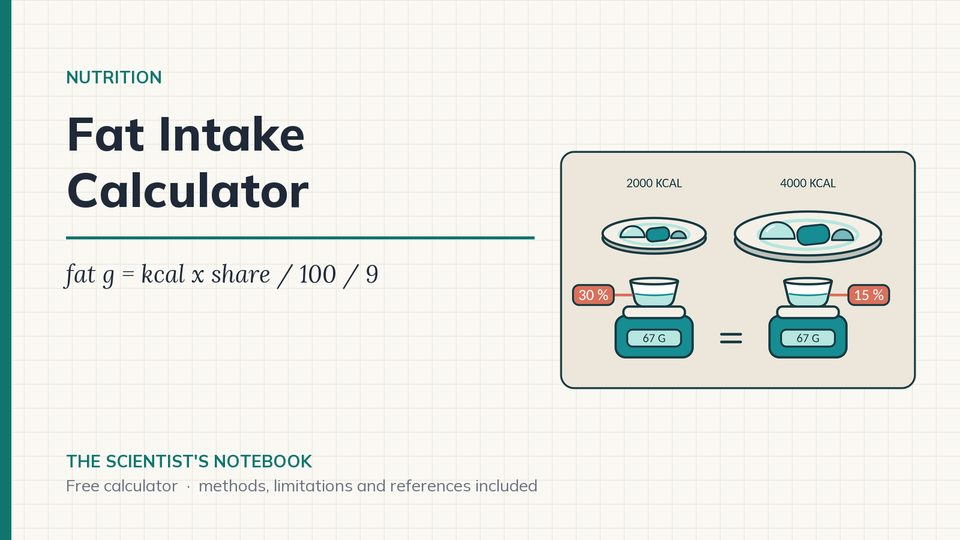
- Recompute when energy changes. A fixed percentage moves with intake: 30 % is 67 g at 2000 kcal and 133 g at 4000 kcal. In a build block your grams should rise with your energy, not stay at last season's number.
- Look at the meals right before a race. A review of gut problems in athletes (de Oliveira 2014) found fibre, fat and protein associated with more gastrointestinal symptoms during exercise, and lists avoiding them among the choices that can reduce gut discomfort. Its practical advice, which the authors say rests on limited research, is to avoid high-fibre foods in the day or even days before competition. The calculator does not set a race-day fat value. The fiber intake calculator covers the fibre side of that plan.
What are the limits?
- This is a fixed-percentage model. It does not know your body composition, training load or health history.
- The 20 to 35 % range is a population reference. Where an individual should sit inside it is not settled by trials.
- The 45 % preset sits above the range used in sports nutrition position stands. Burke 2017 studied a ketogenic low carbohydrate, high fat diet (78 % of energy as fat, under 50 g of carbohydrate a day) in elite race walkers and reported impaired exercise economy. That is a different diet from 45 % of energy, and the study neither supports nor refutes it.
- Fat quality is mostly outside the model. Only a saturated fat ceiling and the two essential fatty acid ranges are shown.
- The saturated fat and essential fatty acid values come from general population guidance (Dietary Guidelines for Americans; Institute of Medicine), not from athlete trials.
- People with a condition that affects fat digestion or blood lipids, or who have been given specific dietary advice, should follow that advice instead of a percentage.
⚠️ HEALTH & TRAINING GUIDANCE
Fat targets are population ranges and individual needs vary significantly. Consult a registered dietitian or physician before changing your fat intake, especially if you have a lipid, digestive or metabolic condition.
ℹ️ IMPORTANT DISCLAIMER
This calculator is for educational purposes only and does NOT constitute medical advice. Consult qualified professionals before making changes. Individual physiology varies. You assume all risk. Must be 18+.
Frequently asked questions
How much fat should an athlete eat per day?
The ACSM, Academy of Nutrition and Dietetics and Dietitians of Canada position stand (Thomas 2016) uses 20 to 35 % of energy from fat for athletes. At 2000 kcal that is 44 to 78 g a day; at 3000 kcal it is 67 to 117 g.
Why does the calculator not go below 20 % fat?
The same position stand does not recommend fat below 20 % of energy for athletes. If you type a lower share, the calculator raises it to 20 % and tells you, rather than returning a lower target.
Is a high-fat or ketogenic diet better for endurance?
The 45 % preset is flagged because it sits above the 20 to 35 % range. Burke 2017 tested a ketogenic diet with 78 % of energy as fat and under 50 g of carbohydrate a day in elite race walkers and reported impaired exercise economy. That study does not describe a 45 % intake.
Which fat quality values does the calculator show?
A saturated fat ceiling of less than 10 % of energy (Dietary Guidelines for Americans 2020 to 2025), and essential fatty acid ranges of 5 to 10 % of energy for linoleic acid and 0.6 to 1.2 % for alpha-linolenic acid (Institute of Medicine 2005).
Should I eat less fat before a race?
A review of gut problems in athletes (de Oliveira 2014) found fibre, fat and protein associated with more gastrointestinal symptoms during exercise. Its advice to avoid high-fibre foods in the day or days before competition rests, the authors say, on limited research. The calculator does not set a race-day fat value.
Related calculators
- Caffeine Dose Calculator for Endurance
- Daily Carbohydrate Intake Calculator
- Creatine Loading and Maintenance Calculator
- Fiber Intake Calculator
- All calculators on The Scientist's Notebook
References
- Thomas et al. · 2016 · Med Sci Sports Exerc · PMID 26891166 · doi
- Burke et al. · 2017 · J Physiol · PMID 28012184 · doi
- U.S. Department of Agriculture & U.S. Department of Health and Human Services · 2020 · Dietary Guidelines for Americans, 2020-2025 · not indexed in PubMed
- Institute of Medicine · 2005 · Dietary Reference Intakes for Energy, Carbohydrate, Fiber, Fat, Fatty Acids, Cholesterol, Protein, and Amino Acids. National Academies Press · not indexed in PubMed
- FAO · 2003 · Food energy: methods of analysis and conversion factors. FAO Food and Nutrition Paper 77 · not indexed in PubMed
- de Oliveira et al. · 2014 · Sports Med · PMID 24791919 · doi