Fiber Intake Calculator
Fibre is the nutrient where athletes get two opposite messages: eat more of it for long-term health, and cut it before you race. This calculator gives the ordinary-day reference values and adds a note for the days before a race.
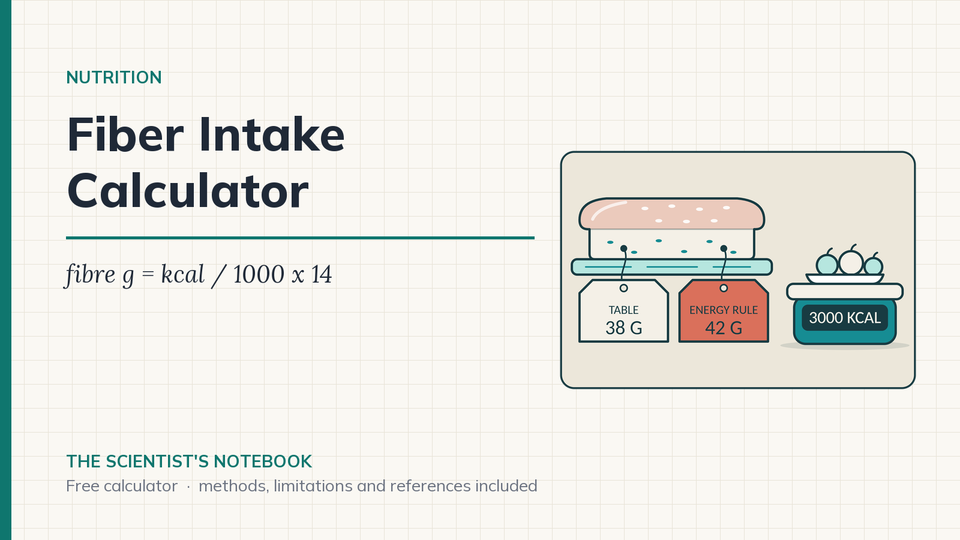
In short: The calculator shows three fibre values. The Institute of Medicine Adequate Intake by sex and age is 38 g a day for men up to age 50 and 25 g for women aged 19 to 50. The energy-based value is 14 g per 1000 kcal, so 3000 kcal gives 42 g. The 25 to 29 g/day band is where Reynolds 2019 saw the largest risk reductions.
How is my fibre target calculated?
Three reference values are shown, all in grams of fibre per day:
- Adequate Intake by sex and age (Institute of Medicine 2005). Male: 38 g up to age 50, 30 g from 51. Female: 25 g from 19 to 50, 21 g from 51. Age 18 uses the 14 to 18 group (male 38 g, female 26 g).
- Energy-based value: fibre (g) = daily energy (kcal) / 1000 x 14. The Adequate Intake itself was built on 14 g per 1000 kcal, so the energy-based figure scales with how much you eat.
- Reference band of 25 to 29 g/day. In the Reynolds 2019 Lancet series of meta-analyses, risk reductions for several outcomes were greatest in that range, and dose-response curves suggested further benefit above it.
The calculator needs your sex and age and will not guess either. Daily energy is optional. The race toggle changes the notes, not the numbers.
Worked example
- Male, 35 years, 3000 kcal per day: Adequate Intake 38 g; energy-based 3000 / 1000 x 14 = 42 g. The energy-based value is higher, so the calculator says so.
- Female, 55 years, 2000 kcal per day: Adequate Intake 21 g; energy-based 2000 / 1000 x 14 = 28 g.
How do I use the result?
- Treat the number as an ordinary-day reference. For a high-volume athlete the energy-based figure is the more useful one. At 4500 kcal it is 63 g. Build toward it gradually and see how your gut handles it on easy days first.
- Plan the days before a race separately. In a review of gut problems in athletes (de Oliveira 2014), studies suggest 30 to 50 % of athletes experience gastrointestinal complaints, and fibre, fat, protein and fructose are all associated with more symptoms. The review advises avoiding high-fibre foods in the day or even days before competition, and keeping adequate fibre in training to keep the bowel regular. The authors say this advice rests on limited research, and it gives no gram value. Practise your plan in training, and pair it with the carbohydrate loading range in the daily carbohydrate calculator and the fat range in the fat intake calculator.
- Resume the normal pattern after the event. A lower-fibre day is a tactic for one event. It is not a new baseline. Return to the reference values once you are back to ordinary training.
What are the limits?
- The Adequate Intake is not an evidence-graded requirement. The Institute of Medicine set it from the intake level observed to go with lower coronary heart disease incidence in cohort studies, then expressed it per 1000 kcal.
- The Reynolds 2019 findings are associations from prospective cohorts plus trials on risk markers. The authors graded certainty for fibre as moderate.
- The 25 to 29 g/day band is where the pooled risk reduction was largest in that analysis. It is not a ceiling and it is not a target for any one person.
- Almost all of the evidence comes from general populations. There is little athlete-specific work on how much fibre supports training or recovery.
- The advice to cut fibre before a race comes from a review of exercise-related gastrointestinal complaints (de Oliveira 2014). Its authors say the advice rests on limited research and seems effective anecdotally, and that evidence for beneficial dietary interventions is lacking. It names no fibre dose, so the calculator sets no race-day number.
- People with bowel conditions, a history of bowel surgery or specific dietary advice should follow that advice instead of these values.
- Raising fibre quickly can cause bloating and gas. The calculator does not set a rate of increase.
⚠️ HEALTH & TRAINING GUIDANCE
Fibre reference values are population figures and individual tolerance varies significantly. Consult a registered dietitian or physician before changing your fibre intake, especially if you have a digestive condition.
ℹ️ IMPORTANT DISCLAIMER
This calculator is for educational purposes only and does NOT constitute medical advice. Consult qualified professionals before making changes. Individual physiology varies. You assume all risk. Must be 18+.
Frequently asked questions
How much fibre should I eat per day?
The Institute of Medicine Adequate Intake is 38 g a day for men up to age 50 and 30 g from 51. For women it is 25 g from 19 to 50 and 21 g from 51. Age 18 uses the 14 to 18 group: 38 g for men and 26 g for women. These are reference values for ordinary days.
Do athletes with big energy intakes need more fibre?
The Adequate Intake was built on 14 g of fibre per 1000 kcal, so the energy-based figure rises with intake. At 3000 kcal it is 42 g, and at 4500 kcal it is 63 g. There is little athlete-specific work on how much fibre supports training or recovery.
What does the 25 to 29 g band mean?
In the Reynolds 2019 Lancet series of meta-analyses, risk reductions for several outcomes were greatest at 25 to 29 g of fibre a day, and dose-response curves suggested further benefit above it. These are associations, and the authors graded the certainty for fibre as moderate. The band is not a ceiling or a personal target.
Should I eat less fibre before a race?
A review of gut problems in athletes (de Oliveira 2014) advises avoiding high-fibre foods in the day or even days before competition, and keeping adequate fibre in training. The authors say this advice rests on limited research. It gives no gram value, so the calculator sets no race-day number. Test any change in training first.
Why does the calculator need my sex and age?
The Adequate Intake differs by sex and age group, and the calculator will not guess either. Daily energy is optional. If you enter it, the calculator adds the 14 g per 1000 kcal figure and says whether it is higher or lower than your age and sex value.
Related calculators
- Caffeine Dose Calculator for Endurance
- Daily Carbohydrate Intake Calculator
- Creatine Loading and Maintenance Calculator
- Fat Intake Calculator
- All calculators on The Scientist's Notebook
References
- Reynolds et al. · 2019 · Lancet · PMID 30638909 · doi
- de Oliveira et al. · 2014 · Sports Med · PMID 24791919 · doi
- Institute of Medicine · 2005 · Dietary Reference Intakes for Energy, Carbohydrate, Fiber, Fat, Fatty Acids, Cholesterol, Protein, and Amino Acids. National Academies Press · not indexed in PubMed
- U.S. Department of Agriculture & U.S. Department of Health and Human Services · 2020 · Dietary Guidelines for Americans, 2020-2025 · not indexed in PubMed