Creatine Loading and Maintenance Calculator
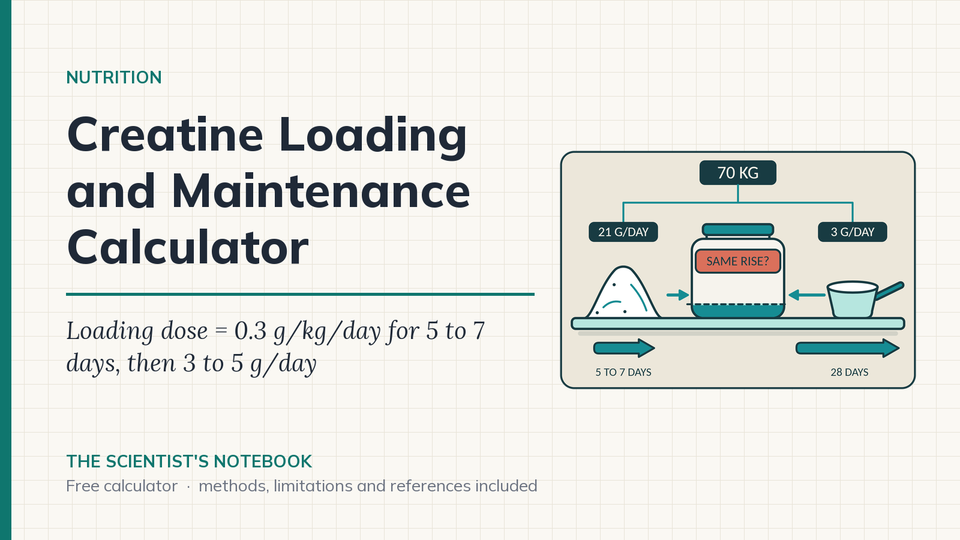
Creatine can be started two ways: a short loading phase, or a steady small dose that takes about four weeks to reach the same place. This calculator gives the doses for both, scaled to your body mass.
In short: Loading takes 0.3 g of creatine per kg of body mass a day, split into four equal servings, for 5 to 7 days, held at 30 g/day. Maintenance is 0.03 g per kg, held between 3 and 5 g a day. Without loading, 3 g a day for 28 days gave a similar rise in muscle creatine of about 20 %.
How does the calculator work?
You enter your body mass and age, and choose a route. The calculator is for adults aged 18 and older and accepts a body mass of 30 to 300 kg. Below 40 kg or above 200 kg it still gives a result, with a warning that the value is outside the usual range.
- Loading dose (g/day) = 0.3 x body mass (kg), rounded to the nearest gram and taken as four equal servings through the day for 5 to 7 days. Each serving is the daily dose divided by 4, so the servings add up to the daily dose. It is held at 30 g/day, which a 100 kg body already reaches.
- Maintenance dose (g/day) = 0.03 x body mass (kg), held between 3 and 5 g and rounded to the nearest 0.5 g.
- No-load route = 3 g/day for 28 days, then the maintenance dose.
- Total over the loading phase = daily dose x number of days.
The loading and no-load numbers come from a study of 31 men. Muscle total creatine rose by about 20 % after 6 days at 20 g/day. That level held with 2 g/day afterwards. A similar but slower rise of about 20 % took 28 days at 3 g/day.
Worked example. A 70 kg athlete: 0.3 x 70 = 21 g/day, as four servings of 5.25 g, for 5 to 7 days. That is 105 to 147 g in total. The maintenance dose is 0.03 x 70 = 2.1 g, which is held at the 3 g floor. On the no-load route the same athlete takes 3 g/day for 28 days, 84 g in total.
How should you use the result?
- Before a block of sprint and strength work. If you add heavy gym work or repeated short efforts for a phase, start the no-load route four weeks ahead or the loading route a week ahead, so the store is full when the block starts.
- Weight-sensitive events. Loading can add about 0.5 to 1.0 L of water in the short term. For a long climb or a running race where each kilogram counts, use the weight impact calculator to see what a kilogram costs you, and decide with that number in hand.
- Long steady events. The evidence base is mostly repeated high-intensity efforts. If your event is a steady aerobic effort, creatine is not the first thing I would spend effort on, and the result here does not change that.
What are the limitations?
- The numbers are published dosing protocols applied to body mass. The 0.03 g/kg maintenance scaling and the 30 g/day ceiling are choices made for this calculator.
- The position stand puts maintenance at 3 to 5 g/day, but notes that some studies indicate larger athletes may need as much as 5 to 10 g/day to maintain creatine stores. This calculator stays inside 3 to 5 g/day.
- The 20 % rise in muscle creatine was measured in men, in a small study. It does not describe every person.
- Responses differ between people. Some see little change.
- Evidence for benefit is strongest for repeated high-intensity efforts and strength work, and thinner for steady endurance performance.
- The ISSN position stand names weight gain as the only consistently reported side effect. Early loading studies measured about 0.5 to 1.0 L of short-term fluid retention.
- The position stand reports supplementation of up to 30 g/day for up to 5 years in healthy people. That describes the studied groups, not any one person.
- Nothing here is advice for people with kidney disease or on medication that affects the kidneys. Speak to a doctor first.
- Supplements are not regulated like medicines. Choose a product with third-party batch testing if you compete under anti-doping rules.
⚠️ HEALTH & TRAINING GUIDANCE
Creatine is a supplement, and individual responses vary. Talk to a doctor or sports dietitian before starting, especially if you have kidney disease, take regular medication, are pregnant or breastfeeding, or compete under anti-doping rules.
ℹ️ IMPORTANT DISCLAIMER
This calculator is for educational purposes only and does NOT constitute medical advice. Consult qualified professionals before making changes. Individual physiology varies. You assume all risk. Must be 18+.
Frequently asked questions
How much creatine should I take to load?
The loading dose is 0.3 g per kg of body mass a day, taken as four equal servings for 5 to 7 days. For a 70 kg athlete that is 21 g a day, four servings of 5.25 g, and 105 to 147 g over the phase. The calculator holds the loading dose at 30 g a day, which a 100 kg body already reaches.
Do I need a loading phase?
No. In a study of 31 men, muscle total creatine rose by about 20 % after 6 days at 20 g a day, and a similar but slower rise took 28 days at 3 g a day. Loading gets there sooner. The no-load route is 3 g a day for 28 days, then the maintenance dose.
What is the creatine maintenance dose?
The calculator uses 0.03 g per kg of body mass a day, held between 3 and 5 g and rounded to the nearest 0.5 g. The position stand puts maintenance at 3 to 5 g a day and notes that some studies indicate larger athletes may need as much as 5 to 10 g a day. This calculator stays inside 3 to 5 g.
Does creatine cause weight gain?
The ISSN position stand names weight gain as the only consistently reported side effect. Early loading studies measured about 0.5 to 1.0 L of short-term fluid retention. For a long climb or a running race where each kilogram counts, decide with that number in hand.
Who should check with a doctor before taking creatine?
Check with a doctor before you start if you have kidney disease, take medication that affects the kidneys, or are pregnant or breastfeeding. The calculator is for adults aged 18 and older, and the result describes published dosing protocols, not advice for any one person.
Related calculators
- Caffeine Dose Calculator for Endurance
- Daily Carbohydrate Intake Calculator
- Fat Intake Calculator
- Fiber Intake Calculator
- All calculators on The Scientist's Notebook